Restaurant insurance is the combination of coverages that protects a food service business from the unique risks of running a commercial kitchen, serving the public, and employing kitchen and front-of-house staff. A standard business owner’s policy covers a lot of what a restaurant needs — but it almost never covers the risks that actually sink restaurants financially: a burst walk-in cooler that spoils a week of inventory, a liquor-related injury after last call, or a kitchen fire that shuts the doors for two months.
The short version: most restaurants need a BOP as the base layer, then liquor liability, equipment breakdown, and spoilage coverage layered on top — plus workers’ comp almost everywhere it’s required, given how physically demanding and high-turnover restaurant work is. Here’s what each piece actually does.
Start with the base: a Business Owners Policy (BOP)
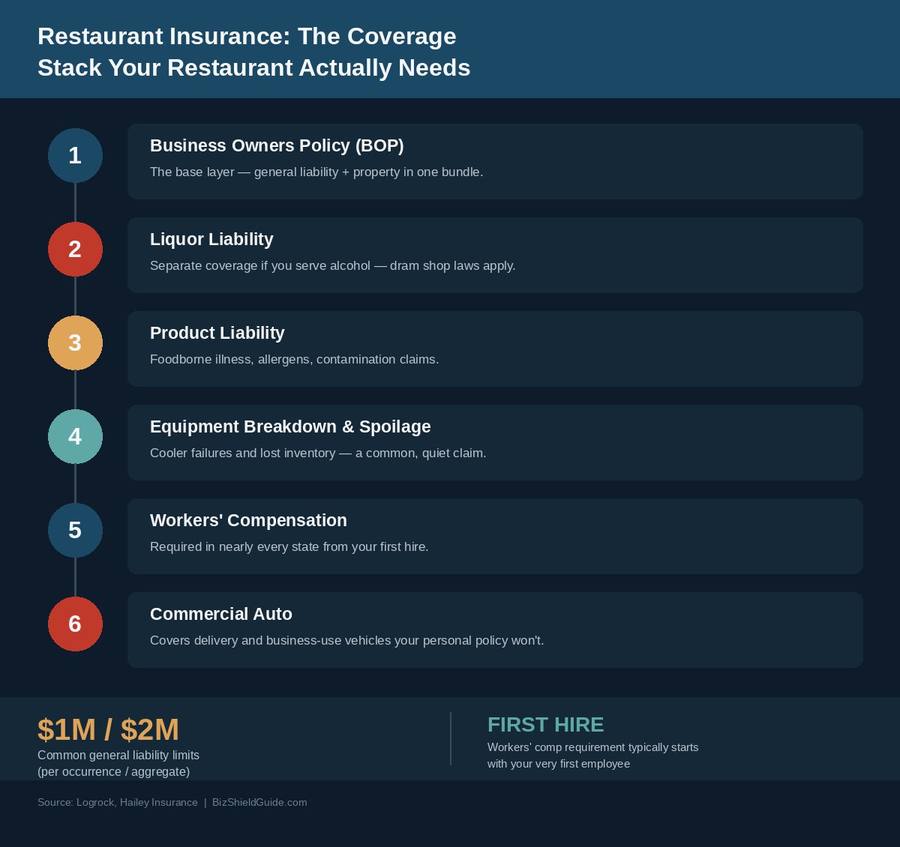
A BOP bundles general liability and commercial property into one policy, usually at a lower combined cost than buying them separately. For a restaurant, that means coverage for customer slip-and-fall injuries, damage to the building and kitchen equipment from fire or storms, and often business income coverage if a covered event forces you to close temporarily. It’s the foundation almost every restaurant insurance program is built on — but on its own, it leaves real gaps for a food-and-beverage business.
Liquor liability: not optional if you serve alcohol
General liability policies typically exclude alcohol-related injury and property damage claims entirely — which means if you serve beer, wine, or liquor, you need a separate liquor liability endorsement or standalone policy. This covers claims where an intoxicated patron causes injury or damage, whether that’s a fight that breaks out at the bar or a drunk-driving accident after someone leaves your restaurant. Many states hold establishments partly liable for over-serving under “dram shop” laws, which is exactly what this coverage is built to respond to. If alcohol is anywhere on your menu — even just beer and wine — treat this as close to mandatory, not optional.
Product liability: when the food itself is the problem
Foodborne illness, an undisclosed allergen, or a foreign object in a dish can trigger a product liability claim fast — and in the age of social media and instant reviews, these claims move faster and more publicly than almost any other type of restaurant risk. Product liability coverage (often bundled into a broader general liability or restaurant-specific policy) responds to claims that your food itself caused harm.
Documentation matters enormously here: health department reports, supplier records, and your own food-safety logs are usually what determines whether a claim is covered or excluded — most policies exclude losses tied to known food-safety violations or poor maintenance, so the paper trail from your own kitchen practices matters as much as the policy itself.
Equipment breakdown and spoilage: the quiet budget-killer
A walk-in cooler compressor fails overnight. A breaker trips over a long weekend. A door gets left ajar and nobody notices until the temperature log shows a problem the next morning. These aren’t rare, dramatic events — they’re some of the most common claims restaurants file, and a standard property policy often doesn’t cover them well on its own. Equipment breakdown coverage pays for the mechanical failure itself (the compressor, the walk-in unit, the dishwasher’s guts), while spoilage coverage separately reimburses the value of the food inventory lost.
Insurers commonly write per-occurrence limits somewhere in the low hundreds of thousands of dollars for spoilage claims, though the right limit depends heavily on how much perishable inventory you typically carry — a bar with mostly liquor and beer needs far less than a seafood restaurant running a full walk-in of fresh product every day.
Workers’ compensation: expect it to be required
Restaurant work is physically demanding — knife cuts, burns, slips on wet kitchen floors, repetitive strain from long shifts — and turnover is high, which means new, less-experienced staff are often the ones handling the riskiest tasks. Nearly every state requires workers’ comp once you have employees, restaurants included, and the requirement typically kicks in with your very first hire, not at some higher headcount threshold. I’ve seen a first-time restaurant owner assume, incorrectly, that a couple of part-time cooks didn’t “count” toward the requirement — that’s a common and expensive misunderstanding to walk into.
Commercial auto — for delivery, not just catering vans
If you run delivery yourself, or use a company vehicle for supply runs and catering, your personal auto policy almost certainly won’t extend to that use. Commercial auto insurance is built specifically for business-use vehicles, and if you’re relying on employees’ personal cars for deliveries, hired and non-owned auto coverage fills the liability gap your business could otherwise be exposed to if one of those drivers causes an accident on the clock.
What coverage limits actually look like
There’s no single right number, since it depends heavily on your restaurant’s size, location, and whether you serve alcohol — but general liability limits of $1 million per occurrence and $2 million aggregate are common starting points in the industry, sometimes required outright by landlords or event venues. Product liability and spoilage limits tend to run lower, often in the low hundreds of thousands per occurrence, scaled to how much inventory and food-related risk the business actually carries. Talk through your specific numbers with an agent who understands restaurants — the right limits for a food truck and a full-service restaurant with a bar look very different.
Restaurant insurance isn’t one policy, it’s a stack of coverages that each cover a different way the business can lose money — and skipping any one of them tends to be the gap that turns into the expensive surprise. This article is for general informational purposes and isn’t personalized insurance, legal, or financial advice. Coverage rules, costs, and state requirements change, and every restaurant’s risk profile is different — for decisions specific to your business, talk to a licensed insurance agent. Learn more About BizShieldGuide or reach us via our Contact page.
Related Reading
10 Insurance Coverages for Food & Beverage Businesses — Logrock
What Insurance Covers Food Contamination in a Restaurant? — Hailey Insurance
Product Liability Insurance: What Small Businesses Need to Know
Workers’ Compensation Insurance 101
Commercial Auto Insurance for Small Business
Best Small Business Insurance Bundles by Industry
The core coverages every restaurant insurance policy should include
General liability insurance is the foundation of restaurant insurance, covering claims like a customer slipping on a wet floor or an allergic reaction traced back to a menu item. Property insurance, the second pillar of restaurant insurance, covers the building, kitchen equipment, furniture, and inventory against fire, theft, and other covered perils — and given how much a commercial kitchen’s equipment costs to replace, this piece of restaurant insurance often carries some of the highest limits in the whole package.
Liquor liability is a critical add-on for any restaurant insurance policy covering an establishment that serves alcohol, protecting against claims that an intoxicated patron caused injury or property damage after being served. Many states legally require liquor liability coverage as part of restaurant insurance before a liquor license will even be issued, making it one of the least optional pieces of the entire restaurant insurance package.
Business interruption and equipment breakdown coverage
Business interruption coverage, often bundled into a restaurant insurance package, replaces lost income and covers ongoing expenses like rent and payroll if a covered event forces a temporary closure — a kitchen fire or a burst pipe can shut a restaurant down for weeks, and restaurant insurance without this coverage leaves the business with no income during the rebuild. Equipment breakdown coverage, another common restaurant insurance add-on, pays to repair or replace walk-in coolers, ovens, and other essential equipment that fails outside of a covered peril like fire, protecting against the everyday mechanical failures that a standard property policy often excludes.
Workers’ compensation and food-specific liability
Workers’ compensation insurance is legally required in nearly every state once a restaurant hires its first employee, and it is a non-negotiable part of any restaurant insurance program given how physically demanding kitchen work is — burns, cuts, and slip-and-fall injuries among staff are common enough that workers’ compensation claims are a routine, expected cost of doing business in this industry. Spoilage coverage, sometimes overlooked when assembling a restaurant insurance package, reimburses the cost of food inventory lost to a power outage or equipment failure, which can otherwise wipe out a meaningful chunk of a restaurant’s perishable inventory value in a single bad night.
How much restaurant insurance costs
Restaurant insurance premiums vary widely based on square footage, whether alcohol is served, the number of employees, and the restaurant’s claims history, but many small to mid-size restaurants pay between a few thousand and ten thousand dollars a year for a complete restaurant insurance package covering general liability, property, liquor liability, and workers’ compensation together. Restaurants that serve alcohol, operate a delivery fleet, or run a full bar typically pay more for restaurant insurance than a quick-service counter operation with no alcohol service and minimal seating, since each of those factors adds distinct liability exposure that underwriters price separately.
Restaurant insurance for delivery and third-party platforms
Restaurants that offer delivery, whether through their own drivers or third-party apps like DoorDash and Uber Eats, need to confirm their restaurant insurance actually extends to that activity. A standard restaurant insurance policy often excludes auto liability for delivery drivers, which means a restaurant using its own employees and vehicles for delivery may need a separate hired and non-owned auto endorsement added to its restaurant insurance program.
Restaurants relying entirely on third-party delivery platforms carry less of this exposure directly, but should still confirm with their restaurant insurance provider exactly where the platform’s coverage ends and the restaurant’s own liability begins, particularly for food safety issues that surface after a delivered order.
Cyber and data breach exposure for restaurants
Modern restaurant insurance increasingly includes cyber liability coverage, since most restaurants now process credit card payments through point-of-sale systems that can be breached, and some collect customer data through loyalty programs, online ordering, and reservation platforms. A data breach at even a single-location restaurant can trigger notification costs, fines, and reputational damage that a standard general liability policy will not cover, making cyber coverage an increasingly common addition to a modern restaurant insurance package rather than the optional extra it once was.
Choosing the right restaurant insurance provider
Not every commercial insurer specializes in restaurant insurance, and working with an agent or carrier that understands the specific risks of food service — from grease fire exposure to foodborne illness claims — tends to produce better coverage than a generalist small business policy retrofitted for a restaurant. Restaurant insurance specialists are also more likely to correctly price liquor liability, spoilage, and equipment breakdown coverage, since these are the areas where a generic policy most often falls short for a food service business.
Seasonal and outdoor dining considerations
Restaurants that added outdoor seating, whether permanently or as a carryover from earlier public health accommodations, should confirm their restaurant insurance extends to that outdoor footprint, including any tents, heaters, or temporary structures used to serve customers outside the original building. Seasonal restaurants, such as those operating primarily during a tourist season, sometimes qualify for restaurant insurance policies that adjust coverage during the off-season, which can meaningfully reduce annual premiums compared to paying full-year rates for a business that only operates part of the year.
Reviewing restaurant insurance as the business grows
A restaurant that adds a second location, expands seating capacity, or starts catering large events should revisit its restaurant insurance program rather than assuming the original policy automatically scales with the business. Catering in particular introduces new liability exposure — off-site events, different food handling conditions, and sometimes alcohol service in a venue the restaurant does not control — that a policy written only for the original restaurant location may not adequately cover. Annual reviews of restaurant insurance, timed around lease renewals or the start of a new fiscal year, help catch these gaps before an actual claim exposes them.
The bottom line for restaurant owners
Running a food service business means accepting a level of physical and financial risk that few other small businesses face day to day: open flame, sharp equipment, alcohol service, a constant flow of the public through the dining room, and perishable inventory that can spoil in hours if the power goes out. A properly assembled restaurant insurance program is what stands between any one of those everyday risks and a financial loss serious enough to threaten the business itself.
Owners who treat restaurant insurance as a routine cost of doing business, reviewed and adjusted as the restaurant grows or changes, tend to weather an incident far better than those who bought a bare-minimum policy at opening and never looked at it again.
Working with an agent early, asking specific questions about liquor liability, spoilage, delivery exposure, and equipment breakdown rather than accepting a generic small business package, and revisiting the policy whenever the restaurant’s operations change are the three habits that consistently separate restaurants that recover quickly from a loss from those that struggle for years afterward. None of this requires a large budget or a dedicated risk manager — it simply requires treating insurance as an active part of running the restaurant rather than a form signed once at opening and forgotten.
Beyond the core policies, it is worth periodically asking whether newer risks have crept into daily operations without a matching insurance conversation — a new online ordering system, a expanded catering menu, or a recently added patio all quietly change what the business actually needs covered, and a short annual walk-through with an agent catches these shifts before a claim forces the question.
Staff training plays a quiet but real role in keeping claims manageable too. Servers who know to flag a spill immediately rather than walking past it, kitchen staff trained on proper equipment shutdown procedures, and a manager who knows exactly who to call the moment something goes wrong all shrink the gap between an incident occurring and it being properly contained and documented. Pairing good coverage with good day-to-day habits on the floor and in the kitchen is what actually keeps both claims frequency and claims severity lower over time, which in turn keeps future premiums more manageable as well.
Ultimately, the restaurants that handle a bad night the best are rarely the ones with the cheapest policy — they are the ones whose coverage, staff habits, and documentation all work together so that when something does go wrong, the response is calm, fast, and well-supported rather than chaotic and improvised.
Building this kind of readiness does not happen overnight, but it compounds quickly once it becomes routine. A five-minute conversation at a monthly staff meeting, a laminated checklist by the kitchen door, and a policy binder that is actually reviewed rather than filed away are small, low-cost habits that pay for themselves many times over the first time an incident actually occurs.

About the Author: BizShieldGuide Team
The BizShieldGuide team researches and writes plain-language guides to business and personal insurance — general liability, professional liability, workers' compensation, business owners policies, cyber liability, and industry-specific coverage for small business owners, alongside straightforward explainers on auto, home, and renters insurance for everyday readers. Our articles are grounded in publicly available data from insurers and carriers (Insureon, The Hartford, Progressive, State Farm, and others), industry cost surveys, and standard policy language, and we link to primary sources wherever a number or coverage detail could change. We are not licensed insurance agents or brokers, and nothing here replaces a quote or advice from one for your specific situation.