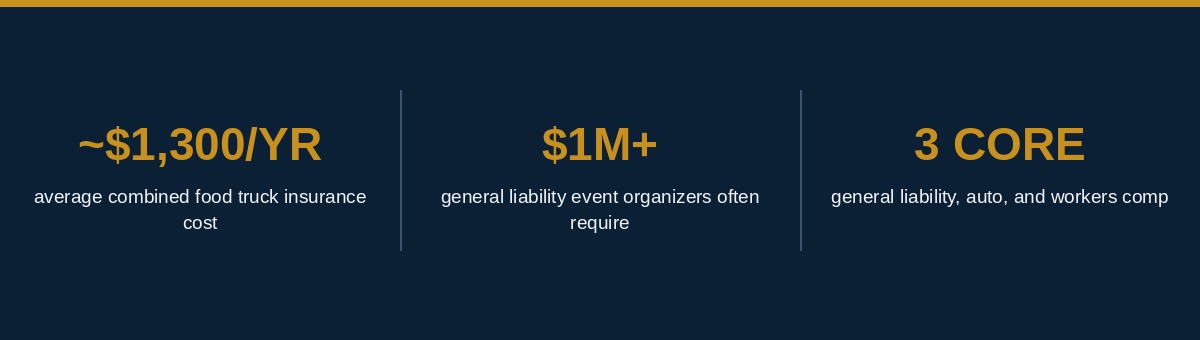
Short answer: food truck insurance typically combines general liability, commercial auto, and workers’ compensation as its core coverage, plus equipment breakdown and food spoilage coverage for the refrigeration and cooking equipment that keeps the business running — combined, these usually run somewhere around $1,300 a year, though the exact mix depends on whether you have employees and what events or commissaries you work with.
A food truck is really two businesses insured at once: a restaurant and a commercial vehicle, operating out of the same asset. That combination is exactly why food truck insurance doesn’t map cleanly onto either a standard restaurant policy or a standard commercial auto policy alone — you generally need both, plus a few coverages specific to the mobile, equipment-heavy nature of the business.
This guide covers the core coverages a food truck actually needs, what they typically cost, and the requirements event organizers and commissaries commonly impose.
General Liability: The Foundation Policy
General liability covers customer injury and property damage claims — a customer who slips near your service window, a burn from hot food, damage to a venue’s property while you’re parked there. Average general liability premiums for food trucks run around $147 a month, or roughly $1,759 a year, though your actual rate depends on revenue, location, and claims history.
This is also the coverage event organizers and venues check first: it’s common for them to require $1 million or more per occurrence before they’ll let a food truck park on their property.
Commercial Auto: Covering the Truck Itself
Because a food truck is a working commercial vehicle, not a personal car, it needs a commercial auto policy rather than a personal auto policy — a personal policy typically excludes business use entirely, which means an accident while driving to an event could go uncovered without commercial auto in place. Commercial auto for food trucks averages around $259 a month, or about $3,103 a year, covering collision damage, injuries from an accident, and damage the truck causes to someone else’s property or vehicle.
Workers’ Compensation, If You Have Employees
Once you hire even one employee, most states require workers’ compensation insurance, which covers medical costs and lost wages if an employee is injured on the job — a real risk in a food truck’s tight, hot, equipment-dense kitchen space. Average cost runs around $34 a month, or about $408 a year, making it one of the cheaper core policies relative to how significant the exposure is in a commercial kitchen environment.
Equipment Breakdown and Food Spoilage Coverage
A food truck’s entire business depends on refrigeration and cooking equipment working correctly, which is exactly what equipment breakdown coverage protects — mechanical or electrical failures of the equipment that runs your kitchen. Food spoilage coverage pairs with it, covering the cost of perishable inventory lost when refrigeration fails.
Inland marine coverage is worth adding too, since it protects removable equipment while it’s being transported between your truck, storage, and event locations — a gap that a standard property policy, built around a fixed location, doesn’t address.
Food Truck Insurance Requirements From Commissaries and Event Organizers
Beyond your own risk tolerance, commissary kitchens and event organizers often set their own minimum insurance requirements before they’ll work with you — commonly $1 million or more in general liability coverage, and sometimes proof of commercial auto and workers’ compensation as well.
Municipal permitting agencies can layer on additional requirements depending on your city, so check both your commissary’s and your target event’s insurance requirements before you commit to a booking, rather than discovering a gap the week of the event. For a general overview of what small businesses need, see the U.S. Small Business Administration‘s guide to business insurance.
Additional Coverage Worth Considering
If you serve alcohol, liquor liability coverage is typically a separate add-on that general liability doesn’t include. Many food truck owners bundle their core coverages into a Business Owner’s Policy (BOP), which combines general liability and commercial property protection into a single, often more cost-effective package — worth asking an agent whether your specific coverage needs fit a BOP structure or are better handled as separate policies.
Shopping for food truck insurance across a few carriers is worth the extra time, since rates for the same core coverages can vary meaningfully between insurers that specialize in mobile food businesses versus general commercial policies. An independent agent who works with food truck operators regularly can usually get you comparable quotes faster than requesting them one by one yourself.
Food Truck Insurance: A Quick Pre-Launch Checklist
Before your first event, confirm three things with your agent: your general liability limit meets the $1 million most venues require, your commercial auto policy actually lists the truck as a business vehicle rather than personal use, and workers’ compensation is in place the day you hire your first employee, not after.
Getting food truck insurance sorted before you book your first commissary or event saves you from scrambling to produce a certificate of insurance on short notice — most venues want proof in hand well before the event date, not the morning of.
How Food Truck Insurance Costs Vary by State and City
Food truck insurance premiums vary more by location than most owners expect, since general liability and commercial auto rates are priced against local claims history, traffic density, and state minimum coverage requirements. A food truck operating primarily in a dense urban market with heavy foot and vehicle traffic will typically see higher general liability and commercial auto premiums than one operating in a smaller town, simply because the statistical likelihood of a claim is higher.
State-mandated minimums for commercial auto liability also differ, and some cities layer on their own permit-level insurance requirements beyond what your state requires — a food truck permit application is a good place to find the specific minimums your city enforces, since they’re not always the same as what your insurer defaults to.
If you operate across state lines or move between markets seasonally, it’s worth confirming that your food truck insurance policy actually extends coverage everywhere you plan to operate rather than assuming it automatically follows you.
Bottom Line
Food truck insurance isn’t one policy — it’s a small stack of coverages built around the fact that a food truck is a restaurant, a commercial vehicle, and an equipment-dependent business all at once. Budgeting around $1,300 a year for the core coverages is a reasonable starting point, but the real number depends on whether you have employees, what events you’re booking, and what your commissary requires — confirm those specifics before your first booking, not after.
Related Reading
Restaurant Insurance: What Coverage Your Restaurant Actually Needs
Commercial Auto Insurance for Small Business: When Your Personal Policy Isn’t Enough

About the Author: BizShieldGuide Team
The BizShieldGuide team researches and writes plain-language guides to business and personal insurance — general liability, professional liability, workers' compensation, business owners policies, cyber liability, and industry-specific coverage for small business owners, alongside straightforward explainers on auto, home, and renters insurance for everyday readers. Our articles are grounded in publicly available data from insurers and carriers (Insureon, The Hartford, Progressive, State Farm, and others), industry cost surveys, and standard policy language, and we link to primary sources wherever a number or coverage detail could change. We are not licensed insurance agents or brokers, and nothing here replaces a quote or advice from one for your specific situation.