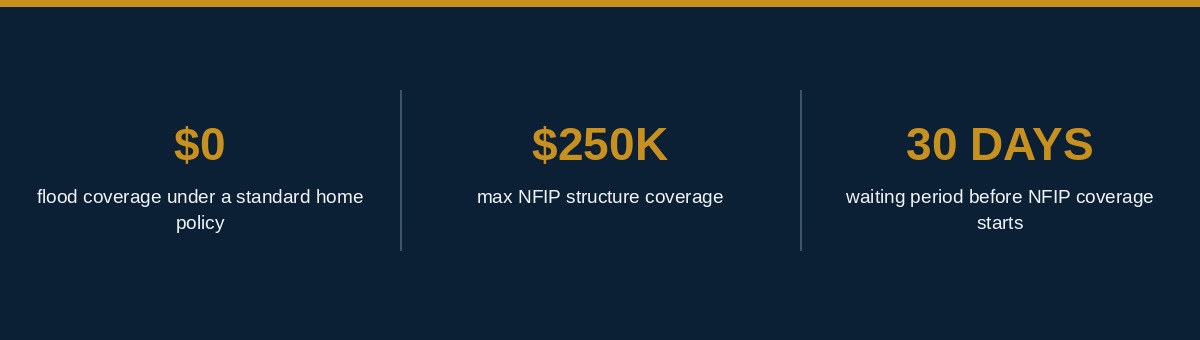
Short answer: standard homeowners and renters insurance does not cover flood damage — it’s one of the most common and most expensive coverage gaps homeowners discover, usually after water has already ruined a home’s flooring, drywall, and belongings, and the only way to actually be covered is a separate flood policy, typically through the National Flood Insurance Program (NFIP) or a private flood insurer.
The confusion is understandable: a standard homeowners policy does cover plenty of water damage — a burst pipe, an overflowing appliance, a roof leak from a storm. What it draws a hard line around is flooding specifically, meaning rising water from heavy rain, storm surge, or an overflowing river or lake. That distinction, buried in policy language most people never read closely, is exactly what leaves flooded homeowners uncovered when they assumed their existing policy had them protected.
This guide covers what counts as flood damage versus what’s covered by a standard policy, how to actually get flood insurance, what it costs and covers, and who needs it even outside a mapped flood zone.
Why Homeowners Insurance Doesn’t Cover Flooding
According to the Insurance Information Institute, “standard homeowners and renters insurance does not cover flood damage.” Flood risk is excluded from standard policies because it doesn’t fit the way property insurers price risk for an individual home — flooding tends to affect entire neighborhoods or regions at once rather than isolated properties, which is part of why a separate, specialized insurance system exists specifically to cover it.
Flood Damage vs. Water Damage: What’s the Actual Difference
A standard homeowners policy typically covers water damage from a sudden, internal source — a burst pipe, a washing machine that overflows, a sudden roof leak during a storm. What it excludes is flooding: water that rises from outside the home, whether from heavy rainfall, storm surge, or a nearby river or lake overflowing its banks. The distinction isn’t about how much damage occurred or how the water got into your home emotionally — it’s specifically about the water’s source and path, and insurers apply that line consistently when a claim comes in.
How to Actually Get Flood Insurance
The National Flood Insurance Program, run by FEMA and sold through private insurance agents, is the most common source of flood coverage, with limits up to $250,000 for the home’s structure and $100,000 for personal belongings. There’s typically a 30-day waiting period before NFIP coverage takes effect, which is exactly why buying it during an active storm warning is usually too late — flood insurance needs to be in place well before a flood event, not purchased in response to one. Private flood insurers are the other option, sometimes offering higher coverage limits than the NFIP caps, either as a primary policy or as excess coverage layered on top of an NFIP policy.
You can check flood risk and buy a policy directly through FEMA’s FloodSmart program.
Do You Need Flood Insurance Outside a Mapped Flood Zone?
Flood risk isn’t limited to homes inside an official FEMA flood zone map — heavy rainfall, poor drainage, and nearby development can all create real flood risk in areas that aren’t formally mapped as high-risk. Homes outside a mapped flood zone typically qualify for lower-cost flood policies, which makes the coverage more affordable exactly where people are least likely to think they need it. If your area has seen flooding in recent years, or you’re in a region prone to heavy rain events, it’s worth pricing out a policy even if you’re not in an officially designated flood zone.
What to Know About NFIP Reauthorization
Because the NFIP operates under a Congressional authorization that requires periodic renewal, the program has faced lapse risk more than once in recent years — during a lapse, the NFIP cannot issue new or renewal policies, though existing policies generally remain in effect through their expiration date, including a grace period. This is a genuinely moving target, so if you’re shopping for flood coverage, check the NFIP’s current status directly, and ask an agent whether a private flood policy makes sense as a hedge against future program lapses.
Bottom Line
If you’ve assumed your homeowners or renters policy covers flood damage, it almost certainly doesn’t — and that gap only becomes visible at the worst possible moment, after water has already damaged a home. Given the 30-day waiting period on NFIP coverage and the program’s periodic reauthorization uncertainty, the safest move is pricing out flood insurance now, whether or not you’re in a mapped flood zone, rather than waiting until a storm forecast makes it too late to buy.
Related Reading
What Does Homeowners Insurance Cover? The Complete 2026 Guide
First-Time Home Buyer Homeowners Insurance: The Complete 2026 Guide to Avoid Coverage Gaps
This guide is general information, not insurance advice. NFIP authorization status and flood zone designations change — confirm current details with FEMA’s Flood Insurance program or a licensed agent before making a coverage decision.

About the Author: BizShieldGuide Team
The BizShieldGuide team researches and writes plain-language guides to business and personal insurance — general liability, professional liability, workers' compensation, business owners policies, cyber liability, and industry-specific coverage for small business owners, alongside straightforward explainers on auto, home, and renters insurance for everyday readers. Our articles are grounded in publicly available data from insurers and carriers (Insureon, The Hartford, Progressive, State Farm, and others), industry cost surveys, and standard policy language, and we link to primary sources wherever a number or coverage detail could change. We are not licensed insurance agents or brokers, and nothing here replaces a quote or advice from one for your specific situation.