A standard homeowners policy isn’t automatically the right fit for a factory-built home, and plenty of manufactured homeowners find that out the hard way when a claim gets denied. Mobile home insurance is written specifically around how these homes are built, transported, and set up, which changes what’s covered and how it’s priced compared to a typical single-family policy. Here’s what it actually covers and how it differs from standard homeowners coverage.
What Mobile Home Insurance Covers
A mobile or manufactured home policy generally covers four core areas: the dwelling itself, other structures on the property like a shed or carport, your personal belongings inside the home, and personal liability if someone is injured on your property. Most policies also include loss-of-use coverage, which helps pay for temporary housing if your home becomes uninhabitable after a covered loss.
Because manufactured homes sit differently on their foundations than site-built houses, many policies also add specific coverage for wind and flood-related risks like tie-down or skirting damage, which a standard homeowners form typically doesn’t anticipate.
How It Differs From Standard Homeowners Insurance
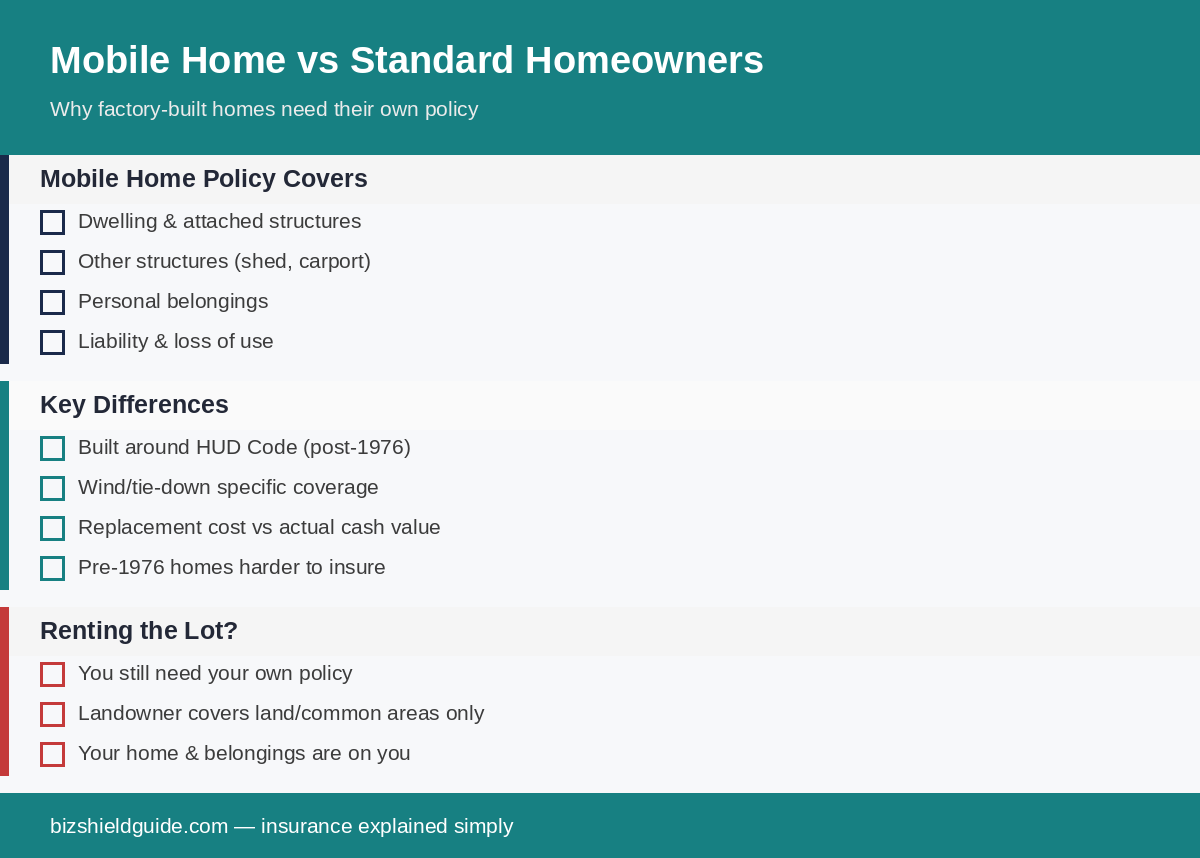
The biggest difference comes down to how the home is classified and built. Homes constructed after June 1976 fall under the HUD Code, a federal construction and safety standard that made manufactured homes significantly easier and cheaper to insure. Homes built before that date are often much harder to insure at all, since many insurers simply won’t write a policy for pre-HUD Code construction.
Manufactured home policies also tend to price replacement cost differently, since these homes can be more expensive to replace per square foot than their market value would suggest, and some insurers cap payouts at actual cash value instead of full replacement cost unless you specifically add that coverage.
Do You Need a Special Policy If You Rent the Land?
If you own the home but rent the lot it sits on — common in manufactured home communities — you still need your own mobile home policy to cover the structure, your belongings, and your liability. The landowner’s coverage, if any, typically only protects the land and shared community areas, not your individual home.
What Affects the Cost
Premiums are driven mainly by the home’s age, size, and construction date relative to the 1976 HUD Code cutoff, along with its location and your claims history. Older, pre-HUD Code homes tend to cost more to insure — when they can be insured at all — because of outdated wiring, plumbing, and structural standards that increase the odds of a claim.
Bundling your mobile home insurance with an auto policy through the same insurer is also worth asking about, since many companies offer a discount for carrying both, and it simplifies claims if a single storm damages your home and vehicle at once.
Getting the Right Mobile Home Insurance Policy From the Start
Before comparing quotes, confirm your home’s exact construction date and pull its HUD Code compliance certificate if you have it, since insurers will ask for it and a missing certificate can slow down or complicate coverage.
It also helps to get a replacement cost estimate specific to manufactured homes rather than relying on the purchase price, since factory-built construction can cost more per square foot to rebuild than most buyers expect.
Finally, ask each insurer directly whether tie-down, skirting, and wind coverage are included by default or sold as separate endorsements, since that single question tends to explain most of the price difference between competing quotes.
Filing a Claim on a Manufactured Home
Document your home’s condition with dated photos before any damage happens, since insurers settling manufactured home claims often ask for more detailed proof of pre-loss condition than a standard homeowners claim requires.
Report damage as soon as it’s safe to do so, keep receipts for any temporary repairs you make to prevent further damage, and ask your adjuster directly whether your policy pays actual cash value or full replacement cost before you agree to a settlement figure.
Bottom Line
Mobile home insurance exists because manufactured homes genuinely are different structures with different risks than a site-built house, and a standard homeowners policy isn’t always built to cover them properly. Check your home’s construction date against the 1976 HUD Code cutoff, ask specifically about replacement cost versus actual cash value, and get a policy written for a manufactured home rather than trying to force a standard homeowners form to fit. For a broader look at what a standard policy does and doesn’t cover, see our guide on what homeowners insurance actually covers.
For an independent, non-commercial look at manufactured home coverage basics, see United Policyholders’ mobile and manufactured home insurance basics.
Related Reading
What Does Homeowners Insurance Cover? The Complete 2026 Guide
First-Time Home Buyer Homeowners Insurance: The Complete 2026 Guide to Avoid Coverage Gaps

About the Author: BizShieldGuide Team
The BizShieldGuide team researches and writes plain-language guides to business and personal insurance — general liability, professional liability, workers' compensation, business owners policies, cyber liability, and industry-specific coverage for small business owners, alongside straightforward explainers on auto, home, and renters insurance for everyday readers. Our articles are grounded in publicly available data from insurers and carriers (Insureon, The Hartford, Progressive, State Farm, and others), industry cost surveys, and standard policy language, and we link to primary sources wherever a number or coverage detail could change. We are not licensed insurance agents or brokers, and nothing here replaces a quote or advice from one for your specific situation.