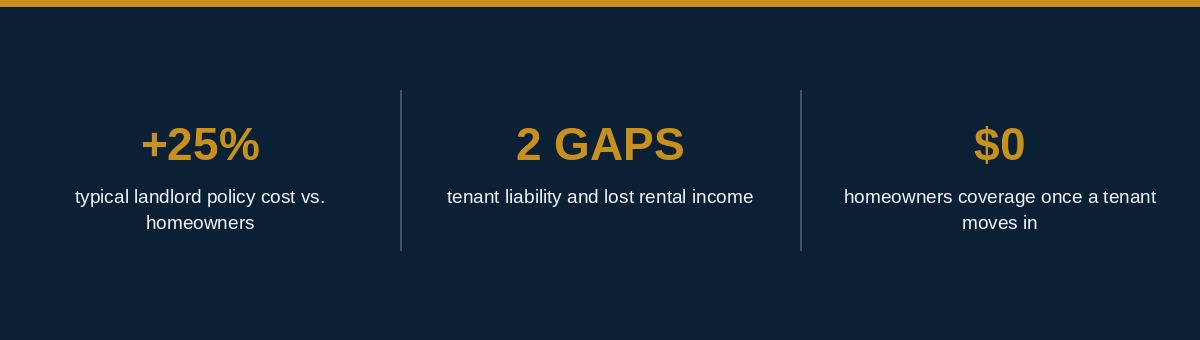
Short answer: landlord insurance is what you need once you rent out a property to tenants, your standard homeowners policy may no longer cover losses that happen there — you generally need a separate landlord (rental dwelling) policy, which typically costs around 25% more than homeowners insurance but adds coverage a homeowners policy was never built to provide, like lost rental income and tenant-related liability.
It’s an easy gap to fall into: you buy a home, live in it, insure it with a standard homeowners policy, then decide to rent it out — maybe you relocate for a job, maybe you turn a starter home into an investment property — without ever updating the insurance. The policy renews automatically, the premium gets paid, and everything looks fine until a claim gets denied because the home was a rental at the time of loss.
This guide breaks down exactly how landlord insurance differs from homeowners insurance, what each one actually covers, what it costs, and when you need to make the switch.
Why a Homeowners Policy Doesn’t Follow You Into Renting
A standard homeowners policy is priced and written around an owner-occupied home — the assumption baked into the underwriting is that you live there, so risks like renting the property to a stranger fall outside what the policy was designed to cover. Once tenants move in, your standard homeowners policy may not cover losses incurred while the home is rented out, which means a fire, storm damage, or liability claim that happens during a tenancy could be denied specifically because the property’s use changed and the policy wasn’t updated to match.
What Landlord Insurance Actually Adds
A landlord policy covers the same physical structure — fire, lightning, wind, hail, and other named perils — plus owner-supplied personal property left on-site, like appliances or maintenance equipment. What it adds beyond a standard homeowners policy is liability coverage that responds if a tenant or their guest is injured on the property, covering legal fees and medical expenses, and loss-of-rental-income coverage that pays out if the property becomes unrentable while it’s being repaired after a covered loss. Those last two are the pieces a homeowners policy simply doesn’t include, because they only make sense once someone other than you is living there and paying you rent.
What Landlord Insurance Costs Compared to Homeowners
Landlord policies generally run about 25% more than a comparable homeowners policy on the same property, reflecting the added liability and rental-income protections. The exact premium still depends on the usual factors — location, property age and condition, coverage limits, and claims history — but budgeting for roughly a quarter more than what you’re paying now is a reasonable starting estimate when you’re comparing quotes. For general background on how rental property risk is underwritten, see the Insurance Information Institute‘s overview of insuring a rental property.
Long-Term Rentals vs. Short-Term and Occasional Renting
For a long-term rental — a tenant on a standard lease living in the property as their primary residence — a dedicated landlord or rental dwelling policy is the standard fit. Short-term or occasional rentals, like renting out a home through a booking platform for part of the year, sometimes require a different endorsement or a specialized short-term rental policy instead, since the risk profile and how often the property changes occupants are both different from a standard tenancy. If you’re not sure which category your situation falls into, that’s exactly the kind of question worth asking an agent directly before a gap in coverage becomes a denied claim.
When to Make the Switch
The switch should happen before a tenant moves in, not after — insurers can decline or complicate a claim if the property’s rental status wasn’t disclosed at the time of loss, even if nothing else about the situation was misrepresented. If you’re actively deciding whether to rent out a property you currently live in, call your insurer or agent as part of that decision, not as a follow-up task after the lease is already signed.
Landlord Insurance: A Quick Pre-Rental Checklist
Before you hand over the keys, run through a short checklist: confirm your landlord insurance policy is active as of the move-in date, not just requested; check that liability limits are high enough to cover a serious injury claim; and make sure loss-of-rental-income coverage is included, not just structure and property coverage. A quick call to your agent to confirm all three is a lot cheaper than discovering a gap after a claim gets denied. None of this is complicated — it just requires treating the switch to landlord insurance as a real step in renting out a property, not an afterthought.
Bottom Line
Landlord insurance and homeowners insurance look similar on the surface — both insure the same building — but they’re built for different situations, and the gap between them is exactly the coverage a landlord actually needs: tenant liability and lost rental income. If you own a property that’s rented out, or you’re considering renting one out, confirming you’re on the right policy is worth a phone call before it becomes the reason a real claim gets denied.
Related Reading
What Does Homeowners Insurance Cover? The Complete 2026 Guide
Renters Insurance 101: What It Covers and Why You Need It
This guide is general information, not insurance or legal advice. Coverage details, endorsements, and pricing vary by insurer and state — confirm the specifics of any policy with your agent or insurer before relying on it.

About the Author: BizShieldGuide Team
The BizShieldGuide team researches and writes plain-language guides to business and personal insurance — general liability, professional liability, workers' compensation, business owners policies, cyber liability, and industry-specific coverage for small business owners, alongside straightforward explainers on auto, home, and renters insurance for everyday readers. Our articles are grounded in publicly available data from insurers and carriers (Insureon, The Hartford, Progressive, State Farm, and others), industry cost surveys, and standard policy language, and we link to primary sources wherever a number or coverage detail could change. We are not licensed insurance agents or brokers, and nothing here replaces a quote or advice from one for your specific situation.