
So, how much does renters insurance cost? Short answer: renters insurance costs about $23 a month, or roughly $276 a year, on average nationally — but your actual price depends heavily on how much personal property coverage you choose, your deductible, your state, and your credit-based insurance score, so the real number for your apartment can land noticeably above or below that average.
That’s a small number relative to what it protects, which is exactly why so few renters shop around before buying the first policy their landlord requires or the first quote a bundling email suggests — but understanding what actually moves the price up or down can meaningfully lower what you pay without cutting real coverage.
This guide breaks down the national average cost, how coverage amount and deductible change your premium, how much prices vary by state, the factors insurers actually weigh, and practical ways to bring your renters insurance cost down.
The National Average Cost of Renters Insurance in 2026
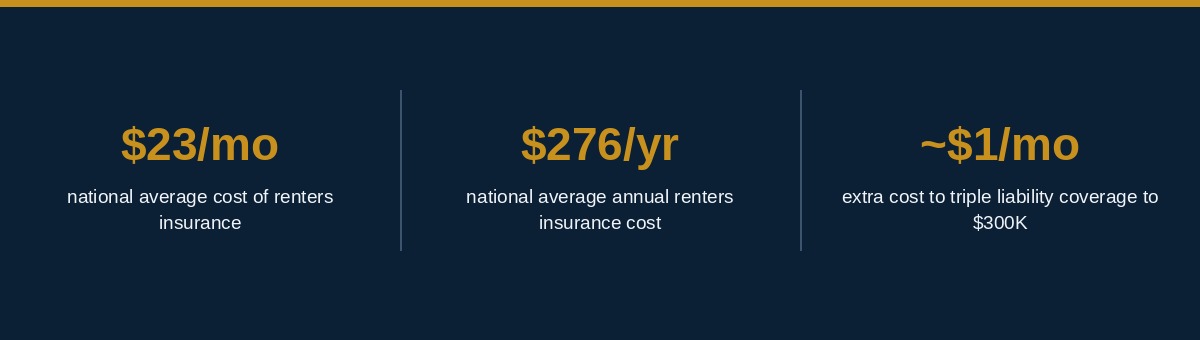
To answer how much does renters insurance cost nationally, renters insurance averages about $23 per month, or around $276 per year, for a standard policy. That figure is a useful benchmark for sanity-checking a quote, but it blends together a wide range of coverage levels, deductibles, and locations — a quote noticeably above or below $23 a month isn’t automatically wrong, it just reflects one of the variables below.
How Coverage Amount Changes Your Renters Insurance Cost
Personal property coverage — the amount that pays out if your belongings are stolen, burned, or otherwise destroyed — is the biggest lever on price. In one representative market, $15,000 of coverage ran about $15 a month, $25,000 ran about $19 a month, and $50,000 ran about $29 a month. Before picking a number, do a rough inventory of what you actually own; underinsuring to save a few dollars a month is the most common renters insurance mistake, and it only becomes visible after a loss.
How Much Does Liability Coverage Add to Your Renters Insurance Cost?
Liability coverage — which protects you if someone is injured in your rental or you accidentally damage someone else’s property — is surprisingly cheap to increase. Moving from $100,000 to $300,000 of liability coverage typically adds only about $1 a month, which makes the higher limit one of the easiest upgrades to justify given how little it costs relative to what a real liability claim or lawsuit could run.
Renters Insurance Cost by State
How much does renters insurance cost varies a lot by location. State-level averages range from about $16 to $36 a month. Louisiana, Arkansas, and Georgia tend to run on the higher end (commonly $33 to $36 a month), largely reflecting hurricane and severe weather exposure in the Southeast. Montana, North Dakota, and Wyoming tend to run on the lower end, often around $16 a month. If your quote looks out of step with the national average, checking where your state falls on this range is a reasonable first place to look before assuming something is wrong with the quote.
What Actually Drives Your Renters Insurance Price Up or Down
Several factors answer how much does renters insurance cost beyond the state average. Your deductible has a real, if modest, effect — a $1,000 deductible averages around $15 a month, versus about $18 a month for a $250 deductible, so raising your deductible is a straightforward way to trim the premium if you can comfortably cover the higher out-of-pocket amount in a claim.
Your credit-based insurance score matters too, since insurers have found a statistical link between lower scores and higher claim frequency, and a past claims history typically stays on record and affects pricing for five to seven years. High-value items — jewelry, cameras, musical instruments — usually need a separate endorsement or rider, which adds cost but is often the only way those specific items are actually covered near their real value.
How to Lower Your Renters Insurance Cost
If you’re wondering how much does renters insurance cost less than you’re paying now, start here. Bundling renters insurance with an auto policy through the same insurer is usually the single biggest discount available, often more valuable than any other individual change you can make. Beyond that: ask about a claim-free discount if you haven’t filed in several years, ask whether a monitored security system or smoke detectors qualify for a discount, consider raising your deductible if you have savings to cover it, and check whether paying annually instead of monthly saves a processing fee that adds up over a year.
Is Renters Insurance Worth the Cost?
At roughly $23 a month, renters insurance costs less than most people’s streaming subscriptions, while protecting against the realistic scenario of having to replace an apartment’s worth of belongings out of pocket after a fire, theft, or burst pipe — a cost that runs into the thousands of dollars for even a modestly furnished one-bedroom. For the large majority of renters, the math clearly favors carrying it; the more useful question isn’t whether to buy it, but how much coverage and which deductible actually fit your situation.
Our Renters Insurance 101 guide covers what a standard policy includes and excludes in more depth if you’re deciding on coverage amount rather than price. For an official, insurer-neutral overview of how these policies work, the NAIC’s consumer guide to renters insurance is a solid reference.
Renters Insurance Cost: Quick Answers
Is renters insurance required by law?
No state requires it by law, but many landlords require it as a lease condition, which is how most renters end up buying their first policy.
Does renters insurance cost more in an apartment than a house rental?
Not directly — the policy prices personal property and liability, not the building itself, so a rented house and a rented apartment with similar contents and location cost about the same.
Renters Insurance Cost Checklist: 5 Things to Confirm Before You Buy
Before you compare quotes, run through this quick checklist so you understand exactly how much renters insurance should cost for your situation, instead of being surprised by a higher premium later.
Knowing how much does renters insurance cost for someone in your exact situation matters more than memorizing a single national number, since two neighbors with the same building can pay very different premiums once coverage limits, deductibles, and credit-based scores are factored in. Run through the checklist below before you request quotes, so every insurer is pricing the same coverage and you can compare how much does renters insurance cost apples to apples.
- Personal property value: add up what it would cost to replace your belongings, since renters insurance cost rises directly with the coverage limit you choose.
- Deductible amount: a higher deductible, such as $1,000 instead of $500, usually lowers your renters insurance cost by roughly 5 to 15 percent.
- State and ZIP code: confirm your state\u2019s average, since renters insurance cost can vary by more than double depending on where you live.
- Credit-based insurance score: ask your insurer how it is weighted, since it is one of the biggest factors behind your renters insurance cost.
- Bundling discounts: check whether bundling with auto or umbrella coverage lowers your renters insurance cost by another 5 to 10 percent.
As a general rule, a higher deductible lowers your renters insurance cost, while a lower deductible raises it. The table below illustrates the typical pattern insurers use, relative to a $250 deductible baseline.
| Deductible | Typical Effect on Renters Insurance Cost |
|---|---|
| $250 | Highest premium (baseline) |
| $500 | Roughly 5% lower than the baseline |
| $1,000 | Roughly 10-15% lower than the baseline |
| $2,500 | Roughly 15-20% lower than the baseline |
Exact percentages vary by insurer and state, so always confirm the specific renters insurance cost quoted for each deductible option before you decide.
Quick Recap: How Much Does Renters Insurance Cost
So how much does renters insurance cost in practice? Around $23 a month nationally, moving up or down based on your coverage amount, deductible, state, and credit-based insurance score. Bundle it with auto insurance, raise your deductible if you can, and ask about a claim-free discount to bring that number down further.
Related Reading
Renters Insurance 101: What It Covers and Why You Need It
First-Time Home Buyer Homeowners Insurance: The Complete 2026 Guide to Avoid Coverage Gaps

About the Author: BizShieldGuide Team
The BizShieldGuide team researches and writes plain-language guides to business and personal insurance — general liability, professional liability, workers' compensation, business owners policies, cyber liability, and industry-specific coverage for small business owners, alongside straightforward explainers on auto, home, and renters insurance for everyday readers. Our articles are grounded in publicly available data from insurers and carriers (Insureon, The Hartford, Progressive, State Farm, and others), industry cost surveys, and standard policy language, and we link to primary sources wherever a number or coverage detail could change. We are not licensed insurance agents or brokers, and nothing here replaces a quote or advice from one for your specific situation.