
Short answer: travel insurance is worth buying when your trip is expensive and nonrefundable, involves international travel where your regular health insurance won’t cover you, or you’re older or traveling somewhere remote enough that a medical evacuation would be a real financial threat — and it’s reasonably skippable for a cheap, flexible, domestic trip your credit card may already partly cover.
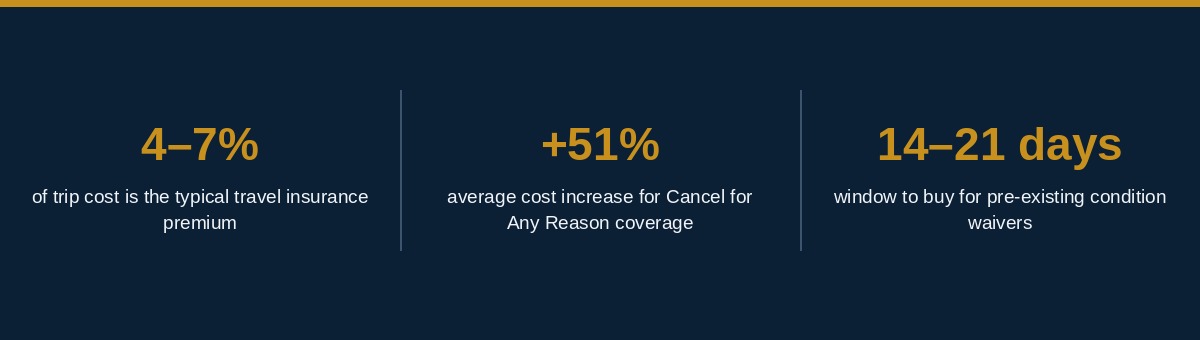
The average cost of travel insurance is small relative to what it protects: roughly $67 on a $1,000 trip and about $845 on a $20,000 trip, generally landing in the 4% to 7% range of total trip cost. That makes it one of the cheaper insurance decisions most people make, which is exactly why it’s worth thirty seconds of actual thought rather than a reflexive yes or no at checkout.
This guide covers what a typical policy covers, what actually drives the price, when travel insurance earns its cost, when it doesn’t, and how to buy it correctly if you decide it’s worth it.
What Does Travel Insurance Actually Cover?
A standard comprehensive policy bundles four main protections: trip cancellation (reimbursement if you have to cancel for a covered reason before departure), trip interruption (reimbursement for the unused portion if you have to cut a trip short), emergency medical expenses abroad, and emergency medical evacuation to get you to adequate care or home. Most policies also include baggage loss or delay coverage, usually with a fairly modest payout cap.
Basic, cheaper plans offer lower coverage limits across all of these categories; premium plans raise the caps and sometimes add extras like “Cancel for Any Reason” coverage, covered separately below. Read the actual coverage limits rather than assuming “comprehensive” means unlimited — a $50,000 medical evacuation cap sounds generous until you’re pricing an actual medevac flight from a remote location.
How Much Does Travel Insurance Cost?
Travel insurance pricing scales with trip cost, not with a flat fee — expect roughly $67 for a $1,000 trip and around $845 for a $20,000 trip, which works out to about 4% to 7% of what you’re spending on the trip itself. A quick two- or three-site comparison at booking time is usually enough to see whether a specific quote is in a reasonable range for your trip.
What Affects the Price of Travel Insurance
Age is the biggest single factor — a 60-year-old traveler typically pays around double what a 20-year-old pays for the same policy, and an 80-year-old can pay roughly four times as much, reflecting genuinely higher medical claim risk. Trip length and destination matter too, with longer trips and higher-risk destinations commanding higher premiums.
Adding “Cancel for Any Reason” coverage raises the premium by about 51% on average, and insuring a couple or family adds a modest amount on top of a solo traveler’s rate — often somewhere in the $34 to $81 range for the additional travelers, depending on the policy.
When Travel Insurance Is Worth Buying
It earns its cost most clearly on an expensive, largely nonrefundable trip — a cruise, an all-inclusive resort package, or a multi-stop international itinerary where a cancellation would mean losing thousands of dollars outright. It’s also genuinely valuable for any international trip where you’re not confident your regular health insurance provides meaningful coverage abroad, since a serious medical event overseas without evacuation coverage can turn into a six-figure financial event fast.
Older travelers, anyone with a pre-existing health condition, and trips to remote or medically under-resourced destinations are three more situations where the math tips clearly toward buying — the shared thread is a scenario where something going wrong would be expensive enough that the 4% to 7% premium is cheap by comparison.
When You Can Reasonably Skip Travel Insurance
A short, inexpensive, fully refundable domestic trip is the clearest case for skipping it — if there’s little to lose financially by canceling and no meaningful medical coverage gap, the insurance is mostly paying for peace of mind rather than real financial protection. The same goes for a trip already substantially covered by a travel credit card’s built-in benefits, covered next.
Does Your Credit Card Already Cover This?
Many travel rewards and premium credit cards include some built-in trip cancellation, trip interruption, or baggage protection automatically when you book travel with that card — and a growing number offer emergency medical or evacuation benefits as well. Before buying a separate policy, check your card’s benefits guide for the specific coverage amounts and conditions; it’s common to find you already have partial protection, which should reduce (not necessarily eliminate) how much additional coverage makes sense.
Cancel for Any Reason (CFAR): Is the Upgrade Worth It?
Standard trip cancellation coverage only pays out for a defined list of covered reasons — illness, a death in the family, specific weather events, and similar. CFAR coverage lets you cancel for literally any reason and still get a partial refund, typically 50% to 75% of your trip cost, in exchange for roughly 50% more in premium. It’s worth considering specifically when your reason for possibly canceling wouldn’t be covered under a standard policy — a change of mind, a work conflict that doesn’t meet the policy’s definition, or general uncertainty about whether the trip will still make sense closer to departure.
How to Buy Travel Insurance the Right Way
Buy soon after your first trip deposit rather than waiting until closer to departure — most policies only waive pre-existing medical condition exclusions if you purchase within a specific window (often 14 to 21 days) of that first payment. Compare a few policies side by side on an aggregator rather than defaulting to whatever the airline or booking site offers at checkout, since those add-on offers aren’t always the most competitively priced option for your specific trip. Read the list of covered cancellation reasons and the medical/evacuation coverage limits specifically — the marketing copy rarely tells you what actually matters until you’re filing a claim.
Bottom Line on Travel Insurance
Travel insurance is a genuinely useful, relatively cheap tool for the specific situations where a cancellation or medical event abroad would be a real financial problem — expensive nonrefundable trips, international travel with a health-coverage gap, older travelers, and remote destinations. For a cheap, flexible, domestic trip, or one already covered by your credit card’s built-in benefits, it’s a reasonable and defensible choice to skip it. The NAIC’s travel insurance consumer resources are a solid neutral reference if you want to dig further into how these policies are regulated.
Related Reading
How Much Life Insurance Do You Need? The 2026 DIME Method Guide
Umbrella Insurance Explained: The Proven Way to Avoid Bank-Breaking Lawsuits in 2026

About the Author: BizShieldGuide Team
The BizShieldGuide team researches and writes plain-language guides to business and personal insurance — general liability, professional liability, workers' compensation, business owners policies, cyber liability, and industry-specific coverage for small business owners, alongside straightforward explainers on auto, home, and renters insurance for everyday readers. Our articles are grounded in publicly available data from insurers and carriers (Insureon, The Hartford, Progressive, State Farm, and others), industry cost surveys, and standard policy language, and we link to primary sources wherever a number or coverage detail could change. We are not licensed insurance agents or brokers, and nothing here replaces a quote or advice from one for your specific situation.