
Short answer: umbrella insurance is extra liability coverage that kicks in once your auto or home policy’s liability limit runs out, and it’s worth buying if you have real assets to protect — a typical $1 million policy costs around $380 a year, which is cheap compared to what a single lawsuit judgment can cost you.
Most people assume their standard auto or homeowners policy has them covered if they’re sued after an accident or an injury on their property. It usually does — up to a point. Auto liability limits often cap out around $300,000, and homeowners liability typically maxes out around $500,000. A serious injury lawsuit, especially one involving lost future income or long-term medical care, can easily exceed either number.
This guide walks through what umbrella insurance actually covers, what it costs, what your underlying policies need to look like before an insurer will sell you one, and how to figure out whether you’re one of the people who genuinely needs it.
What Is Umbrella Insurance, Exactly?
Umbrella insurance is a standalone liability policy that sits on top of your existing auto and homeowners (or renters) coverage. It doesn’t pay for damage to your own car or house, and it doesn’t cover your own medical bills — it only pays out when you’re found legally responsible for someone else’s injury, property damage, or certain lawsuits, and only after your underlying policy’s liability limit has been used up.
Think of it as a second layer that activates exactly where your car or home policy stops. If a guest is seriously injured at your house and the resulting judgment is $800,000, but your homeowners liability limit is $500,000, umbrella insurance is what covers the remaining $300,000 instead of coming out of your savings, your home equity, or future wages.
How Much Does Umbrella Insurance Cost?
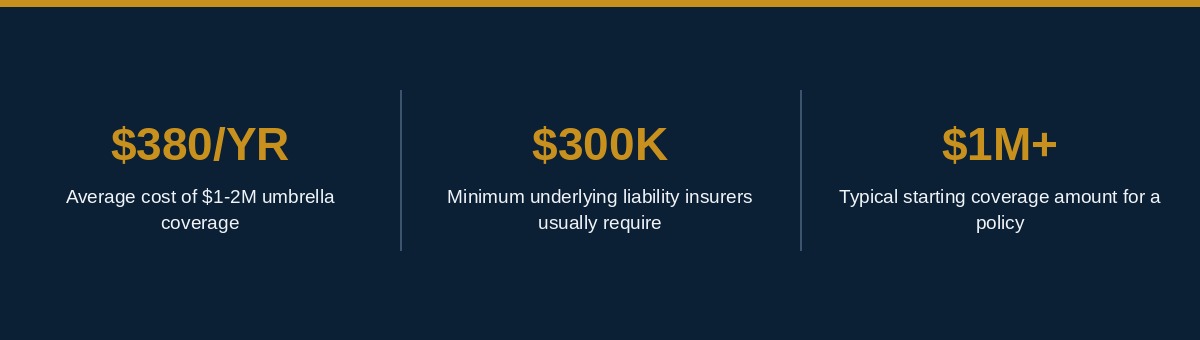
Umbrella insurance is one of the cheapest ways to buy a large amount of coverage. Policies typically start around $200 a year for $1 million in coverage, and the average cost for $1 to $2 million of coverage runs about $380 annually — a few dollars a day for protection against a judgment that could otherwise take years to pay off.
Cost scales with how much coverage you buy and your underlying risk factors (teen drivers, a swimming pool, rental properties, a dog with no bite history versus one with a prior incident all move the price). Insurers also usually require you to hold your auto and home policy with them, or a company they partner with, before offering an umbrella policy.
What Umbrella Insurance Requires From Your Underlying Policies
You can’t buy umbrella insurance with minimum-limit auto or home coverage. Most carriers require at least $300,000 in personal liability on your homeowners policy and comparable bodily injury and property damage limits on your auto policy before they’ll sell you an umbrella policy at all. If your current limits are lower, raising them is usually the first step, and it often costs less than people expect since liability coverage itself is relatively inexpensive to increase.
This requirement exists because umbrella insurance is designed to sit above an already-solid base of coverage, not to substitute for one. An insurer won’t let the umbrella policy become the primary layer of protection.
Who Actually Needs Umbrella Insurance?
The clearest case for umbrella insurance is anyone with meaningful assets to protect: home equity, retirement savings, investment accounts, or future wages a judgment could garnish. If a lawsuit could realistically exceed your existing liability limits and you have something worth losing, the coverage gap is real, not theoretical.
Beyond net worth, certain situations raise your risk regardless of how much you’ve saved: owning a swimming pool or trampoline, having a teen driver in the house, owning rental property, frequently hosting parties or gatherings, serving on a nonprofit board, or being active on social media in a way that could expose you to a defamation claim. Any one of these meaningfully raises the odds you’ll eventually need the extra layer.
What Umbrella Insurance Covers (and What It Doesn’t)
Umbrella policies typically cover bodily injury and property damage liability beyond your underlying limits, personal liability claims like libel, slander, and false arrest that standard home and auto policies often exclude or cap low, and legal defense costs even if a lawsuit against you is ultimately found to be without merit.
What it doesn’t cover: your own injuries, your own property damage, intentional or criminal acts, business liability (a separate commercial policy handles that), and, in most cases, contractual liability. Read the policy’s exclusions list carefully — “umbrella” implies broad coverage, but every policy still has real boundaries.
Real-World Scenario: When Umbrella Insurance Pays Off
A homeowner hosts a backyard gathering; a guest slips near the pool, breaks a hip, and requires two surgeries plus months of physical therapy. The guest sues for $650,000 in medical costs and lost income. The homeowner’s liability coverage caps at $300,000. Without an umbrella policy, the remaining $350,000 judgment becomes the homeowner’s personal responsibility — potentially collectible against home equity, savings, and future income. With a $1 million umbrella policy costing roughly $30 a month, the full judgment is covered and the homeowner’s own assets are never at risk.
How Much Coverage Should You Buy?
A common rule of thumb is to buy umbrella coverage equal to your total net worth, rounded up to the next available policy tier (most insurers sell in $1 million increments). If your net worth, including home equity and retirement accounts, is around $700,000, a $1 million policy provides a reasonable buffer; someone with $1.5 million in assets should look at $2 million in umbrella coverage.
It’s worth revisiting this number every few years, since home values, retirement balances, and income tend to rise over time — a policy sized correctly five years ago may no longer match your current exposure.
Frequently Asked Questions
Does umbrella insurance cover me if I’m sued for something that happened years ago?
Generally no — coverage applies to incidents that occur while the policy is active, not to claims arising from something before you purchased it.
Can renters buy umbrella insurance?
Yes, as long as you carry a renters insurance policy with adequate liability limits, most insurers will sell an umbrella policy on top of it the same way they would for a homeowner.
Is umbrella insurance tax-deductible?
For a personal umbrella policy, no — personal liability insurance premiums generally aren’t deductible on an individual tax return, though a landlord or business owner should check with a tax professional about a policy tied to rental or business exposure.
Bottom Line: Is Umbrella Insurance Worth It?
For anyone with assets worth protecting or a lifestyle factor that raises lawsuit risk, umbrella insurance is one of the highest-value purchases in personal insurance — a few hundred dollars a year for a million dollars or more of protection against the kind of judgment that can otherwise follow you for a decade. Check your current auto and home liability limits first, since raising those may be a prerequisite, then compare umbrella quotes from your existing carrier before shopping elsewhere.
For an independent breakdown of how umbrella policies interact with state-specific liability rules, the National Association of Insurance Commissioners’ liability insurance guide is a useful neutral reference to check against any quote you receive.
Related Reading
What Does Homeowners Insurance Cover? The Complete 2026 Guide
Lower Your Car Insurance Premium and Save Big: The Proven 2026 Guide

About the Author: BizShieldGuide Team
The BizShieldGuide team researches and writes plain-language guides to business and personal insurance — general liability, professional liability, workers' compensation, business owners policies, cyber liability, and industry-specific coverage for small business owners, alongside straightforward explainers on auto, home, and renters insurance for everyday readers. Our articles are grounded in publicly available data from insurers and carriers (Insureon, The Hartford, Progressive, State Farm, and others), industry cost surveys, and standard policy language, and we link to primary sources wherever a number or coverage detail could change. We are not licensed insurance agents or brokers, and nothing here replaces a quote or advice from one for your specific situation.