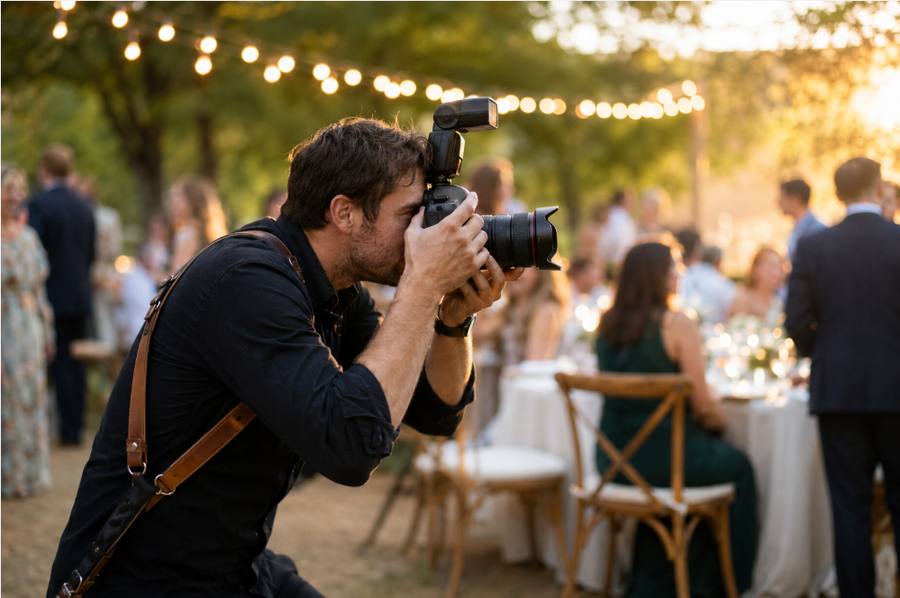
Photography and event business insurance is the coverage photographers, videographers, and event professionals need to satisfy venue contracts and protect against equipment loss, liability claims, and missed-event disputes. A photographer who loses a wedding’s only memory card to equipment failure faces a completely different kind of claim than one whose light stand tips over and cracks a venue’s marble floor — and most photography and event businesses only find out they needed two different policies after one of these has already happened.
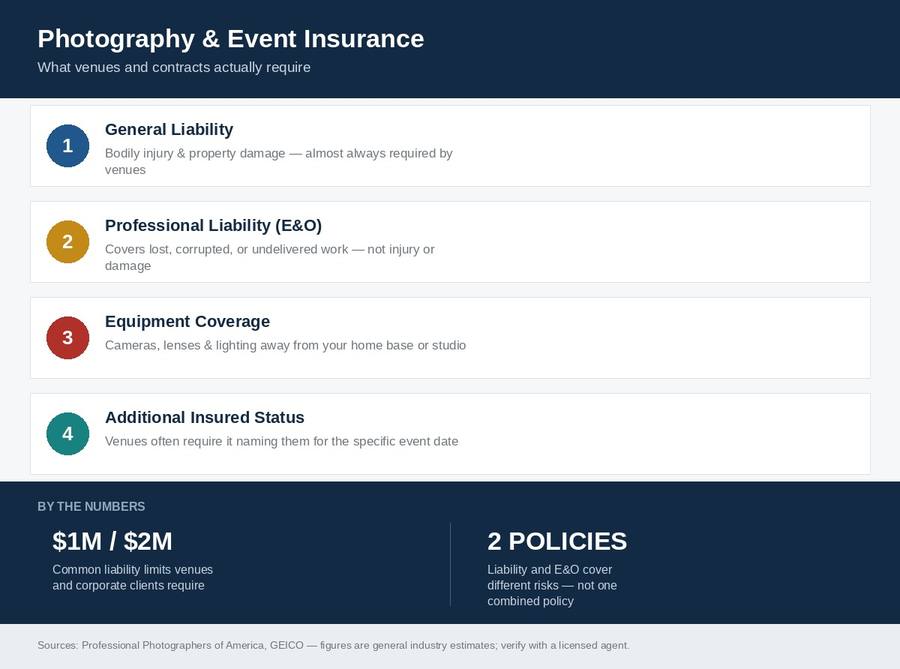
The short version: general liability covers bodily injury and property damage at a shoot or venue (and is almost always required by venues before you can work there), professional liability (errors and omissions) covers the much more photography-specific risk of lost, corrupted, or undelivered work, and equipment coverage protects the gear itself, which is often worth more than a car. Here’s what each piece does and why photographers and event planners need more than a basic liability policy.
General liability: what almost every venue requires before you shoot
General liability covers third-party bodily injury and property damage — a guest who trips over a light stand, a backdrop that damages a venue’s flooring, a client who’s injured by photography equipment during a shoot. Nearly every event venue and a large share of corporate clients require proof of it before allowing a photographer or event vendor on site, commonly with a $1 million per-occurrence limit, and frequently ask to be named as an additional insured on the policy for the date of the event. Without a certificate of insurance ready to produce quickly, a booking can fall through at the venue-approval stage, not the pricing stage.
Professional liability (E&O): the risk that’s specific to this industry
This is the coverage general liability doesn’t touch, and it’s arguably more important for a photography or event business than for most other small businesses: professional liability, often called errors and omissions in this context, responds to claims that the work itself failed — a corrupted memory card that loses an irreplaceable wedding’s photos, a missed shot list at an event that can never be re-staged, a scheduling or delivery failure that breaches the contract.
I’ve talked to a wedding photographer who genuinely believed general liability covered this until a corrupted-card incident made clear it didn’t — general liability responds to injury and property damage, not to a failure to deliver the service as promised. For one-of-a-kind events like weddings, this gap matters more than it would for a business whose mistakes can simply be redone.
Equipment coverage: gear that’s worth more than it looks
A working photographer’s camera bodies, lenses, lighting, and backup gear can add up to tens of thousands of dollars, and a standard business property policy often doesn’t cover equipment once it leaves your home base or studio. Tools and equipment coverage (inland marine) is built specifically for this — it follows the gear to shoots, venues, and while it’s in transit, covering theft or damage wherever the work actually happens, which for this industry is almost never inside an office.
What venues and clients actually ask to see
Beyond the baseline $1 million general liability limit, larger venues and corporate clients increasingly ask for a $2 million aggregate limit and additional insured status naming the venue for the specific event date — not a blanket endorsement for the whole year. Some venues also specifically ask about liquor liability if alcohol will be served, which is usually the caterer’s or venue’s responsibility rather than the photographer’s, but it’s worth confirming who’s covering what before the event rather than assuming.
What coverage costs actually look like
Photography liability coverage is commonly available starting in the low hundreds of dollars annually for a solo shooter, scaling up with revenue, equipment value, and whether you regularly cover large events versus smaller sessions. Event planners juggling vendors, venues, and larger crowds typically carry higher limits than a single photographer working solo. Talk through your specific mix of weddings, corporate work, or portrait sessions with an agent who understands the industry — a portrait studio and a full-service wedding and event photographer carry meaningfully different risk profiles.
Photography and event business insurance isn’t just about the liability a venue requires on paper — the professional liability and equipment pieces are what actually protect the work and the gear that the business depends on. This article is for general informational purposes and isn’t personalized insurance, legal, or financial advice. Coverage rules, costs, and venue requirements change, and every photography or event business’s risk profile is different — for decisions specific to your business, talk to a licensed insurance agent. Learn more About BizShieldGuide or reach us via our Contact page.
Related Reading
General Liability Insurance for Your Photography Business — Professional Photographers of America
Photographer Insurance — GEICO
General Liability Insurance 101: What It Covers and What It Doesn’t
How to Get a Certificate of Insurance (COI) Fast
How Much Does Small Business Insurance Actually Cost in 2026?
Why venues require photography and event business insurance
Nearly every wedding venue, banquet hall, and event space now requires vendors to carry photography and event business insurance before allowing them on the property, typically naming the venue as an additional insured on the policy. This requirement protects the venue from liability if a photographer’s equipment damages the property or a guest is injured by a light stand, tripod, or other gear left in a walkway. Photographers who show up without proof of photography and event business insurance risk being turned away at the door, even after a client has already paid a deposit and planned an entire event around their availability.
General liability insurance is the core of photography and event business insurance, covering third-party bodily injury and property damage claims at a shoot or event location. Equipment coverage, sometimes called inland marine insurance, is the second essential piece, protecting cameras, lenses, lighting, and other gear against theft, drops, and water damage while traveling between shoots — a single professional camera body and lens combination can cost thousands of dollars, making this coverage essential rather than optional for any working photographer.
Errors and omissions coverage for missed or lost shots
Professional liability insurance, also called errors and omissions coverage, is a less obvious but increasingly important part of photography and event business insurance, covering claims that a photographer failed to deliver contracted images — due to equipment failure, a missed shot list, or lost files. Wedding photography in particular carries this risk acutely, since a wedding cannot be reshot if something goes wrong, and a couple who feels their day was inadequately documented can pursue a claim that general liability insurance alone will not cover.
How much photography and event business insurance costs
Photography and event business insurance is relatively affordable for most solo and small-studio operators, with a basic general liability and equipment package often costing a few hundred dollars a year. Photographers who regularly shoot larger events, travel extensively with expensive gear, or hire second shooters and assistants should expect higher premiums to reflect the increased equipment value and liability exposure involved. Comparing quotes from insurers that specialize in photography and event business insurance, rather than a generic small business policy, usually produces better pricing and more relevant coverage.
Photography and event business insurance for other event professionals
Photography and event business insurance is not just for photographers — DJs, event planners, florists, caterers, and mobile bartending services all face similar venue insurance requirements and need a similar mix of general liability, equipment, and sometimes liquor liability coverage. Event planners in particular often need photography and event business insurance broad enough to cover their own liability as well as the coordination risk of managing multiple vendors at a single event, since a planner can be named in a lawsuit even when the actual failure was another vendor’s fault.
Certificates of insurance and additional insured requests
Virtually every venue contract today requires a certificate of insurance proving photography and event business insurance is active before the event date, and many also require the venue to be named as an additional insured for the specific event. Photographers and event vendors should build extra time into their booking process to request this certificate from their insurer, since scrambling to get one issued the week of an event can create unnecessary stress and, in rare cases, a canceled booking if the certificate does not arrive before the venue’s deadline.
Travel and destination event coverage
Photographers and event vendors who travel out of state or internationally for destination weddings and events should confirm their photography and event business insurance actually extends to those locations, since some policies limit coverage to a specific home state or region. International destination events introduce additional complexity, including whether a policy responds to a claim filed in a foreign jurisdiction, which is worth confirming with an insurer well before booking a client’s destination event rather than discovering a gap after travel arrangements are already made.
Business interruption and cancellation coverage
Photography and event business insurance increasingly includes business interruption or cancellation coverage, protecting income if illness, severe weather, or an equipment failure forces a photographer or event vendor to cancel a booking they cannot reschedule. This coverage matters especially for solo operators without a backup shooter or team member who could step in on short notice, since a single missed wedding, unlike a missed corporate headshot session, cannot simply be rebooked for another day without real financial and reputational consequences.
Second shooters, assistants, and hired crew
Photographers who regularly hire second shooters or assistants for larger weddings and events should clarify whether those helpers are covered under the primary photographer’s photography and event business insurance or need their own separate policy. Many venues and clients specifically ask whether every person working the event, not just the lead photographer, is covered, and an incomplete answer here can create liability gaps if an assistant causes damage or is injured while working under someone else’s business.
Independent second shooters who work regularly with multiple primary photographers often benefit from carrying their own photography and event business insurance rather than relying entirely on whichever lead photographer books them for a given event.
Studio and home-based coverage considerations
Photographers who operate a home studio or maintain a dedicated office and editing space need to confirm that a homeowners or renters policy does not exclude business use of the space, since most personal policies specifically exclude business activity and equipment. A proper photography and event business insurance policy extends coverage to a home-based studio setup, protecting both the equipment stored there and covering liability if a client visits the home studio for a consultation or a session.
Photographers renting a dedicated studio space separately from their home face a similar consideration, needing to confirm their landlord’s insurance does not assume the tenant already carries adequate coverage for the specific business risks of a working photo studio.
Client contracts and insurance requirements working together
A well-drafted client contract and a solid photography and event business insurance policy work together, not as substitutes for one another. A contract can limit liability and clarify expectations around rescheduling, cancellation, and delivery timelines, but it cannot pay for a lawsuit, a stolen camera bag, or a venue’s damaged flooring — that is what insurance actually does. Photographers who invest time in a strong contract but skip proper photography and event business insurance are only halfway protected, since a client or venue determined to pursue a claim will not be stopped by contract language alone if the underlying loss is real and significant.
The bottom line for photography and event professionals
Working events means constant exposure to expensive, fragile equipment, unpredictable venues, and clients whose most important day cannot simply be redone if something goes wrong. Photography and event business insurance is what allows a photographer or event vendor to take on ambitious bookings with confidence rather than quiet anxiety about what might happen if equipment fails, a guest is injured, or a shoot cannot be completed as promised.
Building this coverage into the basic cost of running the business, alongside camera gear and software subscriptions, rather than treating it as an optional add-on purchased only when a venue specifically demands it, is what separates photographers who handle a bad day smoothly from those who do not.
Backing up work and protecting against data loss
While not strictly an insurance question, data protection deserves a mention alongside photography and event business insurance, since lost or corrupted files are one of the most common sources of client disputes in this industry. Following a disciplined backup routine — multiple memory cards during a shoot, an immediate backup to a second drive after the event, and cloud storage for the final edited files — reduces the chance that a claim over lost images ever needs to be filed against a photography and event business insurance policy in the first place. Insurance is the backstop for when things go wrong despite good practices, not a substitute for those practices.
Reviewing coverage as the business grows
A photographer who starts out shooting a handful of weddings a year and grows into a studio booking dozens of events, hiring associate shooters, and investing in significantly more equipment should revisit their photography and event business insurance program rather than assuming the original policy purchased at the very start of the business still fits. Higher equipment values, more employees or contractors working under the brand, and a larger volume of contracts all increase the potential size of a claim, and coverage limits that felt generous for a solo operation can become inadequate once the business has genuinely scaled.
Building a simple annual habit around this review — checking equipment schedules against recent purchases, confirming every regularly hired second shooter or assistant is properly covered, and asking directly whether anything about the business has changed enough to warrant a bigger conversation with an agent — keeps a growing photography or event business from quietly outgrowing its own coverage without anyone noticing until a claim exposes the gap. This kind of review takes very little time compared to the disruption a serious uninsured loss would cause, and it fits naturally alongside other routine year-end business tasks like reviewing pricing and updating a portfolio.
For those just starting out, the smartest time to think through all of this is before the first paid booking is confirmed, not after a venue’s contract department flags a missing certificate the week of the event. A short conversation with an agent who understands the events industry specifically, rather than a generalist policy bought online without much thought, usually surfaces coverage details — like second-shooter status or destination-event limits — that a new business owner would not otherwise think to ask about on their own.
Getting this right early also makes every future booking simpler. Once the paperwork, coverage limits, and certificate process are set up correctly the first time, requesting a certificate for a new venue or updating a policy for a new piece of equipment becomes a quick, routine task rather than something that needs to be relearned from scratch each time a new client or venue asks for it.

About the Author: BizShieldGuide Team
The BizShieldGuide team researches and writes plain-language guides to business and personal insurance — general liability, professional liability, workers' compensation, business owners policies, cyber liability, and industry-specific coverage for small business owners, alongside straightforward explainers on auto, home, and renters insurance for everyday readers. Our articles are grounded in publicly available data from insurers and carriers (Insureon, The Hartford, Progressive, State Farm, and others), industry cost surveys, and standard policy language, and we link to primary sources wherever a number or coverage detail could change. We are not licensed insurance agents or brokers, and nothing here replaces a quote or advice from one for your specific situation.