
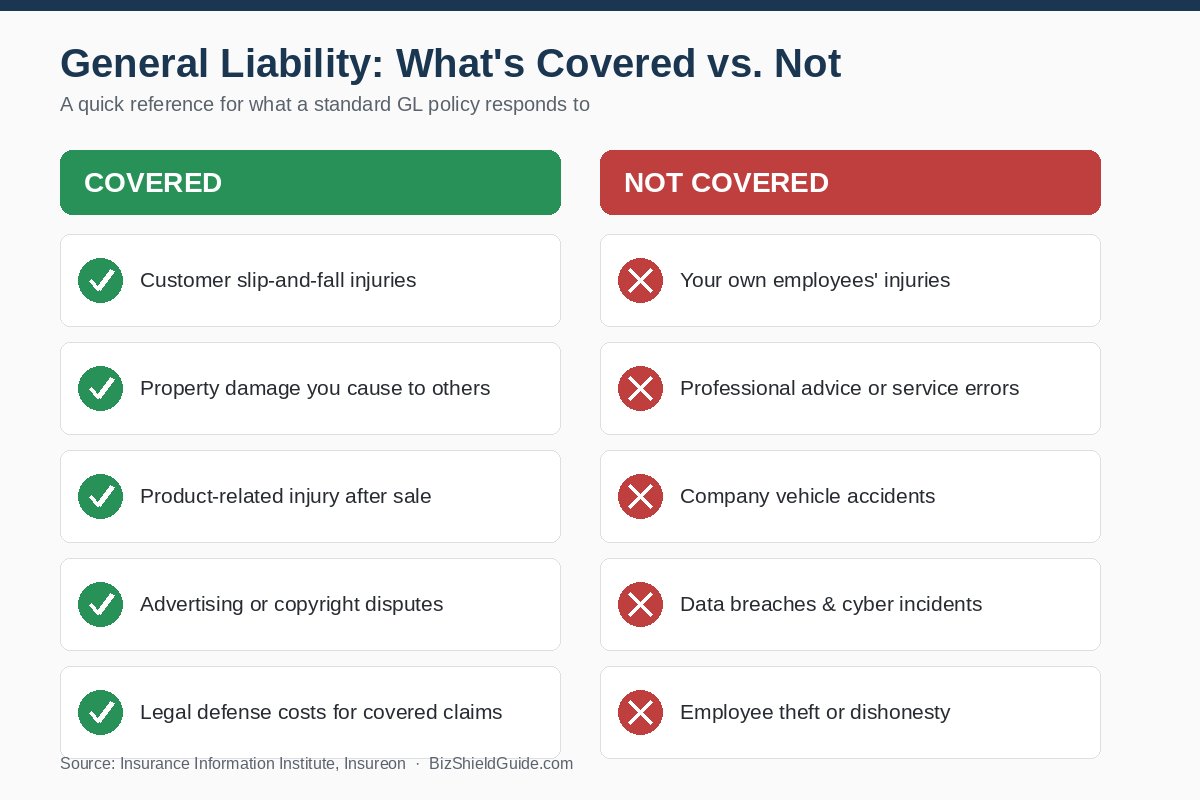
General liability (GL) insurance pays for third-party claims of bodily injury, property damage, and advertising or personal injury caused by your business — a customer who slips in your store, a client’s laptop your contractor knocks off a desk, a competitor who claims your ad copy stole their tagline. It does not pay for injuries to your own employees, mistakes in the professional advice or services you sell, accidents involving a company vehicle, or losses from a data breach. Most small businesses carry a policy with a $1 million per-occurrence limit and a $2 million aggregate limit, and pay somewhere between roughly $30 and $150 a month depending on industry and risk — the exact average varies by which insurer’s book of business you’re looking at, which matters more than most owners realize when they’re comparing quotes.
What General Liability Actually Covers
A standard commercial general liability (CGL) policy is built around three coverage parts, and understanding the split helps explain why the policy has the gaps it does. The Insurance Information Institute’s overview of commercial general liability insurance breaks it down as Coverage A (bodily injury and property damage), Coverage B (personal and advertising injury), and Coverage C (medical payments, a no-fault option for minor injuries that doesn’t require anyone to prove negligence).
Coverage A is the one people picture: a customer trips on a torn rug, breaks a wrist, and sues. GL pays the medical costs, legal defense, and any settlement or judgment, up to your limit. Coverage B is less intuitive — it covers claims like libel, slander, false advertising, and copyright or trademark infringement in your marketing, none of which involve a physical injury at all.
Products-Completed Operations
If you manufacture, sell, or install anything, the products-completed operations part of the policy is arguably more important than the premises coverage. It responds to injuries or damage that happen after you’ve finished the job or the customer has left your store — a shelf you installed collapses two weeks later, or a food product you sold makes someone sick after they’ve gone home. This is a sub-limit within the same aggregate, not a separate policy, so it’s worth checking what portion of your limit it actually gets.
What General Liability Explicitly Does Not Cover
The exclusions are where GL insurance causes the most confusion, and where I’ve seen business owners get burned. Per Insureon’s rundown of commercial general liability exclusions, a standard policy carves out:
- Professional errors and omissions — a consultant’s bad advice, a designer’s missed deadline, an accountant’s mistake. That’s professional liability / errors and omissions (E&O) insurance, a separate product entirely.
- Employee injuries — GL is for third parties, not your own staff. Workplace injuries go through workers’ compensation, which is legally required in nearly every state once you have employees.
- Auto accidents — even a magnetic sign on a personal car used for deliveries needs commercial auto coverage; GL won’t touch a collision claim.
- Intentional acts and criminal conduct — deliberately caused harm is excluded by definition, not just as a policy quirk.
- Employee dishonesty and theft — an employee stealing from the till or embezzling requires a crime or fidelity bond, not GL.
- Pollution — even incidental pollution exposure (a cleaning company’s chemical spill, a landscaper’s fertilizer runoff) is broadly excluded and needs pollution liability coverage.
- Cyber incidents — data breaches, ransomware, and electronic data loss fall to a standalone cyber liability policy; GL’s property damage language generally doesn’t extend to digital data.
In my experience reviewing small business policies, the mistake I see most often is a service-based business — a consultant, a marketing agency, an IT contractor — that buys only general liability because a client’s contract requires “liability insurance,” without realizing GL won’t cover the one claim they’re actually most exposed to: a client alleging their advice or deliverable caused a financial loss. That’s an E&O claim, and GL simply doesn’t respond to it.
Limits: Why $1 Million / $2 Million Became the Default
According to Insureon’s cost data, roughly 85% of its small business customers carry a $1 million per-occurrence / $2 million aggregate limit, with a smaller share (around 8%) stepping up to $2 million/$4 million. That $1M/$2M combination has become the default less because it’s scientifically calibrated to small-business risk and more because it’s what most commercial leases, client contracts, and vendor agreements ask for as a minimum. If you’re bidding on a contract, check the insurance requirements clause before you assume your existing limits are sufficient — it’s a common point where deals stall at the last minute.
What It Actually Costs in 2025–2026
Cost figures vary noticeably depending on which insurer’s data you’re looking at, and it’s worth naming that spread rather than pretending there’s one true number. Insureon reports that its small business customers pay an average of about $45 a month, with most policies falling between $250 and $3,000 a year. Progressive Commercial states that in 2025 its new customers paid an average of $79 a month, though the median — a figure less skewed by high-risk outliers — was $55 a month. The Hartford puts its customer average at roughly $68 a month, or $810 a year, with industry differences ranging from around $421 annually for photographers to $1,352 for restaurants.
The honest takeaway is that “average cost” depends heavily on the insurer’s mix of industries and risk appetite, so treat any single figure as a ballpark rather than a quote. Industry, claims history, location, revenue, and employee count all move the number more than the specific carrier does — a landscaping company and a bookkeeping firm will never land in the same range regardless of who insures them.
General Liability vs. a Business Owner’s Policy
Standalone general liability only covers liability. A Business Owner’s Policy (BOP) bundles that same GL coverage with commercial property insurance and business income (interruption) coverage into a single package, typically at a lower combined price than buying the pieces separately. The NAIC describes the BOP as the most commonly purchased policy type among small businesses, generally available to companies with 100 or fewer employees and up to $5 million in annual revenue.
If you own or lease a physical space — a storefront, office, studio, warehouse — a BOP is usually the more efficient purchase than standalone GL, because you almost certainly need property coverage anyway and the bundle avoids paying two separate policy fees and dealing with two renewal dates. Purely mobile or home-based service businesses with minimal physical assets sometimes stick with standalone GL since there’s less property to insure.
Two Claim Scenarios That Show the Stakes
Numbers make this more concrete than abstract coverage descriptions. A Hartford analysis of small-business claims covering 2015 to 2025 found that the average slip, fall, and customer-injury claim more than doubled over that decade — from about $20,000 in 2015 to roughly $45,000 in 2025 — a shift the insurer attributes largely to rising litigation costs and higher jury awards, not necessarily more accidents. That same analysis put the average fire claim at around $80,000 and vehicle-accident claims at around $50,000 in 2025, for comparison.
On the advertising injury side, a reputational-harm lawsuit — someone suing over a defamatory review response, a competitor claiming trademark infringement in your ad — can run around $50,000 to resolve, according to figures Insureon attributes to The Hartford. Neither of these numbers is exotic. A single bad slip-and-fall claim can now exceed what many small businesses pay in GL premiums over ten or fifteen years, which is the entire argument for carrying the coverage even when a claim feels unlikely.
A Few Things Worth Checking on Your Own Policy
Before renewal, it’s worth pulling out the declarations page and confirming a few specifics rather than assuming the policy still matches your business:
- Does your per-occurrence limit still meet the minimums in your current leases and client contracts, not just the ones from when you first bought the policy?
- Have you added services, products, or locations since the policy was written that aren’t reflected in your class code or payroll estimates?
- If you subcontract any work, does your policy extend to damage those subcontractors cause, or is that excluded absent an endorsement?
- Do you have any professional-service exposure — advice, design, consulting, technical work — that would actually need an E&O policy alongside your GL?
None of this requires becoming an insurance expert. It requires reading the declarations page once a year, comparing it against what your business actually does now, and calling your agent when the two have drifted apart — which, for most growing businesses, happens faster than anyone expects.
Related Reading
- Business Owner’s Policy (BOP) vs. Buying Coverage Separately: Which Saves You Money?
- General Liability vs. Professional Liability (E&O): Which Insurance Do You Actually Need?
This article is for general informational purposes and isn’t personalized insurance, legal, or financial advice. Coverage rules, costs, and state requirements change, and every business’s risk is different — for decisions specific to your business, talk to a licensed insurance agent. Learn more About BizShieldGuide or reach us via our Contact page.