
When it comes to general liability vs professional liability, the short answer is: most businesses need both, just for different reasons. Most small businesses need general liability insurance, full stop. If you also give advice, design something, manage someone else’s money, or deliver a professional service that a client relies on, you probably need professional liability (errors and omissions) coverage too — and a fair number of businesses genuinely need both running side by side. ” It’s that the two cover completely different kinds of harm, and a lot of business owners don’t find out which one they were missing until they’re already served with a claim.
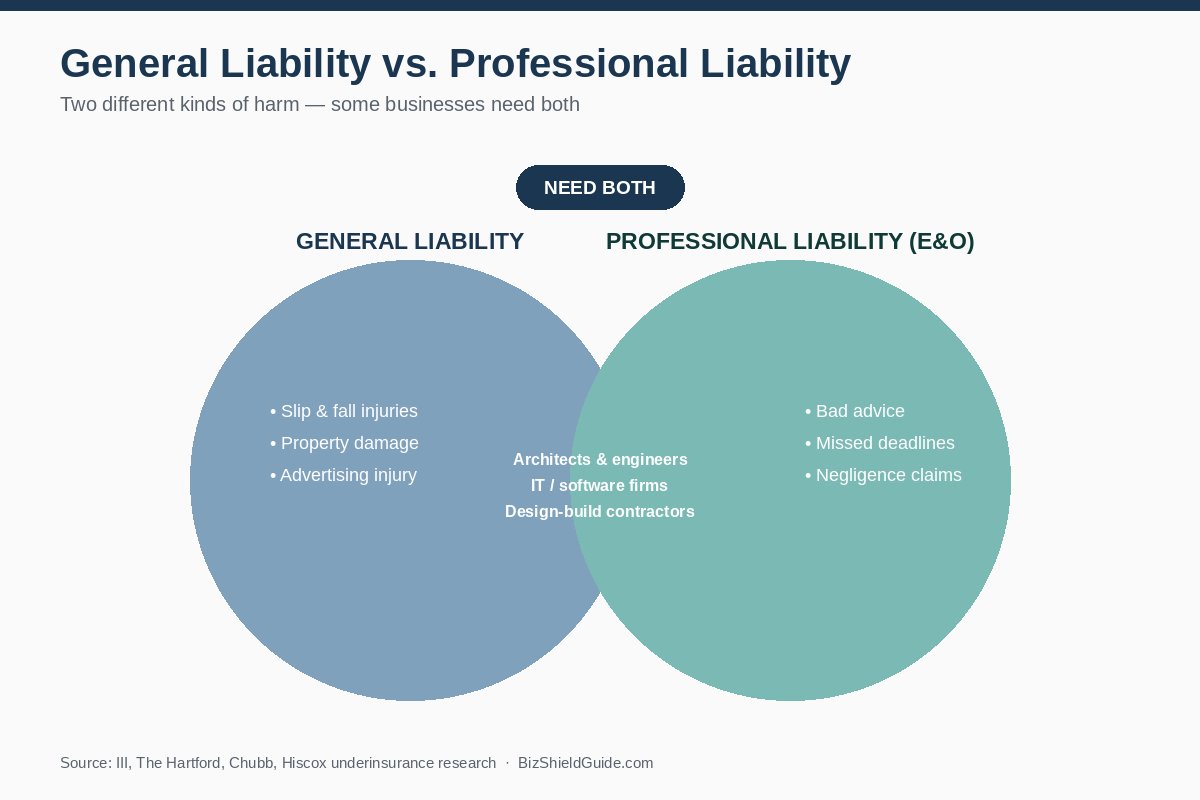
The core distinction: physical harm versus financial harm
General liability (GL) insurance responds to third-party claims of bodily injury, property damage, and advertising or personal injury (things like libel, slander, or copyright disputes in your marketing) that happen as a result of your business operations. Think of it as the policy for the physical, tangible ways your business can hurt someone or something that isn’t yours. A customer slips on a wet floor, a delivery driver knocks over a client’s server rack, your subcontractor’s work damages a wall — GL is built for that.
Professional liability, also called errors and omissions (E&O) insurance, responds to claims that your professional advice, service, or work product caused someone financial loss. According to the Insurance Information Institute, professional liability covers claims of “negligence, misrepresentation, violation of good faith and fair dealing, and inaccurate advice” — the abstract, non-physical mistakes that general liability was never designed to touch. The Hartford frames the same split simply: GL covers “physical risks, such as bodily injuries and property damage,” while professional liability covers “more abstract risks, such as errors and omissions in the services your business provides.”
Why one policy can’t do both jobs
A standard general liability policy explicitly excludes claims arising from professional services or advice — it isn’t an oversight, it’s how the risk is priced. Insurers underwrite bodily-injury and property-damage exposure completely differently than they underwrite the risk that your tax advice was wrong or your software had a bug that cost a client a sales quarter. That’s also why, per the III, professional liability coverage generally can’t be bundled into a Business Owner’s Policy (BOP) or a home-based business policy the way GL often is — it typically has to be purchased as a standalone policy or added to a commercial package policy.
Who needs which: a practical map
In my experience reviewing coverage for consulting clients, the confusion almost always comes down to one thing: people assume “liability insurance” is liability insurance, full stop, and they don’t realize the policy they bought (usually GL, because it’s cheap and it’s what every general contractor and landlord asks for) doesn’t cover the actual way their business is most likely to get sued — which for a consultant is a client claiming the advice was wrong, not a client tripping over a laptop bag. That’s a detail worth double-checking when comparing general liability vs professional liability.
| Business type | Primary need | Why |
|---|---|---|
| Retail store, restaurant, salon | General liability | Customers physically present on premises; slip/fall and product exposure |
| General/trade contractor doing physical work | General liability (often + professional liability for design work) | Property damage, injury on job sites; design-build adds E&O exposure |
| Management/marketing/IT consultant | Professional liability | Financial harm from advice or deliverables, not physical injury |
| Accountant, bookkeeper, tax preparer | Professional liability | Errors in filings or advice cause direct financial loss to clients |
| Real estate agent/broker | Professional liability (E&O often required by brokerage/state) | Disclosure errors, missed deadlines, misrepresentation claims |
| Software/IT services provider | Both | Office visitors (GL) plus product/service failures causing client losses (E&O, often called tech E&O) |
| Architect or engineer | Both | Site visits and office (GL) plus design errors (E&O, sometimes required for licensure/contracts) |
| Financial advisor/insurance agent | Professional liability | Investment or coverage advice causing measurable financial loss |
| Healthcare-adjacent (nutrition coach, counselor, home health aide) | Both | Physical presence in client spaces plus advice/treatment liability |
| Event planner, photographer, interior designer | Both, typically | On-site physical risk plus professional judgment/creative-service disputes |
Chubb’s overview of the coverage puts it plainly: professional liability exists because “even the most skilled professionals can make a mistake” — and a general liability policy simply isn’t triggered by that kind of mistake, no matter how much damage it causes. If you’re evaluating general liability vs professional liability, this distinction is worth remembering.
What claims actually look like
General liability scenarios
- A customer slips on a wet floor in a retail store and requires surgery — GL covers the medical costs and any resulting lawsuit.
- A contractor’s crew damages a client’s plumbing while renovating a kitchen, flooding the unit below — GL covers the property damage claim.
- A restaurant’s delivery driver backs into a parked car (auto exposure aside, the underlying incident still ties to the business’s general operations) or a vendor at a trade show trips over a booth display — GL responds.
- A competitor claims your ad campaign copied their slogan — the “advertising injury” piece of a GL policy typically responds to this kind of claim.
Professional liability / E&O scenarios
- A bookkeeper’s data-entry error understates a client’s tax liability, triggering IRS penalties the client then tries to recover from the bookkeeper.
- A web developer misses a launch deadline for an e-commerce client during the holiday shopping season, and the client sues for lost sales.
- A real estate agent fails to disclose a known defect, and the buyer sues after closing.
- An IT consultant recommends a software migration that causes a client’s system to go down for days, costing the client revenue.
- A marketing consultant gives strategic advice that a client later argues was negligent and directly responsible for a failed product launch.
Insureon’s cost data notes that professional liability claims are typically resolved for a few thousand dollars in legal defense at the low end, but can run into six figures once a matter goes to litigation — which is a large part of why even solo consultants with modest revenue carry the coverage rather than self-insuring the risk. It’s a small detail, but it can make a real difference for general liability vs professional liability.
Why some businesses need both — and what that looks like
The businesses that most often get caught underinsured are the ones that do two distinct things: they’re physically present doing hands-on work, and they’re also exercising professional judgment. An architect who visits a job site (GL exposure — someone could get hurt, or the firm could damage something) and also stamps drawings (E&O exposure — the design itself could be flawed) needs both policies, not one broader one. Same with an IT firm that has clients’ staff in its office for training sessions and also builds the software those clients depend on to run their business.
In practice, “needing both” usually means carrying a GL policy (often bundled into a BOP alongside property coverage) and a separate standalone professional liability or E&O policy, sized to the firm’s revenue and the limits its contracts require. It’s common for client contracts to specify minimum limits for each — $1 million per occurrence for GL and $1 million per claim for E&O are frequent baseline asks in service agreements, though larger clients and public-sector contracts often require more. This is one of the most common questions we hear about general liability vs professional liability.
The 2025 Hiscox underinsurance research illustrates how often this gets missed: the firm found that 77% of small businesses in the U.S. are underinsured, and separately that 83% of surveyed owners couldn’t correctly describe what their professional liability policy covers, versus 74% who misunderstood their general liability coverage. Owners aren’t buying the wrong policy out of carelessness — they’re buying based on what a landlord or one client asked for, then assuming that satisfies the whole risk picture. Understanding this point can save you real money when weighing general liability vs professional liability.
How to figure out what you actually need
A few questions cut through most of the confusion quickly: This is exactly the kind of scenario where general liability vs professional liability matters most.
- Do people other than employees ever physically enter a space you control — office, storefront, job site, client’s home? If yes, you need GL.
- Does your business give advice, create deliverables, or make decisions a client relies on financially? If yes, you need professional liability.
- Do your client contracts specify insurance minimums? Read the actual language — many require both GL and E&O with specific limits, and failing to carry what’s contractually required can void the deal or leave you personally exposed.
- Is your work licensed or regulated (real estate, accounting, engineering, financial advice, health-adjacent services)? Many state licensing boards or professional associations require, or strongly expect, E&O coverage.
- Has your risk profile changed — new service lines, new geography, first time hiring subcontractors? Reassess rather than assuming last year’s coverage still fits.
On cost, the two policies aren’t priced the same and it’s worth knowing that going in. General liability runs an average of around $45 a month, with annual premiums generally landing between $250 and $3,000 depending on industry and exposure. Professional liability carries a median around $1,051 a year (roughly $88/month), with annual premiums ranging from about $400 to over $7,000 depending on profession, revenue, and claims history; architects and building designers tend to sit at the high end, while photographers and accountants often land near $42/month. Keep this in mind the next time you think through general liability vs professional liability.
Hiscox quotes examples as low as the low-$40s per month for a modest-revenue IT consultant carrying a $500,000 limit, climbing toward $85/month for a consultant with $350,000 in revenue and a $1 million limit — a reminder that price tracks revenue and limit choice as much as industry. Many business owners overlook this detail when comparing general liability vs professional liability options.
If you’re still not sure, the fastest gut check is to picture your worst plausible claim. If the mental image involves an ambulance or a damaged building, that’s general liability territory. If it involves a client’s lawyer arguing your advice or your deliverable cost them money, that’s professional liability. Most small businesses can answer that question about themselves in under a minute — and if the honest answer is “actually, both,” it’s worth getting quotes for both policies before you need either one.
Common General Liability vs Professional Liability Claim Scenarios
Working through real claim examples makes the general liability vs professional liability distinction far clearer than any definition. A customer slipping on a wet floor in your office and breaking a wrist is a textbook general liability vs professional liability case that falls squarely on the general liability side, since it involves bodily injury on your premises. A consultant who gives advice that costs a client money — a marketing plan that flops, a financial projection that turns out wrong — sits on the professional liability side of the general liability vs professional liability divide, because no physical injury or property damage occurred at all.
A contractor who accidentally damages a client’s plumbing while renovating a kitchen triggers general liability, while the same contractor being sued for a design error that caused the damage in the first place could trigger both policies at once, which is exactly why the general liability vs professional liability question often does not have a single clean answer.
- Slip-and-fall or property damage at your location — general liability side of the general liability vs professional liability split.
- Bad advice, missed deadlines, or a design error — professional liability side of the general liability vs professional liability split.
- A product that injures a customer — typically general liability, sometimes product liability specifically.
- A software bug that costs a client money — professional liability, often called tech E&O in that context.
How to Decide Between General Liability and Professional Liability
Most small businesses don’t actually have to choose one side of the general liability vs professional liability question — they need both, just in different amounts. A useful starting question is whether the business gives advice, designs something, or performs a service where a mistake costs the client money without anyone getting physically hurt; if yes, professional liability matters regardless of how the general liability vs professional liability comparison shakes out elsewhere. A second question is whether clients, contractors, or the public physically enter your space or interact with a product you make; if yes, general liability is not optional.
Many industries — contractors, consultants, marketing agencies, IT service providers — end up needing both sides of the general liability vs professional liability comparison covered, often through a business owner’s policy for the general liability piece and a standalone E&O policy for the professional liability piece.
| Situation | Where it falls in the general liability vs professional liability comparison |
|---|---|
| Client slips in your office | General liability |
| Advice or service causes financial loss | Professional liability |
| Product causes physical injury | General liability |
| Design or software error causes financial loss | Professional liability |
Frequently Asked Questions About General Liability vs Professional Liability
Can one policy cover both sides of general liability vs professional liability? Rarely as a single unified policy — most businesses carry two separate policies, sometimes bundled through the same insurer for convenience.
Which is cheaper, general liability or professional liability? It depends heavily on industry and risk profile, so the general liability vs professional liability cost comparison varies more by business type than by any fixed rule.
Do I need professional liability if I already have general liability? If your business gives advice or provides a professional service, yes — the general liability vs professional liability comparison shows these policies cover fundamentally different kinds of claims, and one does not substitute for the other.
Documentation That Helps With General Liability vs Professional Liability Claims
Whichever side of the general liability vs professional liability line a claim falls on, documentation speeds up the process. For a general liability claim, photos of the incident scene, an incident report, and witness contact information matter most. For a professional liability claim, the original contract or scope of work, written communications with the client, and any deliverables in question matter most. Keeping both types of records organized, and reviewing the general liability vs professional liability split in your coverage at least once a year as the business grows, reduces friction significantly if a claim is ever filed.
The Bottom Line on General Liability vs Professional Liability
The general liability vs professional liability comparison ultimately comes down to what kind of harm a claim involves: physical injury and property damage point to general liability, while financial loss from advice or a service points to professional liability. Most growing small businesses eventually need both sides of the general liability vs professional liability equation covered, and reviewing that coverage annually as services and client relationships change is the simplest way to avoid an expensive gap.
Related Reading
- General Liability Insurance 101: What It Covers and What It Doesn’t for Small Businesses
- Business Owner’s Policy (BOP) vs. Buying Coverage Separately: Which Saves You Money?
This article is for general informational purposes and isn’t personalized insurance, legal, or financial advice. Coverage rules, costs, and state requirements change, and every business’s risk is different — for decisions specific to your business, talk to a licensed insurance agent. Learn more About BizShieldGuide or reach us via our Contact page. Before you decide, make sure you understand general liability vs professional liability correctly.
Bundling Options in the General Liability vs Professional Liability Decision
Many small businesses simplify the general liability vs professional liability decision by bundling coverage rather than shopping for two entirely separate policies. A business owner’s policy typically packages general liability with property coverage, while professional liability almost always has to be purchased separately as an endorsement or a standalone errors-and-omissions policy. When comparing quotes, it helps to ask each insurer directly how they handle the general liability vs professional liability split — some carriers offer a combined quote that makes the total cost easier to evaluate, while others require getting professional liability priced through a completely different underwriting desk.
Either way, understanding the general liability vs professional liability distinction before requesting quotes saves time, since agents can immediately rule out coverage types that don’t apply to a given business model.

About the Author: BizShieldGuide Team
The BizShieldGuide team researches and writes plain-language guides to business and personal insurance — general liability, professional liability, workers' compensation, business owners policies, cyber liability, and industry-specific coverage for small business owners, alongside straightforward explainers on auto, home, and renters insurance for everyday readers. Our articles are grounded in publicly available data from insurers and carriers (Insureon, The Hartford, Progressive, State Farm, and others), industry cost surveys, and standard policy language, and we link to primary sources wherever a number or coverage detail could change. We are not licensed insurance agents or brokers, and nothing here replaces a quote or advice from one for your specific situation.