
A business owner’s policy bundles the coverage most small businesses need into one simpler, often cheaper package. For most small, low-risk businesses with a storefront, office, or leased space, a Business Owner’s Policy costs less than buying general liability and commercial property coverage as two separate policies — often by 15% to 30% — because the insurer is pricing one combined risk instead of underwriting two transactions. But that math flips for businesses that need coverage a standard BOP doesn’t include, like liquor liability, professional errors-and-omissions protection, or high-value equipment that needs individual scheduling. The honest answer is: run both quotes before you assume bundling wins.
What a BOP Actually Bundles
A Business Owner’s Policy packages three coverages that would otherwise be sold as separate contracts. According to the Insurance Information Institute’s overview of BOPs, the core stack is general liability (third-party bodily injury and property damage claims), commercial property insurance (your building, equipment, inventory, and signage), and business interruption or business income coverage, which replaces lost revenue and pays ongoing expenses if a covered event — a fire, a burst pipe, wind damage — shuts you down temporarily. Some carriers layer in crime coverage for employee theft or forgery as a fourth standard piece; Nationwide’s BOP guide lists this as increasingly common in packaged forms.
What a Standard BOP Leaves Out
This is where the “one policy covers everything” assumption gets business owners into trouble. A BOP is not a catch-all. Per Forbes Advisor’s breakdown of BOP coverage and costs, standard BOPs exclude workers’ compensation, commercial auto, professional liability/errors and omissions, liquor liability, cyber liability, employment practices liability, and equipment breakdown. Nationwide’s guide echoes this, noting flatly that BOPs “don’t cover every type of risk, nor do they make sense for every industry.” Each of those gaps has to be filled with an endorsement, a rider, or a completely separate policy — which matters a lot when you’re comparing total cost, not just the sticker price on the BOP quote.
I’ve seen business owners assume a BOP covers everything and get an unpleasant surprise when a client sues over a botched consulting deliverable — general liability doesn’t touch that; it’s a professional liability claim, and if the owner never added E&O coverage, the BOP does nothing for them. The policy did exactly what it was built to do. It just wasn’t built to do that. Keep this in mind the next time you think through business owner’s policy.
Who Actually Qualifies for a BOP
Insurers reserve BOPs for businesses they consider small and comparatively low-risk. The eligibility bar isn’t universal, but the numbers show up consistently across carriers: Forbes Advisor and the Insurance Information Institute both cite roughly fewer than 100 employees and annual revenue under about $5 million as the general cutoff insurers use, though some carriers set the ceiling higher or lower depending on industry. Beyond size, underwriters look at: That’s a detail worth double-checking with your business owner’s policy carrier.
- Whether the business operates from a fixed physical location (storefront, office, warehouse, or qualifying home office)
- Property value and building construction, security features, and fire protection
- Industry risk level — many restaurants, bars, and habitational or manufacturing operations with heavy machinery get pushed toward standalone or specialty policies instead
- Claims history and financial stability of the business
If a business doesn’t fit that profile — too many employees, revenue past the threshold, or an industry insurers price as high-hazard — a BOP quote may not even be available, which makes the “which saves money” question moot; you’re buying separate policies because that’s the only option on the table. This is one of the most common questions we hear about business owner’s policy.
The Real Cost Comparison: BOP vs. Buying Separately
Published averages vary by source because they’re pulling from different customer books, but the direction is consistent. Insureon’s 2026 cost data, drawn from more than 100,000 small business policyholders, puts average BOP premiums at about $83 a month, with a quarter of customers paying under $50 and a third paying $50–$100. The Hartford’s BOP cost page cites a customer average closer to $141 a month ($1,687 a year), with wide swings by industry — photographers around $72 a month versus restaurants around $413 a month.
Progressive Commercial’s 2025 national comparison puts the median BOP at $80/month versus a median of $55/month for general liability alone — meaning the property piece typically adds somewhere in the $20–$45/month range when bundled, well below what standalone commercial property runs. Many business owners overlook this detail when comparing business owner’s policy options. A business owner’s policy handles this automatically in most cases.
That gap matters because standalone commercial property isn’t cheap on its own. MoneyGeek’s 2026 commercial property analysis puts the average at $125/month ($1,498/year) for businesses with one to four employees, and general liability alone averages around $45/month per Insureon’s general liability cost data. Add those two together and you’re frequently above what a comparable BOP would cost for the same business, which is the core financial argument for bundling in the first place.
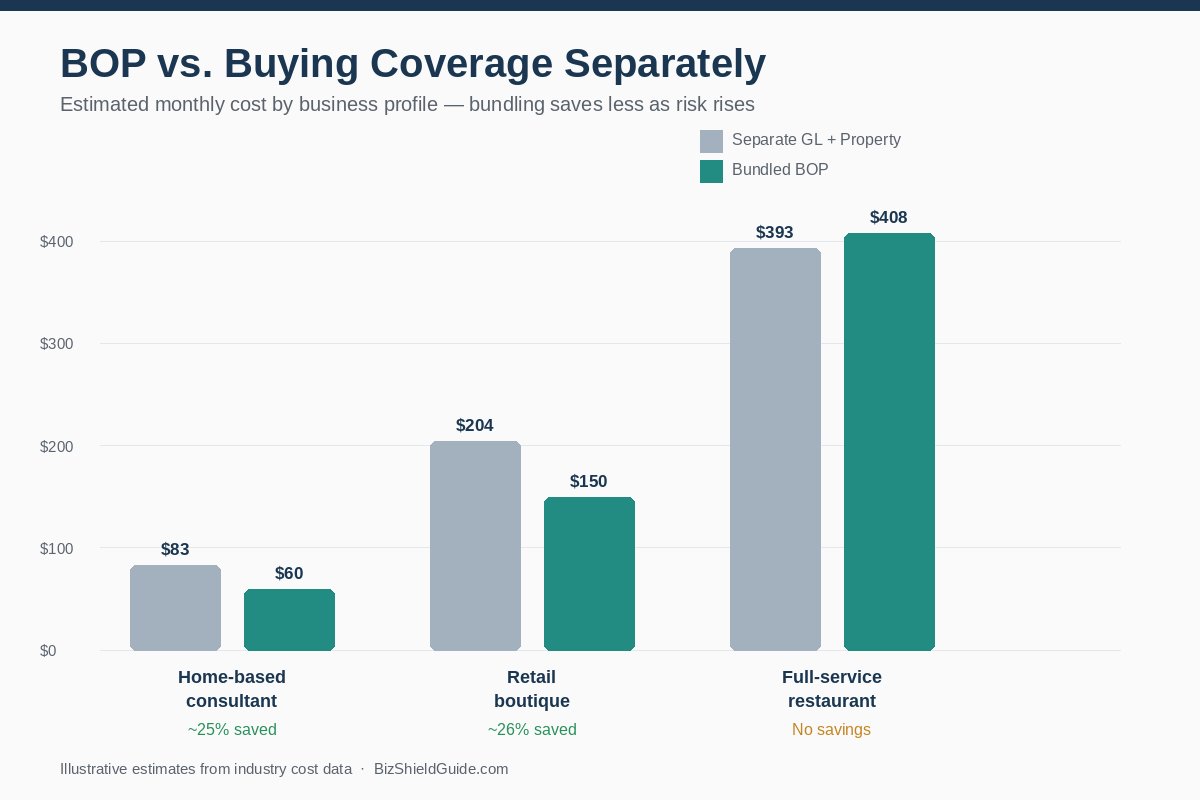
Here’s how that plays out across three illustrative business profiles, built from the ranges above. Treat these as directional, not quotes — your actual premium depends on state, carrier, claims history, and building specifics. If you’re evaluating business owner’s policy, this distinction is worth remembering. That’s the whole point of bundling coverage into a business owner’s policy.
| Business Profile | Standalone GL (est.) | Standalone Commercial Property (est.) | Separate Total (est.) | BOP (est.) | Approx. Savings |
|---|---|---|---|---|---|
| Home-based consultant, no inventory | ~$45–55/mo | ~$25–40/mo (minimal) | ~$70–95/mo | ~$55–64/mo | ~15–30% |
| Small retail boutique, leased storefront | ~$79/mo | ~$125/mo | ~$204/mo | ~$140–160/mo | ~20–30% |
| Full-service restaurant (higher risk) | ~$110–150/mo | ~$225–300/mo | ~$335–450/mo | ~$400–415/mo | Minimal or none |
Notice the pattern: bundling saves the most for lower-risk businesses with modest property exposure, and the advantage shrinks — or disappears — as risk and property value climb. Restaurants are the clearest example; Hartford’s own industry figures put restaurant BOP premiums near $413/month, close to or above what separate policies might cost, and that’s before adding liquor liability, which most restaurants and bars need anyway since it’s excluded from the BOP entirely.
When Buying Coverage Separately Makes More Sense
Bundling isn’t automatically the smarter move. A few situations tend to favor going separate, or at least layering a BOP with additional standalone policies rather than assuming the package handles it: This is exactly the kind of scenario where business owner’s policy matters most. This is exactly why a business owner’s policy exists in the first place.
- You need coverage a BOP excludes by default. Liquor liability, professional liability/E&O, cyber liability, and employment practices liability all require separate policies or endorsements regardless of whether you also carry a BOP.
- Your property risk is unusual or high-value. Specialized equipment, fine art, high-value inventory, or a building that needs individually scheduled coverage often prices out better — and gets broader terms — under a standalone commercial property policy than under a packaged BOP’s blanket limits.
- You don’t need the property piece at all. A fully remote service business with no significant business personal property may find that general liability alone, without paying for bundled property coverage it doesn’t use, is the cheaper path.
- You’ve outgrown BOP eligibility. Once revenue or headcount crosses a carrier’s threshold, or your industry is excluded, separate policies (sometimes a full commercial package policy, or CPP) become the only route.
- A landlord, lender, or franchisor has specific limit or form requirements. Standalone policies are often easier to customize to a required certificate of insurance than a packaged BOP with fixed sublimits.
I’ve also seen the reverse mistake: an owner buys separate GL and property policies out of habit — because that’s what their previous business carried — without ever getting a BOP quote, and leaves real savings on the table for a business that would have qualified easily. Before you decide, make sure you understand business owner’s policy correctly. This is precisely the gap a business owner’s policy is designed to close.
How to Actually Decide (and Shop)
The only reliable way to answer “which saves money” for your specific business is to get both quotes side by side, from the same carrier if possible, since bundled and unbundled pricing for identical coverage limits from the same insurer is the cleanest comparison. A few practical steps: It’s a small detail, but it can make a real difference for business owner’s policy.
- Start with a BOP quote from a carrier that writes your industry — The Hartford, Progressive Commercial, Nationwide, and Travelers all publish BOP eligibility guidelines by industry code.
- Get a separate GL and commercial property quote for the exact same limits (commonly $1 million per occurrence / $2 million aggregate for GL) so you’re comparing equivalent coverage, not just price.
- List every coverage you actually need — liquor liability, E&O, cyber, workers’ comp — and confirm whether each is included, an available endorsement, or requires a fully separate policy either way.
- Ask an independent agent to run both scenarios; agents who write for multiple carriers can often show you the bundled-vs-separate math in one conversation instead of you collecting quotes one at a time.
- Re-shop every renewal. BOP eligibility and pricing shift as your revenue, employee count, and claims history change, and a business that didn’t qualify two years ago might now.
For a typical small retailer, office-based service business, or single-location shop, get the BOP quote first — it’s very likely to come in cheaper than piecing together the same coverage separately. But if you pour drinks, give professional advice, own equipment worth scheduling individually, or you’re brushing up against the size limits carriers use for BOP eligibility, don’t let the bundling instinct skip the separate-policy comparison. Pull both quotes, match the limits, and let the actual numbers — not the assumption that packaging always wins — make the call.
Related Reading
- General Liability Insurance 101: What It Covers and What It Doesn’t for Small Businesses
- How Much Does Small Business Insurance Actually Cost in 2026?
This article is for general informational purposes and isn’t personalized insurance, legal, or financial advice. Coverage rules, costs, and state requirements change, and every business’s risk is different — for decisions specific to your business, talk to a licensed insurance agent. Learn more About BizShieldGuide or reach us via our Contact page. Understanding this point can save you real money when it comes to business owner’s policy.
A business owner’s policy isn’t the right fit for every company, though. Businesses with heavy inventory, a fleet of vehicles, or unusually high liability exposure (like contractors or restaurants with liquor service) often outgrow a standard business owner’s policy fairly quickly and end up layering additional coverage on top anyway. In those cases, a business owner’s policy still makes sense as the base layer, but it shouldn’t be treated as the entire insurance program.
The simplest way to decide is to ask your agent for both quotes side by side: one for a business owner’s policy, and one for the same coverages purchased separately. If the business owner’s policy price is close to (or cheaper than) buying everything piecemeal, and it covers everything you actually need, it’s usually the better deal purely on convenience alone.

About the Author: BizShieldGuide Team
The BizShieldGuide team researches and writes plain-language guides to business and personal insurance — general liability, professional liability, workers' compensation, business owners policies, cyber liability, and industry-specific coverage for small business owners, alongside straightforward explainers on auto, home, and renters insurance for everyday readers. Our articles are grounded in publicly available data from insurers and carriers (Insureon, The Hartford, Progressive, State Farm, and others), industry cost surveys, and standard policy language, and we link to primary sources wherever a number or coverage detail could change. We are not licensed insurance agents or brokers, and nothing here replaces a quote or advice from one for your specific situation.