
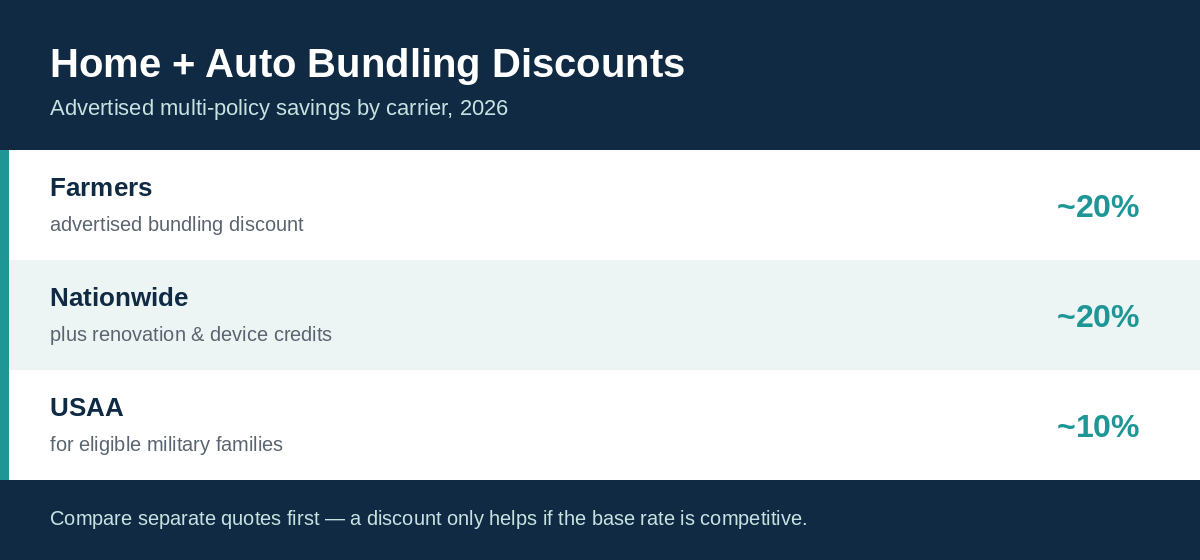
Short answer: bundling home and auto insurance with the same carrier typically saves 10–20% compared to buying the two policies separately, though the exact discount varies a lot by insurer — Farmers and Nationwide advertise around 20% off, while USAA caps its bundling discount closer to 10%. The catch is that the cheapest bundle isn’t always cheaper than the best unbundled combination, so the discount percentage alone doesn’t tell you whether bundling home and auto insurance actually saves you money.
This guide walks through how much bundling home and auto insurance typically saves, when it doesn’t actually pay off, and how to check whether a bundled quote is really the better deal.
How Much Bundling Home and Auto Insurance Actually Saves
Bundling discounts are usually applied as a percentage off your total premium once you hold both a home (or renters) policy and an auto policy with the same company. Farmers and Nationwide both advertise savings of roughly 20% for bundled customers, while USAA — which serves military members and their families — offers up to 10% in bundling savings on top of its already competitive base rates.
These percentages apply to the combined premium, not to each policy individually, and the real dollar savings depend heavily on how much you’re already paying for each policy. A driver with a clean record and a modest home policy will see a smaller dollar benefit from a 20% discount than someone with a higher-risk profile on either policy.
Why Bundling Home and Auto Insurance Doesn’t Always Win
A bundling discount is a percentage off that specific insurer’s rates — it isn’t a guarantee that the insurer’s rates are competitive to begin with. If one company’s baseline auto insurance rate for your profile is significantly higher than a specialist competitor’s, a 20% discount on the expensive policy can still cost more than paying full price with the cheaper insurer and a separate home policy elsewhere.
This is most likely to happen when your driving record, vehicle type, or home’s location makes you a higher-risk profile with one insurer specifically — the bundle can mask that mismatch rather than fix it.
How to Check Whether Your Bundle Is Actually the Better Deal
The only reliable way to know is to get separate quotes for both policies from at least two or three insurers each, then compare that combined total against the bundled quote from a single carrier. Most insurance comparison sites and independent agents can run this comparison for you, and it typically takes less time than the potential savings are worth.
Pay attention to coverage limits and deductibles when comparing, not just the premium — a cheaper bundled quote with a much higher deductible or lower liability limit isn’t actually the better deal, even if the sticker price looks smaller.
Other Discounts That Stack With Bundling
Bundling savings often stack with other discounts rather than replacing them: protective device discounts for home security systems, home renovation credits for updated roofing or plumbing, safe-driver discounts, and low-mileage discounts on the auto side can all apply on top of the bundle percentage. Asking your agent for a full discount checklist before finalizing a bundled policy is worth the five extra minutes, since these stack silently and aren’t always mentioned upfront.
Quick Checklist Before You Bundle
Get at least two separate quotes for your auto policy and two for your home or renters policy before requesting a bundled quote. Compare the combined separate total against the bundled price, not just the percentage discount advertised. Check that deductibles and liability limits match across the comparison — a lower bundled premium with a much higher deductible isn’t really cheaper. Ask specifically about stacking discounts like protective devices, home renovation credits, and safe-driver programs, since these often apply on top of the bundling home and auto insurance discount but aren’t always mentioned by default.
According to the Insurance Information Institute, multi-policy discounts remain one of the most common ways households reduce their overall premium spend, but only when the base rates are competitive to begin with.
Bottom Line
Bundling home and auto insurance saves most people 10–20%, but that discount is only valuable if the underlying insurer’s rates were competitive in the first place. Get separate quotes to establish a baseline, then compare that total against the bundled price before assuming the single-carrier option is automatically cheaper. The right answer depends on your specific risk profile, not just the advertised discount percentage.
Related Reading
- What Does Homeowners Insurance Cover? The Complete 2026 Guide
- Lower Your Car Insurance Premium and Save Big: The Proven 2026 Guide
- Cheapest Car Insurance Companies: The 2026 State-by-State Guide

About the Author: BizShieldGuide Team
The BizShieldGuide team researches and writes plain-language guides to business and personal insurance — general liability, professional liability, workers' compensation, business owners policies, cyber liability, and industry-specific coverage for small business owners, alongside straightforward explainers on auto, home, and renters insurance for everyday readers. Our articles are grounded in publicly available data from insurers and carriers (Insureon, The Hartford, Progressive, State Farm, and others), industry cost surveys, and standard policy language, and we link to primary sources wherever a number or coverage detail could change. We are not licensed insurance agents or brokers, and nothing here replaces a quote or advice from one for your specific situation.