
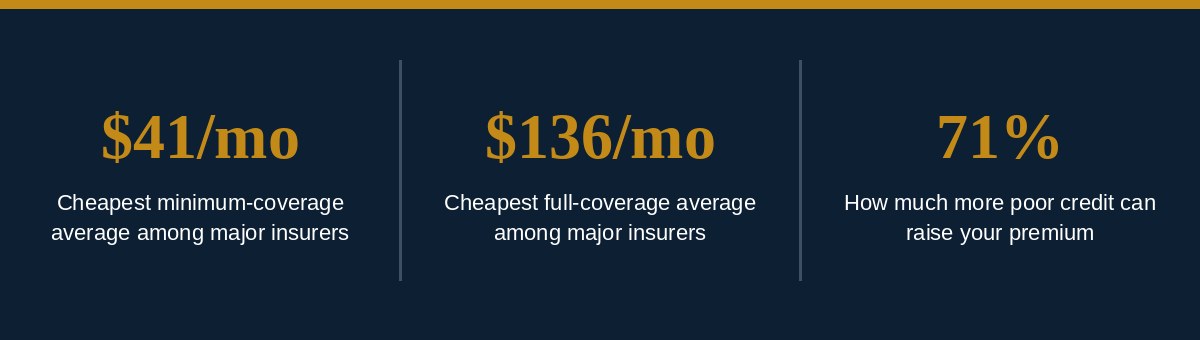
Short answer: among the cheapest car insurance companies in 2026, GEICO and Travelers consistently come out near the top for cost, with GEICO typically cheapest for minimum coverage (around $41/month) and Travelers frequently cheapest for full coverage (around $136/month) — but the honest answer is that “cheapest” is personal, since your age, location, credit history, and driving record can shift which company is actually cheapest for you by a wide margin.
Up front: among the cheapest car insurance companies, your personal quote will still vary by age, location, and driving record.
This guide compares the companies that consistently rank as the cheapest car insurance companies in 2026, breaks down what actually moves your personal price up or down, and covers the concrete steps that lower a quote regardless of which insurer you choose.
Why “Cheapest” Is the Wrong First Question for Some Drivers
Before diving into which companies post the cheapest car insurance companies rankings, it’s worth being clear about what you’re actually optimizing for. If you’re required to carry only state-minimum liability coverage and your car has little resale value, pure lowest-price shopping makes sense.
But for a financed or leased vehicle, a newer car, or a driver who values fast, hassle-free claims handling over saving the last few dollars a month, the cheapest headline rate isn’t automatically the best overall value once you weigh in coverage limits, deductible levels, and how a company has historically handled claims in your state.
Shopping among the cheapest car insurance companies is worth the twenty minutes it takes, since the savings can be substantial.
This article covers both angles: which companies are consistently the cheapest starting point for quotes, and the concrete factors that determine whether “cheapest” and “best for you” actually turn out to be the same company.
The Cheapest Car Insurance Companies in 2026, at a Glance
Industry rate comparisons for 2026 consistently put a small group of national insurers at the top of the “cheapest” list, though the exact ranking shifts depending on whether you’re comparing minimum liability coverage or full coverage.
For full coverage, Travelers has stood out with average annual rates around $1,634, ahead of GEICO (around $2,023), Progressive (around $2,062), and State Farm (around $2,065); USAA is frequently the single cheapest option of all at around $1,588 per year, but it’s only available to military members, veterans, and their families.
For minimum liability coverage, the ranking shuffles — GEICO leads at around $488 per year ($41/month), with Travelers close behind around $537, State Farm around $551, and Progressive around $608. These figures are national averages and will not match your own quote exactly, but they’re a useful starting point for which companies to request quotes from first.
Rate comparisons among the cheapest car insurance companies shift every year, so what was cheapest last year may not be cheapest today.
A Closer Look at Each Insurer
GEICO consistently ranks among the cheapest for minimum liability coverage, with a large enough customer base and direct-to-consumer sales model that helps keep overhead, and therefore price, competitive; it’s a strong first quote to get for drivers prioritizing the lowest possible legal minimum.
Travelers frequently posts the lowest full-coverage average among major national insurers and tends to price competitively across a range of driver ages, making it a strong all-around comparison quote rather than a specialist in one narrow profile.
Progressive is generally not the single cheapest option in most comparisons but is known for usage-based telematics programs and a wide range of discount opportunities that can close the gap for drivers willing to opt into usage tracking.
State Farm combines a large network of local agents with generally competitive pricing, which appeals to drivers who prefer in-person service over a purely digital experience.
USAA is frequently the single cheapest option across both minimum and full coverage in rate comparisons, but eligibility is restricted to active-duty military, veterans, and their immediate family members, which rules it out for most drivers regardless of how competitive its pricing is.
Why the Same Driver Gets Different Prices From Different Insurers
Car insurance pricing isn’t standardized the way a lot of consumers assume — each insurer weighs the same risk factors differently based on its own claims data and underwriting model, which is exactly why shopping around produces real savings rather than roughly the same quote everywhere.
One insurer might weight your credit history heavily while another weights your ZIP code’s claims history more; one might offer a steep discount for bundling home and auto while another doesn’t emphasize it. This is the core reason financial advisors and insurance comparison sites consistently recommend getting quotes from at least three to five insurers rather than trusting a single company’s rate or a “cheapest overall” ranking as automatically true for your specific situation.
Most drivers assume the cheapest car insurance companies are the same everywhere, but pricing varies significantly by state and personal risk factors.
What Actually Moves Your Price
A handful of factors do most of the work in determining your personal rate, and understanding them tells you where you actually have some control. Age matters substantially: rate comparisons show young drivers paying dramatically more (reported around $300/month with some insurers) than middle-aged drivers (commonly $120–140/month), reflecting insurers’ data on accident rates by age group.
Driving record moves the needle sharply too — a single speeding ticket has been shown to push a monthly rate up by roughly $40–50 on average, an at-fault accident by more, and a DUI conviction substantially more still, often adding well over $100/month depending on the state and insurer.
Credit history is a bigger factor than many drivers realize in states that allow its use for pricing — comparisons show drivers with poor credit paying on the order of 70% more than otherwise-identical drivers with good credit. Location matters enormously too, with state-level averages varying by more than $100/month between higher-cost and lower-cost states, driven by differences in accident rates, repair costs, and state minimum coverage requirements.
If you only remember one thing about the cheapest car insurance companies, remember this: always compare identical coverage limits before calling anything cheaper.
State-by-State Cost Differences
Where you live has an outsized effect on your quote, sometimes more than any single personal factor besides driving record. Rate comparisons for 2026 show state averages ranging widely — Georgia, for example, has averaged around $261/month for a standard profile, while Alaska has averaged around $137/month for essentially the same coverage, a gap driven by differences in state minimum coverage requirements, local accident and theft rates, litigation environment, and the cost of vehicle repairs in a given region.
This is exactly why a national “cheapest company” ranking is only a starting point — the cheapest insurer nationally isn’t necessarily the cheapest in your specific state, since insurers price state-by-state based on their own claims data for that market, not a single nationwide number. Always request quotes from the specific companies available and licensed in your own state rather than assuming a national average applies directly to you.
Special Situations: Young Drivers, High-Risk Drivers, and Seniors
A handful of driver profiles face meaningfully different shopping strategies. Young drivers (especially teens and drivers in their early twenties) face the highest rates of any age group, reflecting insurers’ accident-rate data for that group; staying on a parent’s policy as an added driver, maintaining good grades (many insurers offer a good-student discount), and choosing an older, less powerful car can all meaningfully offset the age-related premium.
None of the cheapest car insurance companies will automatically apply every discount you qualify for, so it pays to ask directly.
Drivers with a recent at-fault accident, DUI, or multiple violations are considered high-risk and may find some standard insurers unwilling to offer competitive rates at all, making it worth specifically comparison-shopping insurers known for serving higher-risk drivers rather than assuming every company prices this segment the same way.
Senior drivers sometimes see rates tick back up after a long stretch of relatively stable pricing through middle age, reflecting insurer data on age-related risk factors; maintaining a clean record and asking specifically about senior or long-time-customer discounts can help offset this.
Minimum Coverage vs Full Coverage: Which Should You Buy?
Every state sets a minimum required liability coverage, and buying only that minimum is the cheapest legal option — but it’s not necessarily the wise one. Minimum liability coverage pays for damage and injuries you cause to others; it does not pay to repair or replace your own car after an accident that’s your fault, nor does it typically cover your car for theft, vandalism, or weather damage.
Full coverage adds collision (your car, in an at-fault accident) and comprehensive (theft, weather, and other non-collision damage) on top of liability.
Getting quotes from several of the cheapest car insurance companies at once is the only reliable way to know your actual best rate.
As a general rule of thumb, if your car is worth more than a few thousand dollars, or if you’re still financing or leasing it (most lenders require full coverage as a loan condition), full coverage is usually worth the added cost.
For an older car worth relatively little, some drivers reasonably decide the cost of comprehensive and collision isn’t worth it relative to the car’s value — a decision worth revisiting periodically as your car ages and its value drops.
How Much Coverage Do You Actually Need Beyond the Minimum?
Most states set liability minimums that are lower than what many financial advisors consider genuinely adequate protection, since a serious accident can easily generate medical and repair costs well above a bare-minimum policy limit — leaving you personally on the hook for the difference if you’re at fault.
A common recommendation is carrying liability limits closer to $100,000 per person and $300,000 per accident for bodily injury, rather than a state’s lower legal minimum, especially if you have meaningful assets (a home, savings) that a lawsuit following a serious accident could otherwise put at risk.
This costs more per month than bare-minimum coverage, but the gap is often smaller than drivers expect, and it’s worth pricing out explicitly rather than defaulting to the legal minimum simply because it’s the cheapest checkbox on the quote form.
How to Actually Lower Your Quote
A few concrete actions reliably lower a car insurance quote regardless of which company you choose. Raising your deductible — the amount you pay out of pocket before coverage kicks in on a claim — lowers your premium in exchange for more risk if you do have to file a claim; this trade-off makes the most sense if you have savings to cover the higher deductible comfortably.
Bundling auto with renters or homeowners insurance through the same company frequently unlocks a meaningful multi-policy discount.
Many insurers offer usage-based or telematics programs that track driving habits (braking, speed, mileage) through an app or device in exchange for a discount for demonstrably safe driving — worth considering if you’re a genuinely cautious driver.
Maintaining good credit where your state allows it to be used in pricing, keeping a clean driving record, and simply re-shopping your rate every year or two (since loyalty rarely earns you a lower renewal price the way it does with some other services) round out the list of levers actually within your control.
Discounts Worth Asking About
Beyond the big levers already covered, most insurers offer a longer list of smaller discounts that add up, and none of them apply automatically — you generally have to ask or check the boxes yourself during the quote process.
Common ones include a multi-car discount for insuring more than one vehicle on the same policy, a good-student discount for young drivers maintaining a strong GPA, a defensive-driving-course discount in states where completing an approved course qualifies, a low-mileage or occasional-driver discount for anyone who doesn’t commute daily, safety-feature discounts for cars with anti-lock brakes, airbags, or anti-theft systems, and a paperless or autopay discount simply for enrolling in electronic billing.
Individually small, these discounts can meaningfully lower a quote when several apply at once, which is part of why getting a fresh, detailed quote (rather than assuming your current policy already reflects every discount you qualify for) is worth the twenty minutes it takes.
Common Mistakes When Shopping for Cheap Car Insurance
The most common mistake is comparing quotes with different coverage limits and calling the lower number “cheaper” — a quote with lower liability limits or a higher deductible will always look cheaper than one with more robust coverage, so the only fair comparison is quotes built on identical coverage limits and deductibles across every insurer.
A second common mistake is letting a policy auto-renew year after year without re-shopping, since insurers routinely raise renewal rates gradually in ways that go unnoticed until you compare against what a new customer would pay for the same coverage.
Drivers also frequently overlook discounts they already qualify for — good student discounts, low-mileage discounts, safety-feature discounts, and multi-policy bundling are commonly underclaimed simply because the driver never asked. Finally, choosing the cheapest available policy without checking the insurer’s claims-handling reputation and financial strength rating can be a false economy — the cheapest premium isn’t a bargain if the company is slow or difficult during an actual claim.
Frequently Asked Questions
Is the cheapest car insurance company always the best choice? Not necessarily — price is one factor, but claims-handling reputation, financial strength, and customer service matter too, especially since the real test of an insurer is how it behaves when you actually need to file a claim, not just its sticker price.
How often should I shop around for car insurance? Most advisors recommend comparing quotes at least once a year, or any time a major life event occurs (moving, buying a new car, a change in driving record), since rates and relative rankings between insurers shift over time.
Does my credit score really affect my car insurance rate? In most states, yes, sometimes substantially — though a handful of states restrict or prohibit using credit in auto insurance pricing, so whether this applies to you depends on where you live.
Will switching car insurance companies leave a gap in my coverage? Not if you time it correctly — start your new policy’s effective date on or before your current policy’s cancellation date, and most insurers will help coordinate the switch so there’s no lapse.
Do usage-based telematics programs actually save money? For genuinely safe, low-mileage drivers, often yes — but the programs track real driving behavior (hard braking, speeding, late-night driving), so a driver with riskier habits could see a rate increase rather than a discount once the program has enough data, which is worth knowing before opting in.
Is it cheaper to pay for car insurance annually or monthly? Many insurers charge a small installment fee for monthly payments, so paying the full six-month or annual premium upfront, if you can afford to, is often modestly cheaper over the course of a year than paying month to month.
To recap, the cheapest car insurance companies for you personally may not match the national ranking, so always request your own quotes before deciding.
Bottom Line
Among the cheapest car insurance companies in 2026, GEICO and Travelers are consistently strong starting points, and USAA is worth checking first if you qualify through military service — but the only way to actually know your cheapest option is to get quotes from several insurers using identical coverage limits, since your personal rate depends heavily on factors specific to you rather than any single “cheapest overall” ranking.
Combine comparison shopping with the concrete levers covered above — deductible choice, bundling, telematics programs, and an annual re-shop — and most drivers can meaningfully lower what they pay without reducing the coverage that actually protects them.
One last note: even among the cheapest car insurance companies, rates change with life events, so re-shop annually rather than assuming your rate stays competitive.
Related Reading
National Association of Insurance Commissioners • Consumer Financial Protection Bureau • About BizShieldGuide
Rates cited in this article are national averages from industry rate comparisons as of publication and will not match every driver’s actual quote. This article does not provide personalized insurance advice; always confirm current rates and coverage details directly with a licensed insurance agent or company before purchasing a policy.

About the Author: BizShieldGuide Team
The BizShieldGuide team researches and writes plain-language guides to business and personal insurance — general liability, professional liability, workers' compensation, business owners policies, cyber liability, and industry-specific coverage for small business owners, alongside straightforward explainers on auto, home, and renters insurance for everyday readers. Our articles are grounded in publicly available data from insurers and carriers (Insureon, The Hartford, Progressive, State Farm, and others), industry cost surveys, and standard policy language, and we link to primary sources wherever a number or coverage detail could change. We are not licensed insurance agents or brokers, and nothing here replaces a quote or advice from one for your specific situation.