
Small business insurance bundles save money by combining policies you’d otherwise buy separately into one package with one renewal date. There’s no single “starter pack” that fits every small business, because the risks that sink a boutique aren’t the risks that sink a plumbing outfit. A retail shop mostly worries about a customer slipping on a wet floor and a laptop full of card numbers walking out the door. A restaurant worries about grease fires, cut fingers, and a drunk patron who crashes into a mailbox on the way home. It’s worth revisiting small business insurance bundles every year as your business changes.
A contractor worries about a nail gun accident and a stolen trailer of tools. A consultant worries about a client claiming bad advice cost them six figures. Insureon’s 2025-2026 policyholder data show why the range is so wide. Before you decide, make sure you understand small business insurance bundles correctly.
Retail Stores: Property and Liability First, Cyber Close Behind
A storefront’s core exposure is physical: people walking through the door, inventory sitting on shelves, and a building that could flood or burn. That’s what a business owner’s policy (BOP) is built for — it bundles general liability with commercial property coverage at a lower combined rate than buying each separately. According to Insureon’s retail insurance cost data, retailers pay an average of $95 per month for a BOP ($1,136 annually) versus $42 per month for general liability alone, which tells you the property piece is usually worth bundling in.
What Rounds Out the Retail Stack
Once you’ve hired even one part-time employee, workers’ compensation becomes non-negotiable in nearly every state — retailers pay a median of $86 per month, or roughly $1,036 a year, per Insureon. Requirements and exemptions vary by state, so check your state’s threshold before assuming you’re exempt; the NAIC’s workers’ compensation overview is a decent starting point. Cyber liability is the newer addition to the retail bundle — any shop running a point-of-sale system or storing customer payment data is a target, and Insureon puts the average cost at $57 per month. Commercial auto only enters the picture with deliveries; otherwise it’s rarely needed for a fixed-location store.
- Essential: BOP (general liability + commercial property), workers’ compensation once you have staff
- Common: cyber liability, especially with a POS system or e-commerce arm
- Rarely needed: commercial auto (unless delivering), liquor liability (unless selling alcohol), professional liability
A starter bundle of BOP plus workers’ comp for a single-location shop with a couple of employees typically lands around $150–$250 a month before adding cyber coverage; add that in and $200–$300 is a realistic range for most independent retailers. It’s a small detail, but it can make a real difference for small business insurance bundles.
Restaurants and Food Service: The Most Layered Bundle of the Four
Restaurants carry more overlapping risk than any other category here — kitchens injure people, alcohol changes liability exposure, and the building is full of expensive equipment. It shows in the price: Insureon reports restaurants pay an average of $251 per month for a BOP, more than double the retail figure, and $141 per month for general liability alone. Workers’ comp runs about $113 a month, reflecting a genuinely higher injury rate from burns, cuts, and slip-and-falls in a working kitchen. This is one reason small business insurance bundles vary so much by industry.
Liquor Liability Isn’t Optional If You Pour
Any restaurant serving alcohol needs liquor liability, separate from general liability, because most general liability policies exclude alcohol-related claims outright. Most states have some form of “dram shop” law that can hold a bar or restaurant financially responsible for harm caused by an intoxicated patron, and Insureon’s dram shop law breakdown is worth a look before assuming your state doesn’t apply. The average premium is about $41 a month, but Insureon’s data shows a wide spread — from around $150 to well over $4,000 a year — depending on how much of your revenue comes from alcohol sales and claims history.
I’ve reviewed coverage stacks for restaurant owners who bundled everything except liquor liability, figuring general liability “probably covers it.” It doesn’t, and a single dram shop claim can exceed a general liability limit fast. Delivery-heavy concepts also need commercial auto (around $181 per month per Insureon) unless drivers rely entirely on a gig platform’s own coverage. That’s a detail worth double-checking with your broker on small business insurance bundles.
- Essential: BOP, workers’ compensation, liquor liability if alcohol is served
- Common: commercial auto for delivery, cyber liability for POS/online ordering systems
- Rarely needed: professional liability, inland marine (unless catering with mobile equipment)
Stack BOP, workers’ comp, and liquor liability together and a typical full-service restaurant lands somewhere in the $350–$550 monthly range for a starter package, before delivery-related auto coverage. If you’re evaluating small business insurance bundles, this distinction is worth remembering.
Contractors and Trades: Liability, Comp, and the Tools in the Truck
Contractors face the most “hard requirement” coverages of any group here, largely because general contractors, property managers, and licensing boards routinely demand proof of insurance before a sub can even bid a job. General liability averages $162 per month for general contractors per Insureon’s contractor cost data, and workers’ compensation — driven by the physical risk of the work — averages $196 monthly, the highest workers’ comp figure across the four industries here. Most brokers will tell you this is the first thing to check with small business insurance bundles.
Don’t Skip the Tools
Inland marine coverage for tools and equipment is where a lot of small contracting operations under-insure. It’s relatively cheap — Insureon puts the average at $42 per month — but it pays out when a job-site trailer gets broken into or a generator disappears overnight. The Hartford’s contractor’s equipment coverage overview explains why standard property policies won’t cover tools once they leave a fixed location, which is exactly the gap inland marine closes. I’ve reviewed coverage stacks for contractors who skipped tools and equipment coverage because it felt like an “extra,” then had to replace a stolen trailer of equipment out of pocket — a five-figure mistake a policy costing under $50 a month would have absorbed.
Commercial auto is essential rather than optional here, since work trucks and trailers are constantly on the road and mixing business and personal auto policies is a common way to end up with a denied claim; Insureon’s average for general contractors is $287 monthly. Contractors doing design-build work sometimes carry professional liability too (around $67 per month), since a design error is a different exposure than a physical injury claim. That’s the single biggest factor that shapes small business insurance bundles.
- Essential: general liability, workers’ compensation, commercial auto
- Common: tools and equipment (inland marine), builder’s risk for active projects
- Rarely needed: liquor liability, and professional liability outside of design-build work
A realistic starter bundle — general liability, workers’ comp, and tools/equipment coverage — runs roughly $400 a month for a small crew; add a couple of work trucks and $600–$700 monthly is a more accurate all-in figure. Many owners overlook this detail when comparing small business insurance bundles.
Consultants and Professional Service Firms: Lean on the Property Side, Heavy on the Advice Side
Flip the retail and contractor logic on its head for consultants. There’s usually no storefront, no inventory, and often no employees beyond the owner, so property and workers’ comp exposure shrink dramatically. What doesn’t shrink is the risk a client claims your advice, deliverable, or missed deadline cost them money — that’s what professional liability, also called errors and omissions (E&O), is for. Insureon’s consulting cost data shows consultants paying an average of $62 per month, with annual costs ranging from around $400 to over $3,750 depending on the type of consulting and limits chosen.
General liability is cheap for this group — about $32 per month — but many consultants still need it, not because their own risk profile demands it but because commercial leases and client contracts frequently require proof of a policy before anything gets signed. Cyber liability is the coverage most independent consultants underestimate; if you’re handling client financial data, HR records, or proprietary strategy documents on a laptop, a breach notification obligation can get expensive fast. Insureon’s average is $81 per month for consultants specifically, running as high as $6,500 a year at the top end.
- Essential: professional liability/E&O
- Common: general liability (often contractually required), cyber liability, BOP if leasing office space
- Rarely needed: workers’ compensation (solo/contractor-only firms), commercial auto, inland marine
A lean but sensible starter bundle for a solo or small consulting firm — E&O plus general liability — comes out to roughly $90–$150 a month; add cyber liability and $170–$230 is a more complete number for firms handling client data. This is one of the most common questions we hear about small business insurance bundles.
Building Your Own Stack If Your Business Doesn’t Fit Neatly Into One Category
Plenty of real businesses straddle these categories — a food truck is part restaurant, part mobile operation with commercial auto needs; a design-build contractor is part tradesperson, part consultant; a boutique that also offers in-home styling consultations mixes retail and professional-service risk. When that’s the case, work outward from what’s non-negotiable rather than searching for a pre-packaged bundle that matches your business card. This nuance comes up constantly in small business insurance bundles conversations with clients.
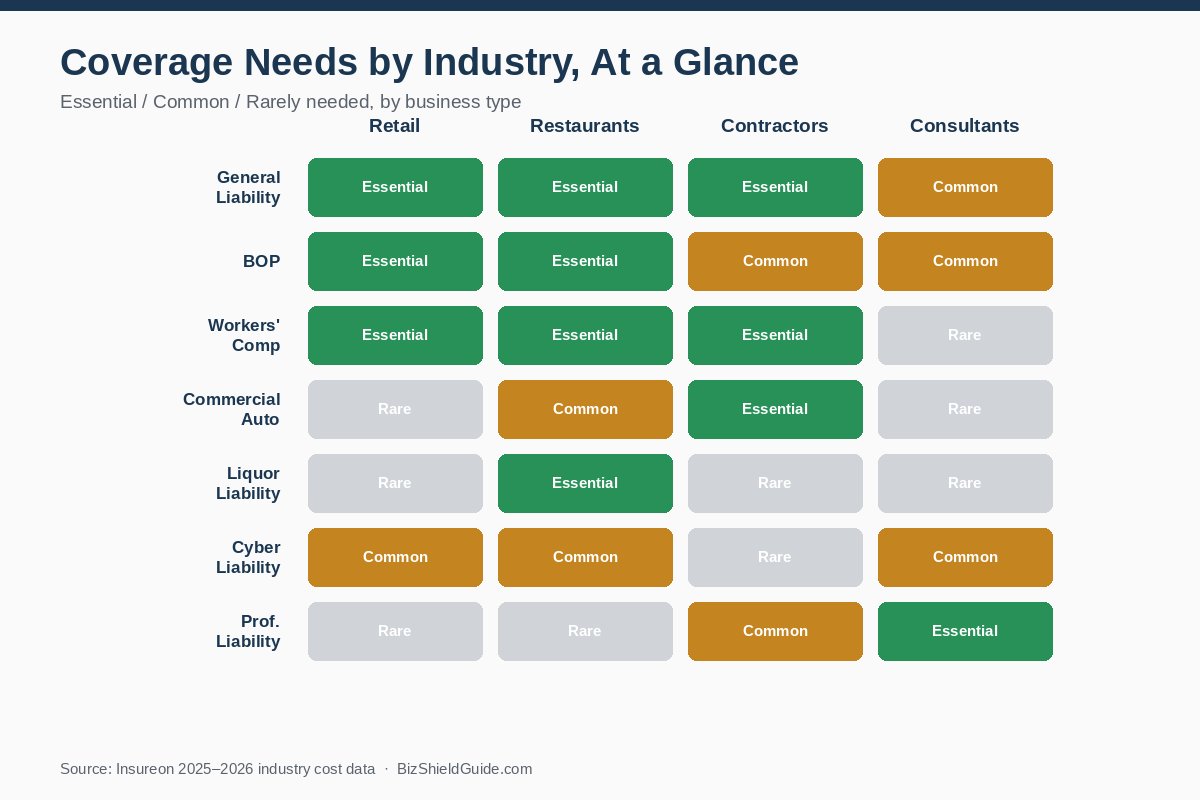
The table below lines up nine common coverage types against the four industries covered here, as a quick reference for where each typically falls. This is exactly the kind of scenario where small business insurance bundles matters most.
| Coverage Type | Retail | Restaurants | Contractors | Consultants |
|---|---|---|---|---|
| General liability | Essential | Essential | Essential | Common |
| BOP (GL + property bundle) | Essential | Essential | Common | Common |
| Workers’ compensation | Essential once staffed | Essential | Essential | Rarely needed (solo firms) |
| Commercial property | Essential | Essential | Common | Rarely needed |
| Professional liability / E&O | Rarely needed | Rarely needed | Common (design-build) | Essential |
| Commercial auto | Rarely needed | Common (delivery) | Essential | Rarely needed |
| Liquor liability | Rarely needed | Essential if serving alcohol | Rarely needed | Rarely needed |
| Inland marine / tools & equipment | Rarely needed | Rarely needed | Common | Rarely needed |
| Cyber liability | Common | Common | Rarely needed | Common |
If your business doesn’t map cleanly onto one column, build from three questions: What does your state or landlord legally require (usually workers’ comp and, often, general liability)? What does a single bad incident cost with zero coverage (this is where property and liability limits earn their keep)? And what coverage would you be embarrassed to explain skipping after a claim — for most hybrid businesses, that turns out to be cyber liability or inland marine, the two categories owners consistently underestimate until something goes missing or gets hacked. An independent agent working across industries, or a marketplace like Insureon, can usually quote a genuinely custom bundle rather than forcing a hybrid business into a category it doesn’t fit.
Whatever combination you land on, treat the first policy year as a baseline, not a final answer — revisit it annually as revenue, headcount, and equipment change, since a gap that didn’t matter at $150,000 in revenue can matter a great deal at $500,000. Understanding this point can save you real money when it comes to small business insurance bundles.
Related Reading
- Cyber Liability Insurance 101: What It Covers and Why Small Businesses Can’t Ignore It Anymore
- Business Owner’s Policy (BOP) vs. Buying Coverage Separately: Which Saves You Money?
This article is for general informational purposes and isn’t personalized insurance, legal, or financial advice. Coverage rules, costs, and requirements change, and every business’s risk is different — for decisions specific to your business, talk to a licensed insurance agent. Learn more About BizShieldGuide or reach us via our Contact page. Keep this in mind the next time you shop for small business insurance bundles.
The most common small business insurance bundles pair general liability with commercial property into a business owner’s policy, then layer on workers’ compensation once you hire your first employee. Industry-specific small business insurance bundles go further: a restaurant package usually adds liquor liability, while a contractor package adds commercial auto and tools coverage.
Shopping small business insurance bundles side by side against separate policies is the only way to know which actually saves money for your situation — bundling isn’t automatically cheaper, but it usually is once you need three or more of the underlying coverages anyway.

About the Author: BizShieldGuide Team
The BizShieldGuide team researches and writes plain-language guides to business and personal insurance — general liability, professional liability, workers' compensation, business owners policies, cyber liability, and industry-specific coverage for small business owners, alongside straightforward explainers on auto, home, and renters insurance for everyday readers. Our articles are grounded in publicly available data from insurers and carriers (Insureon, The Hartford, Progressive, State Farm, and others), industry cost surveys, and standard policy language, and we link to primary sources wherever a number or coverage detail could change. We are not licensed insurance agents or brokers, and nothing here replaces a quote or advice from one for your specific situation.