
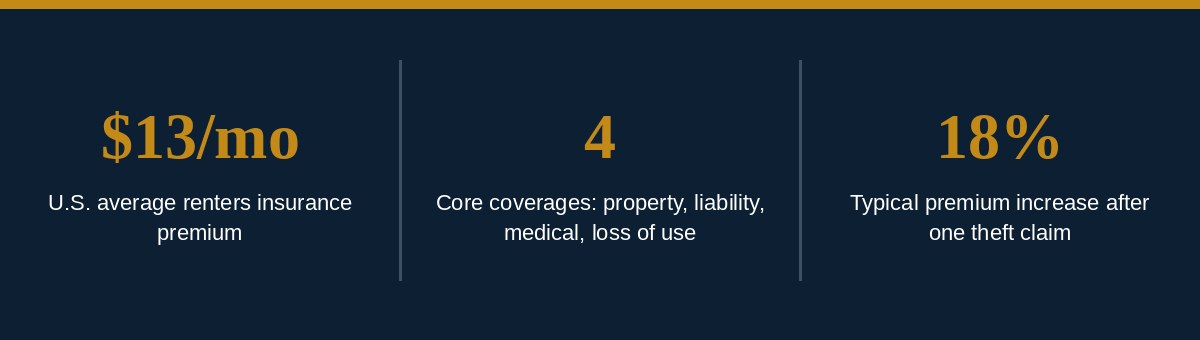
Short answer: renters insurance 101 comes down to this — for around $13 a month on average, a standard policy covers your personal belongings against theft and covered disasters, protects you financially if someone is injured in your rental or you accidentally damage someone else’s property, and pays for a hotel and other extra costs if you’re temporarily displaced by a covered event.
Most renters go without it because they assume their landlord’s insurance covers their stuff (it doesn’t — that policy only covers the building itself) or because they underestimate how cheap renters insurance actually is relative to what it protects. This guide covers exactly what a standard policy includes, what it typically costs, and how to actually get the right amount of coverage.
Who Renters Insurance 101 Is Actually For
If you rent an apartment, house, condo, or even a room and don’t own the building, this applies to you regardless of how much you own or how long you plan to stay.
Some renters assume insurance isn’t worth it because they don’t own much of value, but between electronics, clothing, furniture, and everyday belongings, most people underestimate what a full replacement would actually cost until they’re forced to add it up — and the liability protection alone (covering an injured guest or accidental damage to someone else’s property) is often worth the modest premium on its own, independent of how much personal property coverage you think you need.
Why Your Landlord’s Insurance Doesn’t Cover You
This is the single most common misunderstanding driving low renters insurance adoption. A landlord’s property insurance policy covers the physical building — the structure itself, and sometimes appliances or fixtures the landlord owns — but it does not cover your personal belongings, and it does not protect you if you’re personally liable for an injury or damage that occurs inside your rented unit.
If a pipe bursts and ruins your furniture, if your apartment is broken into, or if a guest slips and injures themselves in your unit, your landlord’s policy simply doesn’t apply to any of that — you’re financially exposed unless you have your own renters policy.
This gap is exactly what renters insurance is designed to close, and it’s worth internalizing clearly: “the building is insured” and “your stuff and your liability are insured” are two completely separate things. Understanding this renters insurance 101 basic — that the landlord’s policy and your policy are separate — prevents a lot of surprise later.
What a Standard Renters Insurance Policy Actually Covers
Most standard policies bundle four core types of protection.
Personal property coverage reimburses you if your belongings — furniture, electronics, clothing, and so on — are stolen or damaged by a covered event like fire, theft, or certain kinds of water damage, subject to your policy’s deductible and coverage limit.
Liability coverage protects you financially if you’re found responsible for someone else’s injury or property damage — a common example is a guest being injured in your apartment, or your dog biting a visitor — covering legal costs and damages up to your policy limit.
Medical payments coverage is a smaller, no-fault component that pays a guest’s medical bills if they’re injured on your property, regardless of who was at fault, without requiring a liability claim or lawsuit.
Loss of use coverage (sometimes called additional living expenses) pays for a hotel, meals, and other reasonable extra costs if a covered disaster makes your rental temporarily uninhabitable while it’s being repaired. Together, these four categories are the backbone of what “renters insurance 101” actually means in practice.
What Renters Insurance Does Not Cover
Just as important as what’s included is what’s typically excluded, since assuming a policy covers something it doesn’t is how people end up with an unpleasant surprise at claim time. Standard policies commonly exclude flood damage and earthquake damage, both of which typically require separate, specific add-on policies if you live in a risk area for either.
Many policies also exclude or sharply limit coverage for extremely high-value items — expensive jewelry, fine art, or high-end camera equipment — beyond a fairly modest built-in sublimit, unless you add a scheduled personal property endorsement specifically listing and insuring those items.
Damage from normal wear and tear, pest infestations, and your own routine maintenance neglect generally aren’t covered either, since insurance covers sudden, accidental events rather than gradual deterioration. Always read your specific policy’s exclusions list rather than assuming any of the general patterns above apply exactly to your particular policy. Knowing these limits is part of renters insurance 101.
How Much Does Renters Insurance Actually Cost?
Nationally, the average renters insurance policy runs around $151 per year, or roughly $13 per month, for a fairly standard profile: a policy with $30,000 in personal property coverage, $100,000 in liability coverage, and a $500 deductible. That’s a useful benchmark, but actual cost varies meaningfully based on where you live — state averages have ranged from around $101/year in lower-risk states like Alaska to $266/year or more in higher-risk states like Louisiana, reflecting differences in local crime rates and natural disaster exposure.
Your own price will also move based on your specific coverage limits, deductible choice, claims history, credit history in states that allow its use, and whether you own pets, particularly larger or certain breeds some insurers price differently. Even at the higher end of these ranges, renters insurance remains one of the least expensive types of insurance most people can buy, especially relative to the actual replacement cost of an apartment’s worth of belongings. This national average is a core renters insurance 101 number worth remembering.
Natural Disasters and Renters Insurance: What’s Actually Included
Standard renters insurance policies typically cover a specific, named list of disaster events — commonly fire, smoke damage, windstorms, hail, lightning, theft, vandalism, and certain kinds of water damage like a burst pipe. What’s usually excluded, and this trips up a meaningful number of renters after the fact, is flood damage from external water (rising water from a storm or nearby body of water) and earthquake damage, both of which almost always require a separate, specific policy or endorsement rather than being bundled into a standard renters policy.
If you live somewhere with meaningful flood or earthquake risk, it’s worth explicitly asking your insurer or agent whether either add-on makes sense for your specific location, since assuming a standard policy already covers these events is one of the more expensive mistakes a renter can make. This distinction is one of the more commonly misunderstood parts of renters insurance 101.
How Much Coverage Do You Actually Need?
The most reliable way to size your personal property coverage is a rough home inventory rather than a guess: walk through your rental room by room, estimating the replacement cost (not the depreciated current value) of your furniture, electronics, clothing, and other belongings, and total it up. Many renters are surprised the number lands higher than they expected once everything is actually added up — a modestly furnished one-bedroom apartment easily totals $20,000–30,000 in replacement value once clothing, electronics, kitchenware, and furniture are all counted.
For liability coverage, $100,000 is a common default minimum, but renters with more savings or assets to protect — and therefore more to lose in a lawsuit following a serious injury on their property — often reasonably choose $300,000 or higher, since the incremental cost of higher liability limits is usually modest relative to the base policy price. Getting this number right is one of the more practical renters insurance 101 steps.
Replacement Cost vs Actual Cash Value: A Distinction That Matters
One policy detail meaningfully affects what you actually collect on a claim: whether your policy pays replacement cost or actual cash value for your belongings. Replacement cost coverage pays what it actually costs to buy a new equivalent item today. Actual cash value coverage pays the depreciated value of your old item — meaning a five-year-old laptop or couch is reimbursed at its current used-market value, not what a new equivalent would cost, which can leave a meaningful gap between your payout and what you’d actually need to spend to replace the item.
Replacement cost policies cost somewhat more in premium, but most insurance advisors consider the difference worth paying for exactly this reason — check which type your policy quote is offering before assuming a low premium is automatically the better deal. This is one of the finer points of renters insurance 101 that’s easy to miss.
Renters Insurance and Roommates: What You Need to Know
Renters insurance policies are generally written to cover the named policyholder and their belongings specifically — a roommate who isn’t named on the policy typically isn’t covered for their own belongings or liability under your policy, even though you share the same address.
Most insurers allow adding a roommate as a co-insured for an additional cost, or the roommate can simply buy their own separate policy covering their own belongings at that same address — either approach works, but assuming one renter’s policy automatically protects everyone living in the unit is a common and costly misunderstanding. If you’re moving in with a roommate for the first time, it’s worth having this conversation explicitly rather than assuming it’s already handled. This is a frequently asked renters insurance 101 question.
Filing a Claim: What to Expect
If you ever need to actually use your policy, the process generally follows a predictable path. Document the loss immediately — photos of damaged property, a police report for theft or break-ins, and a written list of affected items with estimated values. Contact your insurer promptly to start the claim, since most policies specify a window for reporting a loss and delaying can complicate the process.
An adjuster may review the claim, particularly for larger losses, and will typically ask for receipts, photos, or other documentation supporting the value of what was lost, which is exactly why keeping a running home inventory (even just photos and a spreadsheet, updated after major purchases) makes a real claim significantly smoother than trying to reconstruct everything you owned from memory after a fire or burglary.
Once approved, payout timing depends on the insurer and claim complexity, but straightforward claims with good documentation generally move faster than ones requiring extensive follow-up. Following this process is part of renters insurance 101 preparedness.
Renters Insurance for Specific Situations
A few common situations are worth addressing directly. College students living off-campus generally need their own renters policy the same as any other renter — a common myth is that a parent’s homeowners policy automatically extends coverage to an off-campus apartment, and while some homeowners policies do offer limited extended coverage for a dependent’s dorm room specifically, this typically does not apply to an off-campus rental, making a separate renters policy the safer assumption.
Pet owners should specifically ask about dog-bite liability coverage, since some insurers exclude certain breeds from standard liability coverage or require a separate rider, which is worth confirming before assuming your policy covers a bite incident involving your dog.
Renters with a home business, even a small one, should ask specifically about business property and liability coverage, since a standard renters policy typically offers only limited or no coverage for business equipment or business-related liability claims, which may require a separate business policy or rider entirely. Each of these scenarios is a common renters insurance 101 edge case.
Common Mistakes Renters Make
The most common mistake is simply not buying a policy at all, often because of the landlord’s-insurance misunderstanding covered above, or because the cost is assumed to be higher than the roughly $13/month national average actually is. A second common mistake is underestimating personal property value without doing an actual inventory, leading to a coverage limit that wouldn’t fully replace everything lost in a serious event like a fire.
Renters also frequently forget to update their policy after a significant purchase — a new laptop, a nicer TV, an engagement ring — leaving newer, valuable items effectively under-insured relative to the policy’s original coverage limit. And some renters choose actual cash value coverage without realizing it, simply because the premium looked slightly cheaper, without understanding the gap that creates at claim time compared to replacement cost coverage. Avoiding these mistakes is central to renters insurance 101.
How to Actually Get a Policy
Getting renters insurance is usually a quick process: most insurers let you get a quote online in a few minutes by entering your address, desired coverage limits, and a few details about the property, with a policy able to start within a day or two of purchase (many landlords require proof of coverage before or shortly after move-in, so this is worth doing before your lease start date rather than after).
Bundling renters insurance with an existing auto policy through the same insurer is one of the most reliable ways to get a discount on both, and is worth asking about specifically even if you weren’t planning to switch auto insurers. Because renters insurance is inexpensive enough that price differences between insurers are usually small in absolute dollar terms, it’s reasonable to prioritize an insurer’s claims-handling reputation and ease of the online/app experience alongside price when choosing where to buy. This final step completes the renters insurance 101 checklist.
Frequently Asked Questions
Is renters insurance legally required? Not by law in most places, but many landlords require proof of renters insurance as a lease condition, so check your specific lease agreement rather than assuming it’s optional.
Does renters insurance cover my belongings if they’re stolen from my car? Often yes, up to a sublimit — personal property coverage on a standard renters policy typically extends to your belongings even when they’re not physically inside your rental, such as a stolen laptop from a parked car, though limits and exact terms vary by policy.
What’s the difference between renters insurance and homeowners insurance? Homeowners insurance covers both the structure itself and the owner’s belongings and liability, since the homeowner owns the building; renters insurance only covers belongings and liability, since the landlord’s own policy covers the structure.
Can I cancel renters insurance anytime? Generally yes, though check your specific policy and lease terms — some landlords require continuous proof of coverage throughout your tenancy, so canceling without a replacement policy in place could put you in breach of your lease even if the insurer itself allows the cancellation.
Does renters insurance cover a roommate’s belongings too? Not automatically — a policy generally covers only the named policyholder unless a roommate is specifically added as a co-insured, so each renter should confirm who’s actually covered rather than assuming one policy protects everyone at the address.
What deductible should I choose? A higher deductible lowers your monthly premium but means paying more out of pocket before coverage kicks in on a claim; choosing an amount you could comfortably afford to pay unexpectedly is a reasonable way to balance the premium savings against real affordability if you do need to file a claim.
Bottom Line
Renters insurance 101, boiled down: your landlord’s policy doesn’t cover your belongings or your personal liability, a standard policy covering both plus medical payments and loss-of-use typically costs around $13 a month nationally, and the right coverage amount comes from an honest inventory of what you own rather than a guess.
Given how inexpensive it is relative to the financial exposure it removes — a full apartment fire or a serious liability claim can easily run into the tens of thousands of dollars — renters insurance is one of the highest-value, lowest-cost insurance decisions most renters will make.
Related Reading
National Association of Insurance Commissioners • Consumer Financial Protection Bureau • About BizShieldGuide
This article is for general educational purposes and does not constitute personalized insurance advice. Coverage details, exclusions, and pricing vary by insurer and location; always review your specific policy documents and consult a licensed insurance agent before purchasing.

About the Author: BizShieldGuide Team
The BizShieldGuide team researches and writes plain-language guides to business and personal insurance — general liability, professional liability, workers' compensation, business owners policies, cyber liability, and industry-specific coverage for small business owners, alongside straightforward explainers on auto, home, and renters insurance for everyday readers. Our articles are grounded in publicly available data from insurers and carriers (Insureon, The Hartford, Progressive, State Farm, and others), industry cost surveys, and standard policy language, and we link to primary sources wherever a number or coverage detail could change. We are not licensed insurance agents or brokers, and nothing here replaces a quote or advice from one for your specific situation.