If your business makes, distributes, or sells a physical product, product liability insurance protects you when that product injures someone or damages their property. If your business makes, sells, distributes, or even just imports a physical product, general liability insurance alone doesn’t fully cover what happens when that product hurts someone or damages their property.
That’s a separate risk — product liability — and while it’s often bundled into a general liability policy, it isn’t automatic everywhere, and the businesses that assume it’s included are usually the ones who find out otherwise during a claim.
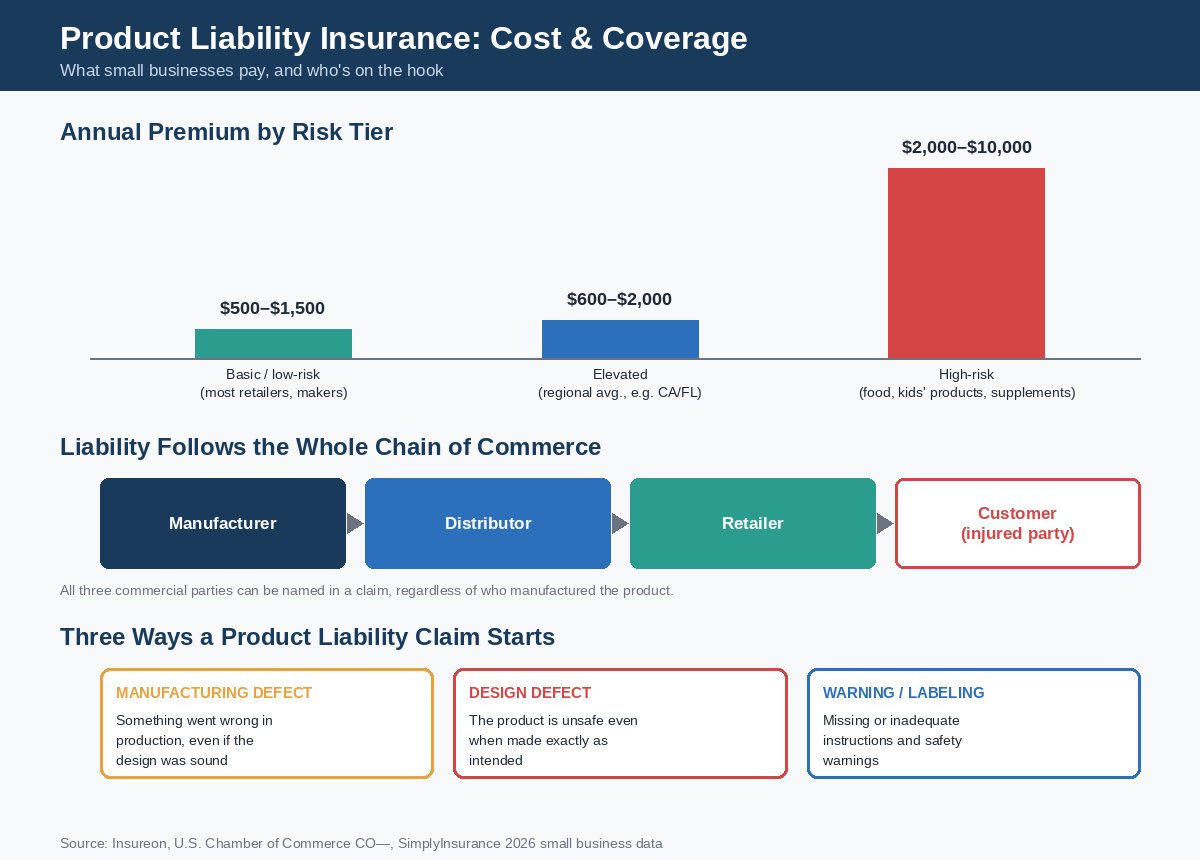
For most small retailers and makers, decent coverage runs $500–$1,500 a year; for higher-risk products it climbs into the thousands — cheap relative to what a single defective-product lawsuit costs to defend, let alone lose.
General Liability Covers the Incident. Product Liability Covers the Product.
It’s easy to assume these are the same thing, since both fall under the umbrella of “liability insurance” and both protect against third-party claims. They’re not the same. General liability responds to things that happen during normal business operations — a customer slips in your store, your work damages a client’s property. Product liability responds specifically to harm caused by something you made, sold, or distributed reaching someone after it left your hands: a defect, a labeling error, a design flaw, an allergic reaction, an injury from a failure to warn.
The overlap causes real confusion. Many standard general liability (CGL) policies do include product liability coverage by default — but not all of them, and some insurers write it as an add-on endorsement rather than baking it in. If you sell physical products and haven’t specifically confirmed product liability is in your policy (not just assumed it is because you have “liability insurance”), that’s worth a five-minute call to your agent before it’s worth a lot more during a claim. Keep this in mind the next time you shop for product liability insurance.
Who Actually Needs This
Any business that sells a physical product carries some exposure, but the risk isn’t evenly distributed. Retailers, wholesalers, distributors, manufacturers, and importers are the core group — and notably, liability doesn’t stop at whoever manufactured the item. Courts have consistently held that every party in the chain of commerce can be named in a claim, which means a boutique that simply resells a defective product it didn’t make can still be sued alongside the manufacturer. This is one of the most common questions we hear about product liability insurance.
Risk is highest in a handful of categories: food and beverage, children’s products, consumer electronics, supplements and health products, and toys or sporting goods. I’ve seen a small candle-making business get flagged by their insurer specifically because “flammable product, sold to the public” is exactly the profile underwriters price up — it wasn’t about how careful the business was, it was about the category. It’s a small detail, but it can make a real difference for product liability insurance.
What’s Actually Covered — and What Isn’t
A product liability claim can be triggered by three broad failure types: a manufacturing defect (something went wrong in production, even if the design was sound), a design defect (the product is inherently unsafe even when made correctly), or a marketing/warning defect (missing or inadequate instructions and warnings). Coverage typically pays for the injured party’s medical costs, property damage, and — often the largest line item — your legal defense costs and any settlement or judgment. Understanding this point can save you real money on product liability insurance.
What it does not cover matters just as much: product liability doesn’t pay to replace or recall the defective product itself, and it doesn’t cover the cost of shipping or transporting products. If your business has ever had to consider a recall, that’s a separate policy (product recall insurance) — don’t assume it’s bundled in. Many owners overlook this detail when comparing product liability insurance options.
What It Costs
For most small businesses selling lower-risk products, basic product liability coverage runs in the range of $500 to $1,500 a year — roughly $40 to $125 a month — according to small-business insurance data. Higher-risk categories (pharmaceuticals, children’s products, anything ingested or used on the body) can push premiums into the $2,000–$10,000 range annually. State matters too: quoted ranges for California and Florida tend to run somewhat higher than Georgia or Texas for comparable coverage, reflecting differing litigation environments. As with any insurance cost, these are planning ranges rather than quotes — your actual premium depends on your specific product category, revenue, and claims history, so treat these figures as a starting point for budgeting rather than a guarantee.
The factors that move your premium the most are the product category itself, your business’s revenue and size (more units sold generally means more exposure), and your claims history. Insurers reward businesses that can show documented quality-control processes — a paper trail showing you test, inspect, and label consistently tends to work in your favor at renewal time, even before any claim happens. Before you decide, make sure you understand product liability insurance correctly.
How to Get the Right Coverage Without Overpaying
- Confirm, don’t assume. Ask your agent directly whether product liability is included in your current general liability policy or written as a separate endorsement — get the answer in writing.
- Match limits to your actual exposure. A candle maker selling at local markets and a supplement brand selling nationally online carry very different risk profiles, even if both are “small.”
- Document your quality control. Testing records, supplier certifications, and labeling review processes aren’t just good practice — they’re evidence that helps in underwriting and in a defense if a claim happens.
- Ask about recall coverage separately if your product category has any history of recalls in your industry — it isn’t included by default.
- Bundle where it makes sense. Pairing product liability with your general liability and property coverage under one carrier often brings the combined premium down versus buying each separately.
The businesses that get burned by this gap usually aren’t the ones selling obviously risky products — they’re the ones who sell something ordinary, assume “liability insurance” covers everything, and find out during a claim that product-specific coverage was never actually confirmed. This is exactly the kind of scenario where product liability insurance matters most.
Related Reading
- Insureon’s comparison of general liability vs. product liability insurance
- U.S. Chamber of Commerce CO— guide to product liability insurance
- SimplyInsurance’s product liability cost data
- Our guide to general liability insurance 101
This article is for general informational purposes and isn’t personalized insurance, legal, or financial advice. Coverage rules, costs, and state requirements change, and every business’s risk is different — for decisions specific to your business, talk to a licensed insurance agent. Learn more About BizShieldGuide or reach us via our Contact page. If you’re evaluating product liability insurance, this distinction is worth remembering.
Product liability insurance typically comes bundled into a general liability policy as “products-completed operations” coverage, rather than sold as a fully separate line. That distinction matters because the limits and exclusions on products-completed operations can be very different from your everyday premises liability, so it’s worth asking your agent to confirm the actual product liability insurance limit in writing.
Manufacturers and importers usually pay more for product liability insurance than retailers who simply resell a finished product, since liability tends to follow the party closest to the design and manufacturing decisions. Retailers still carry real exposure, though, especially for private-label or imported goods where the original manufacturer may be hard to reach in a lawsuit.

About the Author: BizShieldGuide Team
The BizShieldGuide team researches and writes plain-language guides to business and personal insurance — general liability, professional liability, workers' compensation, business owners policies, cyber liability, and industry-specific coverage for small business owners, alongside straightforward explainers on auto, home, and renters insurance for everyday readers. Our articles are grounded in publicly available data from insurers and carriers (Insureon, The Hartford, Progressive, State Farm, and others), industry cost surveys, and standard policy language, and we link to primary sources wherever a number or coverage detail could change. We are not licensed insurance agents or brokers, and nothing here replaces a quote or advice from one for your specific situation.