
Filing a small business insurance claim is rarely complicated on paper, but it’s easy to get wrong in the moment — and a mistake in the first 72 hours (a late report, a missing photo, a repair started before the adjuster sees the damage) can shrink or even sink a claim that should have paid out cleanly. ” Here’s what the process actually looks like, step by step.
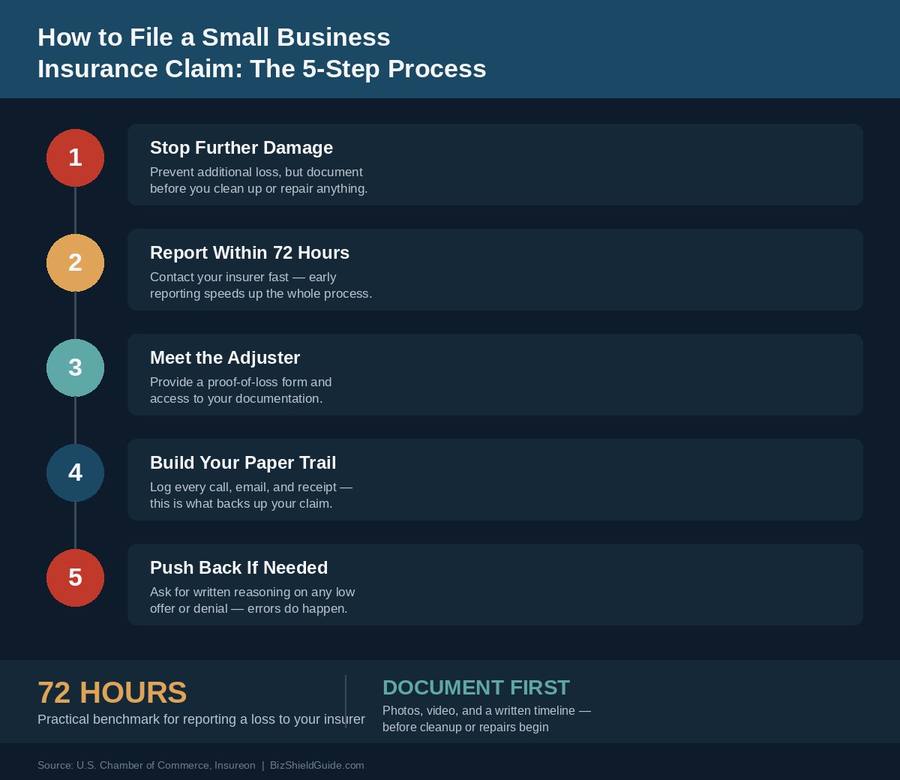
Step 1: Stop the bleeding, but don’t destroy evidence
Your first job after a covered loss — a pipe burst, a break-in, a customer injury, a fire — is to prevent further damage. Board up a broken window, shut off a leaking valve, get an injured customer medical attention. Insurers expect you to take reasonable steps to stop a loss from getting worse, and most policies actually require it.
What they don’t want is for you to start ripping out damaged flooring or throwing away spoiled inventory before anyone has documented it. Photograph and video everything first — the damage, the surrounding area, serial numbers on damaged equipment, expiration dates on spoiled stock — and only then start cleanup or temporary repairs.
Step 2: Report the claim fast — 72 hours is the practical benchmark
Most policies don’t print an exact deadline for reporting a loss, but insurance-industry guidance generally points to contacting your carrier or agent within 72 hours of discovering the incident. Reporting sooner rather than later isn’t just about compliance — the faster an insurer starts gathering evidence and assigning an adjuster, the faster your claim actually moves.
When you call or file online, have this ready: your policy number, the date and time of the loss, an exact description of what happened, and contact information for anyone else involved (a customer who was injured, a driver in an auto accident, a witness). If theft, vandalism, or an auto accident is involved, file a police report too — most carriers will ask for the report number.
Step 3: Understand what happens after you report it
Once a claim is open, the insurer typically assigns an adjuster — either an employee of the insurance company or an independent adjuster working on its behalf. Their job is to evaluate the damage, confirm it’s covered under your policy’s terms, and determine how much the insurer owes.
You’ll usually be asked to complete a proof-of-loss form and give the adjuster access to the damaged property, along with your supporting documentation. In my own experience helping a client through a kitchen fire claim at a small café, the adjuster’s visit went far more smoothly once we’d already organized photos, a written timeline, and receipts for the damaged equipment into one folder — it turned what could have been a multi-week back-and-forth into a single site visit and a fairly quick settlement offer.
Step 4: Build a documentation trail — and keep building it
Claims that drag on or get underpaid are often ones where the paper trail is thin. Keep records of:
Every email, text, and phone call with your insurer or adjuster (note the date and a one-line summary if it was a call). An inventory of damaged or destroyed items with estimated repair or replacement costs. Any lost income or extra expenses caused by the interruption — lost work hours, a temporary rental, overtime pay to catch up. Witness names and contact information, gathered as early as possible.
This isn’t just paperwork for its own sake — if a claim is later disputed or underpaid, this is the record you’ll lean on.
Step 5: Know when to push back — or bring in help
Not every claim resolves cleanly on the first offer. If the insurer’s settlement seems low, or a claim is denied outright, you’re generally entitled to ask for a written explanation citing the specific policy language behind the decision. Compare that language against your actual policy — sometimes an adjuster misapplies an exclusion, and pointing that out in writing resolves it.
For larger or more contested claims, some business owners bring in a public adjuster (who works for you, not the insurer, typically for a percentage of the payout) or an attorney. That’s usually worth considering when the dispute involves a meaningful dollar amount and informal back-and-forth with the insurer isn’t going anywhere.
Common mistakes that slow claims down
A few patterns show up again and again in delayed or reduced claims: waiting too long to report the loss, describing damage vaguely instead of specifically, starting permanent repairs before the adjuster has seen the property, and letting communication go quiet for weeks at a time instead of following up. None of these are dramatic mistakes — they’re just small gaps that add friction to a process that otherwise moves fairly predictably.
Filing an insurance claim is one of those things you hope you rarely have to do, but when you do, moving fast and documenting thoroughly makes the biggest difference in how smoothly — and how fully — it gets resolved. This article is for general informational purposes and isn’t personalized insurance, legal, or financial advice. Claims processes vary by carrier and policy, and every incident is different — for guidance specific to your situation, talk to your insurance agent or a licensed adjuster. Learn more About BizShieldGuide or reach us via our Contact page.
Related Reading
5 Steps to File a Small Business Insurance Claim — U.S. Chamber of Commerce
How to File a Business Insurance Claim — Insureon
General Liability Insurance 101: What It Covers and What It Doesn’t
Business Owner’s Policy (BOP) vs. Buying Coverage Separately
How to Get a Certificate of Insurance (COI) Fast
How long a small business insurance claim actually takes
Every small business insurance claim moves through roughly the same timeline: acknowledgment, investigation, evaluation, and either payment or denial. Simple property claims with clear documentation can resolve within a few weeks, while a small business insurance claim involving a liability lawsuit, a disputed cause of loss, or a large dollar amount can take many months or longer.
Insurers are required in most states to acknowledge a small business insurance claim within a specific number of days and to explain in writing why a small business insurance claim is denied, delayed, or only partially paid — knowing these state-specific deadlines gives a policyholder leverage if an insurer is dragging its feet without a good reason.
Business owners filing their first small business insurance claim are often surprised by how much of the timeline depends on the policyholder’s own responsiveness. An adjuster who is still waiting on requested documents, photos, or receipts cannot move a small business insurance claim forward, so the fastest way to speed up any small business insurance claim is to respond to every request from the adjuster within a day or two rather than letting paperwork sit.
What to do if a small business insurance claim is denied
A denied small business insurance claim is not necessarily the final word. Every insurer is required to provide a specific written reason for denying a small business insurance claim, and that reason is the starting point for an appeal. Common denial reasons include a policy exclusion the insurer believes applies, a claimed loss that occurred before the policy started, or missing documentation the policyholder can often still provide after the fact.
Requesting the full claim file, including the adjuster’s notes and any expert reports used to evaluate the small business insurance claim, gives a policyholder the information needed to challenge a denial on its actual merits rather than guessing at the insurer’s reasoning.
If an internal appeal does not resolve a denied small business insurance claim, a business owner can typically escalate to the state insurance department, which investigates complaints about how insurers handle a small business insurance claim, or hire a public adjuster or attorney who specializes in disputed claims. Public adjusters work on behalf of the policyholder rather than the insurer and are paid a percentage of the eventual settlement, which makes them worth considering on any small business insurance claim large enough to justify the fee.
Small Business Insurance Claim: Frequently Asked Questions
Business owners preparing to file often ask how a small business insurance claim affects future premiums. In most cases, a single small business insurance claim causes a modest premium increase at the next renewal rather than an outright cancellation, though multiple claims within a short window can lead an insurer to non-renew the policy.
Another common question is whether hiring a public adjuster is worth it for a small business insurance claim — for straightforward claims with clear documentation, it usually is not, but for a complex or high-value small business insurance claim where the insurer’s initial offer seems low, the added recovery a public adjuster negotiates often exceeds their fee.
Documentation that strengthens any small business insurance claim
The single biggest factor separating a smoothly paid small business insurance claim from a drawn-out dispute is the quality of documentation submitted at the start. Date-stamped photos of the damage or loss, a detailed written account of what happened and when, receipts or invoices for damaged property, and any relevant correspondence with third parties all strengthen a small business insurance claim before an adjuster ever asks for them. Businesses that keep basic records — an updated inventory list, recent equipment receipts, and a simple log of major purchases — going into a small business insurance claim recover faster and more completely than those scrambling to reconstruct records after the fact.
Witness statements matter more than many business owners realize when filing a small business insurance claim tied to a customer injury or a liability dispute. Collecting contact information and a brief written account from anyone who saw what happened, while memories are still fresh, can make the difference in a small business insurance claim that later turns into a contested liability question. Waiting weeks to gather this information, after people have forgotten details or moved on, weakens a claim that could otherwise have been resolved quickly.
Working with an insurance agent during a small business insurance claim
An independent insurance agent, as opposed to a captive agent who only represents one insurer, can be a valuable advocate throughout a small business insurance claim, since their ongoing relationship with the business gives them a stake in seeing the claim resolved fairly. Looping in the agent as soon as a loss occurs, rather than after a small business insurance claim has already stalled, lets them flag potential issues early and sometimes speed up the adjuster’s response simply by making a call on the policyholder’s behalf.
Agents can also help translate adjuster language into plain terms during a small business insurance claim — explaining what “reservation of rights,” “proof of loss,” or “actual cash value versus replacement cost” actually mean in the context of a specific claim, which matters because these terms directly affect how much money a small business insurance claim ultimately pays out.
Avoiding the mistakes that turn a routine claim into a dispute
Many disputes over a small business insurance claim trace back to a handful of avoidable mistakes: giving a recorded statement to the insurer before consulting an agent or attorney, making repairs before the adjuster has inspected the damage, or downplaying the extent of a loss out of an instinct to seem reasonable. Each of these can quietly reduce what a small business insurance claim ultimately pays, sometimes without the policyholder realizing it happened until the settlement offer arrives lower than expected.
Filing a small business insurance claim promptly after a loss, rather than waiting to see if a problem resolves itself, also protects the claim procedurally — most policies require notice “as soon as practicable,” and a long delay in reporting a small business insurance claim can itself become grounds for a reduced payout or denial, even when the underlying loss was otherwise covered.
Preparing before a loss ever happens
The businesses that navigate a claim most smoothly are usually the ones that did a small amount of preparation long before anything went wrong. Keeping a policy’s declarations page, contact numbers for the insurer and agent, and a basic photo inventory of equipment and inventory somewhere easy to find — rather than buried in an old email or a filing cabinet that may itself be damaged in the same incident — saves precious time in the first confused hours after a loss. Some business owners keep this information in a shared cloud folder specifically so it survives a fire, flood, or theft that might otherwise destroy the only physical copy.
It also helps to read through the policy itself at least once a year, rather than only opening it after something goes wrong. Understanding in advance what triggers a duty to notify the insurer, what documentation will eventually be requested, and roughly how the payout is calculated for different types of losses turns a stressful, unfamiliar process into something closer to a known checklist when an actual incident occurs. None of this preparation is complicated or expensive, and the businesses that do it consistently report far less friction and far faster resolutions than those encountering the process for the first time under pressure.
Employees can play a useful role here too, especially in a business with multiple locations or shifts where the owner is not always present. A short, plain-language guide for staff — who to call first, what to photograph, and what not to say to a customer or a third party before management is involved — turns every employee into an early responder rather than a bystander waiting for the owner to arrive. Even a single page taped near a register or posted in a back office break room can shave meaningful time off the initial response to an incident, which often translates directly into a faster and better-documented resolution later.
Finally, it is worth remembering that insurers themselves have an interest in resolving claims accurately and reasonably — a policyholder who is organized, responsive, and reasonably persistent is simply easier and faster for an adjuster to work with than one who is scattered or combative. Approaching the process as a collaborative fact-finding exercise, backed by solid documentation, tends to produce better outcomes than treating every interaction with the insurer as adversarial from the outset.
None of this guarantees every dispute disappears, but it stacks the odds in the policyholder’s favor. A business that reports promptly, documents thoroughly, stays responsive to requests, and knows when to bring in outside help for a complex or high-value dispute is simply better positioned than one that treats the process passively and hopes for the best. Over time, these habits become second nature, and the anxiety that often surrounds an unfamiliar claims process fades into a routine, manageable part of running the business.
Ultimately, the goal of every step covered here is the same: getting the business back to normal operations as quickly and completely as the policy allows, with as little unnecessary friction along the way as possible. Treating preparation, documentation, and follow-through as ordinary parts of running a business, rather than as an afterthought reserved for emergencies, is what separates a manageable claims experience from a genuinely stressful one.

About the Author: BizShieldGuide Team
The BizShieldGuide team researches and writes plain-language guides to business and personal insurance — general liability, professional liability, workers' compensation, business owners policies, cyber liability, and industry-specific coverage for small business owners, alongside straightforward explainers on auto, home, and renters insurance for everyday readers. Our articles are grounded in publicly available data from insurers and carriers (Insureon, The Hartford, Progressive, State Farm, and others), industry cost surveys, and standard policy language, and we link to primary sources wherever a number or coverage detail could change. We are not licensed insurance agents or brokers, and nothing here replaces a quote or advice from one for your specific situation.