
Contractor insurance protects general contractors, subcontractors, and construction trades from the liability, property, and injury risks that come with building, renovating, and repairing structures on someone else’s property. A general contractor’s insurance program almost never looks like one policy — it’s usually five or six pieces stacked together, because a construction business faces risks a standard office-based small business simply doesn’t: a subcontractor’s tools stolen off a job site overnight, a client’s near-finished kitchen flooded by a burst pipe mid-renovation, or a property owner who won’t let you start work until you’ve named them as an “additional insured” on your liability policy.
The short version: general liability and workers’ comp are the non-negotiable base layer almost everywhere you have employees, tools and equipment coverage (inland marine) protects what GL and property insurance don’t, builder’s risk covers the project itself while it’s under construction, and commercial auto plus a surety bond round out what most GCs and property managers will actually ask to see before handing you a contract. Here’s what each piece does and why it exists.
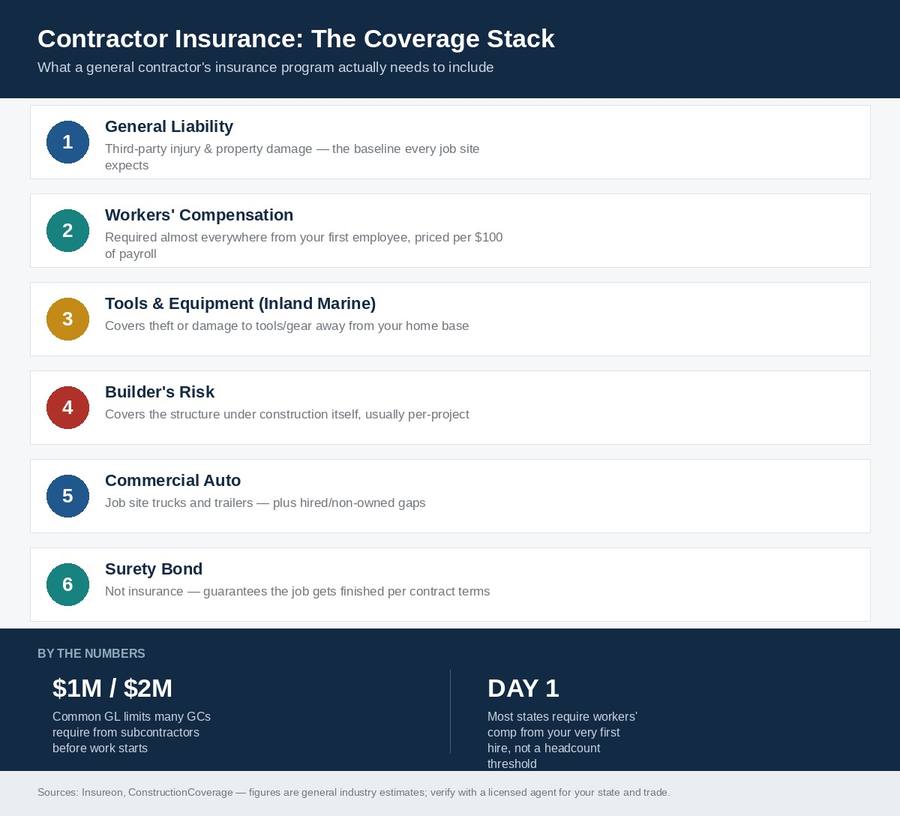
General liability: the policy every job site assumes you already have
General liability insurance is the baseline almost every property owner, GC, or building manager expects before letting a contractor on site. It covers third-party bodily injury and property damage — a client who trips over a stack of lumber, a nail gun mishap that damages someone else’s property, a subcontractor’s work that ends up causing damage after the fact.
Average premiums are commonly cited in the range of a bit over $150/month for a small contracting operation, though the real number swings hard based on trade, revenue, and claims history — a roofer or electrician will typically pay noticeably more than a handyman doing light carpentry, because the underlying risk is different.
Workers’ compensation: expect it from your very first hire, not your tenth
Construction is physically demanding and injury-prone work — falls, power tool injuries, repetitive strain — and nearly every state requires workers’ comp once you have even one employee, contractors included. The requirement typically kicks in immediately, not at some higher headcount threshold, and it’s one of the most common blind spots for new contractors who bring on a helper or two before formally setting up payroll.
It’s also usually priced per $100 of payroll rather than as a flat premium, which means it scales with how much labor-intensive work you’re actually doing — a detail worth understanding before you bid a big job, since your insurance cost moves with your crew size.
Tools and equipment coverage: the gap general liability doesn’t fill
General liability protects against harm to other people and their property — it doesn’t cover your own tools if they’re stolen out of a truck overnight or damaged on a job site. That’s what tools and equipment coverage, usually written as an inland marine policy, is for: it protects movable business property away from your regular business location, which describes almost everything a contractor owns. It’s often one of the cheaper add-ons relative to the risk it addresses — theft of tools and equipment is a genuinely common, unglamorous claim in this industry, not a rare edge case.
Builder’s risk: covering the project, not just your business
Builder’s risk insurance is different from the policies above in one important way — it covers the structure under construction itself (and often materials staged on site) against fire, weather, vandalism, and similar perils, rather than covering your business’s liability or property. It’s typically written per-project rather than as an annual policy, and larger GCs or property owners frequently require proof of it before a project breaks ground, especially on new construction or major renovations where a mid-project loss could be financially significant for everyone involved.
Commercial auto: job site trucks, and the drivers who aren’t on your policy
A personal auto policy almost never extends to a vehicle used for business hauling, and if your crew regularly drives personal vehicles between job sites, that’s a real liability gap. Commercial auto insurance covers business-owned trucks and trailers, while hired and non-owned auto coverage extends protection to vehicles you don’t own but that get used for the business — a common setup on smaller crews where not everyone drives a company truck.
Surety bonds and “additional insured” status: not insurance, but expect to need both
A surety bond isn’t insurance — it’s a three-party guarantee that reimburses a client if you fail to complete a contracted job or violate licensing terms, and many states and municipalities require one just to pull permits or hold a contractor’s license.
Separately, don’t be surprised when a GC or property owner asks to be added as an “additional insured” on your general liability policy before work starts — I’ve walked a first-time subcontractor through exactly this request, and the confusion is almost always the same: they assume it means sharing their policy or raising their own premium, when in practice it just extends a defined slice of your existing liability coverage to protect the party requesting it, usually at little or no added cost. Getting comfortable producing a certificate of insurance with that endorsement attached, quickly, is genuinely part of how construction contracts get signed.
What coverage limits and costs actually look like
There’s no universal number, since cost depends heavily on trade, payroll, revenue, and claims history, but $1 million per occurrence / $2 million aggregate general liability limits are a common baseline that many GCs and property managers require outright before subcontractors can work under them. Tools and equipment limits should roughly track the replacement value of what you’d actually need to cover after a bad night — not an arbitrary round number. Talk through your specific trade and project mix with an agent who understands construction; a solo handyman and a mid-size framing crew need meaningfully different coverage stacks.
Contractor insurance isn’t one policy, it’s a small stack of coverages that each answer a different “what if” — and the ones that get skipped are usually the ones that turn into the expensive surprise later. This article is for general informational purposes and isn’t personalized insurance, legal, or financial advice. Coverage rules, costs, and state requirements change, and every contracting business’s risk profile is different — for decisions specific to your business, talk to a licensed insurance agent. Learn more About BizShieldGuide or reach us via our Contact page.
Related Reading
General Contractor Insurance: Types, Costs, and Requirements — Insureon
Contractor General Liability Insurance Coverage Guide — ConstructionCoverage
General Liability Insurance 101: What It Covers and What It Doesn’t
Workers’ Compensation Insurance 101
Commercial Auto Insurance for Small Business
How to Get a Certificate of Insurance (COI) Fast
The core coverages in a contractor insurance package
General liability insurance is the foundation of contractor insurance, covering third-party bodily injury and property damage claims — a common example is a subcontractor’s equipment damaging a client’s existing structure during a renovation. Most clients and general contractors require proof of contractor insurance with specific liability limits before allowing a subcontractor onto a jobsite, which makes this coverage effectively mandatory rather than optional for anyone bidding on construction work.
Workers’ compensation insurance is a legally required part of contractor insurance in nearly every state once a contractor has employees, and construction work carries some of the highest workers’ compensation rates of any industry given the physical risks of falls, power tool injuries, and heavy equipment accidents. Commercial auto insurance, another standard piece of contractor insurance, covers trucks and trailers used to haul tools, materials, and crews between jobsites, since a personal auto policy typically excludes vehicles used for business purposes.
Tools, equipment, and builder’s risk coverage
Inland marine insurance, sometimes called contractor’s equipment coverage, is the piece of contractor insurance that protects tools and equipment while in transit or stored at a jobsite rather than at a fixed business location — standard property insurance typically only covers items at a specific address, leaving mobile tools and equipment exposed without this add-on. Builder’s risk insurance, another common component of contractor insurance, covers a structure under construction against fire, theft, weather damage, and vandalism during the build itself, before the property owner’s own insurance would typically take over at project completion.
Professional liability for design-build contractors
Contractors who also provide design services, not just construction labor, often need professional liability insurance as part of their contractor insurance program, since a design error or omission is a different kind of claim than a construction defect and is typically excluded from a standard general liability policy. This distinction matters most for design-build contractors and those offering engineering or architectural services alongside construction, where the line between a construction defect and a design flaw can determine which policy actually responds to a claim.
How contractor insurance requirements vary by trade and project size
Contractor insurance requirements are rarely one-size-fits-all: a residential handyman working alone needs a much smaller policy than a commercial general contractor managing multiple subcontractors on a large build. Larger commercial projects typically require higher liability limits, an owner’s and contractor’s protective policy, and sometimes wrap-up insurance covering every subcontractor on the project under one umbrella. Reviewing the specific insurance requirements listed in a project’s bid documents before submitting a proposal, rather than assuming an existing contractor insurance policy automatically qualifies, avoids losing a bid over a coverage technicality that could have been fixed in advance.
How much contractor insurance costs
Contractor insurance premiums vary significantly by trade, since a roofer or excavation contractor carries far more inherent risk than an interior finish carpenter, and insurers price contractor insurance accordingly. A small residential contractor with no employees might pay a modest annual premium for basic general liability contractor insurance, while a commercial general contractor managing multiple crews and higher project values pays substantially more to cover the higher limits and broader scope of work involved.
Certificates of insurance and additional insured requests
Nearly every construction project today requires contractors to provide a certificate of insurance before work begins, proving that contractor insurance is active and meets the project’s minimum requirements. Property owners and general contractors frequently also request to be named as an “additional insured” on a subcontractor’s contractor insurance policy, which extends a layer of the subcontractor’s liability coverage to protect the party requesting it. Understanding the difference between simply holding contractor insurance and actually adding someone as an additional insured matters, since failing to process this request correctly can leave a general contractor unprotected despite believing coverage was in place.
Contractor insurance for subcontractors versus general contractors
Subcontractors typically need a narrower contractor insurance policy focused on their specific trade — electrical, plumbing, framing — while a general contractor managing an entire project needs broader contractor insurance that accounts for oversight liability across every trade working under them. General contractors are often named in a lawsuit even when a subcontractor’s work caused the actual damage, simply because the general contractor held overall responsibility for the site, which is why many general contractors require every subcontractor on a project to carry their own contractor insurance meeting a minimum threshold before being allowed on site.
The bottom line on contractor insurance
Contractor insurance is not a single policy but a coordinated set of coverages built around the specific risks of construction work: liability for jobsite accidents, workers’ compensation for a physically demanding workforce, coverage for tools and equipment on the move, and builder’s risk protection for a structure that does not yet exist as a finished, insurable asset. Contractors who assemble contractor insurance piece by piece as new risks emerge, rather than reviewing the full package with an agent who understands construction, often discover a gap only after a claim exposes it.
Reviewing contractor insurance at least once a year, and definitely before bidding on a larger or unfamiliar type of project, keeps coverage matched to the actual work being performed.
Common gaps that surface after a claim
Some of the most damaging insurance gaps in construction only surface after a claim has already been filed, when it is too late to fix them cheaply. A contractor who quietly expanded from residential remodels into small commercial buildouts, without telling their insurer about the change in scope, may find a claim denied because the policy was underwritten for a different type of work entirely. Similarly, a contractor who hires their first W-2 employee after years of working solo needs to update workers’ compensation immediately rather than treating it as a formality to handle later, since an uninsured workplace injury claim can be financially devastating for a small operation.
Leased or rented equipment is another frequent blind spot. Equipment rented for a specific job is sometimes assumed to be covered under a general liability or inland marine policy when it is not, and rental agreements often require the renter to carry specific coverage for the leased equipment regardless of what the contractor’s own policy otherwise includes. Reading the equipment rental agreement’s insurance requirements before signing, rather than assuming existing coverage applies, avoids being held personally responsible for a piece of rented machinery damaged or stolen on the jobsite.
Working with an agent who understands construction risk
Because construction risk varies so much by trade, project type, and even region — coastal contractors face different exposures than those working inland, and contractors in seismically active areas face considerations that do not apply elsewhere — working with an agent who specifically writes policies for the construction trades produces a meaningfully better outcome than a generalist small business insurance agent handling a policy as a side offering.
A specialist agent is more likely to catch the specific gaps described above before they become a claim, and can usually structure a policy that satisfies the certificate-of-insurance requirements a contractor will keep encountering across different projects and general contractors throughout a career.
Beyond finding the right agent, a contractor’s own documentation habits matter just as much once a claim actually happens. Photographing site conditions before work begins, keeping signed contracts and change orders on file, and documenting any existing damage noticed before a crew starts work all protect against being blamed for pre-existing conditions later. These habits cost almost nothing to build into a normal workflow, but they consistently make the difference between a claim that resolves quickly in the contractor’s favor and one that drags on over a dispute about who caused what and when.
Building this discipline into the business from the start — before it is ever tested by an actual incident — is far easier than trying to retrofit good habits after a difficult claim has already made the stakes painfully clear.
A short annual checklist works well for most small contracting businesses: confirm every active project’s insurance requirements are still met, verify workers’ compensation covers everyone currently on payroll including any new hires, check that equipment values on file still reflect what was actually purchased or replaced during the year, and ask the agent directly whether anything about the business has changed enough to warrant a coverage review. Ten minutes spent on this once a year is a small price for the peace of mind it buys.

About the Author: BizShieldGuide Team
The BizShieldGuide team researches and writes plain-language guides to business and personal insurance — general liability, professional liability, workers' compensation, business owners policies, cyber liability, and industry-specific coverage for small business owners, alongside straightforward explainers on auto, home, and renters insurance for everyday readers. Our articles are grounded in publicly available data from insurers and carriers (Insureon, The Hartford, Progressive, State Farm, and others), industry cost surveys, and standard policy language, and we link to primary sources wherever a number or coverage detail could change. We are not licensed insurance agents or brokers, and nothing here replaces a quote or advice from one for your specific situation.