Cleaning business insurance is the coverage residential and commercial cleaning companies need to protect against property damage, employee injury, and theft accusations that come with working inside clients’ homes and offices every day. Most cleaning business owners assume general liability insurance is the whole conversation — and then lose a commercial contract because the property manager also wanted a janitorial bond, which is a completely different thing that GL insurance doesn’t provide.
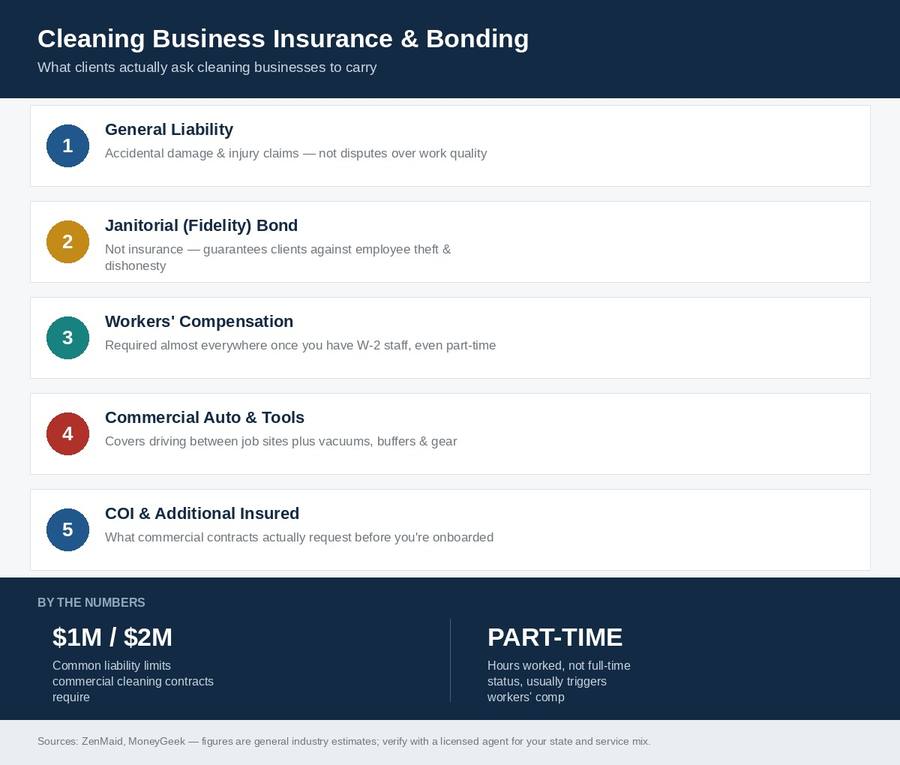
The short version: general liability covers accidental damage and injury claims, a janitorial (or fidelity) bond specifically covers employee theft and protects clients if a job isn’t completed as promised, workers’ comp is required almost everywhere you have W-2 cleaners even part-time, and commercial auto and tools coverage round out the rest.
Commercial and office-cleaning contracts routinely ask for proof of two or three of these at once, so it’s worth understanding what each one actually does before a client’s request catches you off guard.
General liability: covers accidents, not complaints about the work itself
General liability is the foundation almost every cleaning business needs — it covers third-party bodily injury and property damage, like a slip-and-fall on a wet floor you just mopped, or a bottle of cleaning solution that discolors a client’s hardwood. What it doesn’t cover is a client simply being unhappy with the quality of a job, or a dispute over whether the work was completed as contracted — that’s a different kind of protection entirely, which is exactly where bonding comes in.
Premiums for a small cleaning operation are commonly cited somewhere in the few-hundred-to-low-thousands-per-year range, though the number moves a lot based on whether you clean homes, offices, or higher-risk commercial spaces.
Janitorial bonds: the piece that isn’t insurance at all
A janitorial bond (a type of fidelity bond) is not insurance — it’s a three-party guarantee that reimburses a client for losses caused by employee dishonesty, most commonly theft, and it’s one of the most commonly misunderstood pieces of a cleaning business’s coverage stack. ” It’s typically inexpensive relative to the trust it buys you in a sales conversation — often just a couple hundred dollars a year for a modest bond amount — but skipping it can quietly cost you contracts you never even hear you lost.
Workers’ compensation: it applies to your part-time cleaners too
Cleaning work involves a fair amount of physical strain — repetitive motion, chemical exposure, slips on wet surfaces — and nearly every state requires workers’ comp once you have employees, which for most states means the moment you hire your first W-2 worker, regardless of whether they’re full-time or just cleaning a few houses a week on the side. I’ve talked a residential cleaning business owner through exactly this misunderstanding: she assumed a couple of part-time cleaners paid hourly didn’t “count” as employees requiring coverage, when in most states that distinction doesn’t matter — hours worked and pay structure, not full-time status, is usually what triggers the requirement.
It’s a costly assumption to get wrong after an injury has already happened.
Commercial auto and tools coverage: getting there, and what’s in the trunk
If your team drives between job sites in personal vehicles, your personal auto policy typically won’t cover an accident that happens while they’re doing business driving — that gap is what commercial auto insurance, or hired and non-owned auto coverage for vehicles you don’t own, is built to close. Separately, the vacuums, floor buffers, and other equipment your team carries from site to site usually aren’t covered by a standard property policy once they leave your home base; tools and equipment coverage (inland marine) protects that movable equipment against theft or damage on the road or on a client’s property.
What clients and commercial contracts actually require
Once you move from residential clients to commercial or property-management contracts, expect a certificate of insurance (COI) request as a standard part of onboarding — often specifying minimum liability limits, sometimes $1 million per occurrence and $2 million aggregate, and frequently asking to be named as an additional insured on your policy. Larger commercial accounts may also specify a minimum bond amount.
None of this is unusual or a sign a client doesn’t trust you — it’s simply how commercial cleaning contracts are underwritten on the client’s side, and being able to produce the right documentation quickly is often what separates a business that lands bigger accounts from one that stays stuck with small residential jobs.
What coverage costs actually look like
There’s no single right number, since it depends on whether you clean homes, offices, or industrial spaces, how many employees you have, and which state you’re in — but a small cleaning business commonly budgets somewhere in the low-to-mid hundreds of dollars annually for general liability, a comparatively small amount for a modest janitorial bond, and workers’ comp priced per $100 of payroll rather than as a flat fee. Talk through your specific service mix and client types with an agent who understands the cleaning industry — a business that only ever cleans private homes has a different risk profile than one bidding on office contracts.
Cleaning business insurance isn’t just about protecting yourself from a bad accident — a chunk of it exists because your clients want proof, in writing, that you carry it, and not having the right piece ready when asked is what actually costs businesses contracts. This article is for general informational purposes and isn’t personalized insurance, legal, or financial advice. Coverage rules, costs, and state requirements change, and every cleaning business’s risk profile is different — for decisions specific to your business, talk to a licensed insurance agent. Learn more About BizShieldGuide or reach us via our Contact page.
Related Reading
Cleaning Business Insurance and Bonding: Types, Cost, Requirements — ZenMaid
Cleaning Business Insurance Requirements — MoneyGeek
General Liability Insurance 101: What It Covers and What It Doesn’t
Workers’ Compensation Insurance 101
Business Owner’s Policy (BOP) vs. Buying Coverage Separately
How Much Does Small Business Insurance Actually Cost in 2026?
Why clients specifically ask about cleaning business insurance
Commercial clients, property managers, and even many residential customers now routinely ask cleaning companies for proof of cleaning business insurance and bonding before allowing a crew into their space. This is because cleaning work involves unsupervised access to a client’s property, and both the client and the cleaning company benefit from cleaning business insurance being in place before anything goes wrong — it protects the client from bearing the cost of an accident, and it protects the cleaning business from having to pay out of pocket for a claim large enough to threaten the company itself.
General liability insurance is the core of any cleaning business insurance package, covering claims like a client’s furniture being damaged by a cleaning product or a client slipping on a wet floor left by a cleaning crew. Without this piece of cleaning business insurance, a single damaged item or a single injury claim can cost a small cleaning business far more than years of premiums combined.
Janitorial bonds and theft protection
A janitorial bond, often bundled with cleaning business insurance, protects clients against theft by an employee while working inside their home or office — and just as importantly, it protects the cleaning company’s reputation, since being able to say “we are bonded” alongside standard cleaning business insurance reassures nervous clients who are handing over keys or access codes to strangers.
Unlike general liability insurance, a bond does not cover the cleaning company’s own losses; it specifically reimburses the client if an employee steals from them, which is why bonding is typically sold and marketed separately from the rest of a cleaning business insurance package even though it is usually purchased together.
Workers’ compensation for cleaning crews
Workers’ compensation insurance becomes mandatory cleaning business insurance in nearly every state once a company hires its first employee, and cleaning work carries real physical risk — repetitive strain injuries, chemical exposure, and slip-and-fall accidents are all common in this industry. Cleaning companies that rely heavily on independent contractors instead of employees should understand that misclassifying workers to avoid workers’ compensation costs is a common and costly mistake; if a worker is later found to be an employee rather than a true independent contractor, the cleaning business insurance gap created by that misclassification can result in significant fines and an uninsured injury claim.
How much cleaning business insurance costs
Cleaning business insurance is relatively affordable compared to many other small business categories, with a basic general liability policy for a solo or small residential cleaning operation often costing a few hundred dollars a year, while a larger commercial cleaning company with employees and higher liability limits pays more to reflect that increased exposure. Adding a janitorial bond typically costs relatively little on top of the core cleaning business insurance policy, making it one of the more cost-effective ways to win client trust relative to its price.
Cleaning business insurance for specialized services
Cleaning companies that offer specialized services beyond routine dusting and vacuuming — carpet cleaning, pressure washing, window cleaning at height, or post-construction cleanup — often need additional endorsements added to their cleaning business insurance to cover the specific equipment and elevated risk those services involve. A standard janitorial cleaning business insurance policy may not automatically extend to a crew using ladders or lifts for high window cleaning, and confirming this with an insurer before offering the service prevents an expensive gap if a fall injury occurs mid-job.
Cleaning companies working in specialized environments like medical offices, food service kitchens, or data centers also face industry-specific liability that a generic cleaning business insurance policy may not anticipate — a cleaning error in a medical setting or a data center can trigger far more expensive consequences than a similar mistake in a typical office or home. Insurers who write cleaning business insurance for these niches usually offer tailored endorsements once the specific environment is disclosed on the application.
Vehicles, supplies, and property coverage
Commercial auto insurance is another piece of cleaning business insurance that solo cleaners sometimes overlook, since a personal auto policy typically excludes vehicles used to transport equipment and supplies between client jobs for business purposes. Property insurance, covering the cleaning company’s own equipment, chemicals, and supplies stored at a home office or a small commercial space, rounds out a typical cleaning business insurance package, protecting against theft or damage to the tools of the trade itself.
Growing from solo cleaner to full cleaning company
A solo cleaner who starts hiring additional cleaners to keep up with demand should revisit their cleaning business insurance at that exact moment rather than waiting for a renewal date, since adding employees changes workers’ compensation requirements and often increases the liability exposure insurers price into the policy. Cleaning business owners who scale from a handful of residential clients into commercial contracts should expect their cleaning business insurance needs to grow accordingly — commercial clients typically require higher liability limits than residential customers ever ask for, and failing to increase coverage to match can cost a growing cleaning company a lucrative commercial contract during the bidding process.
Choosing between a franchise and independent cleaning business insurance
Cleaning businesses operating under a franchise brand sometimes have access to a master cleaning business insurance policy negotiated by the franchisor, which can offer better group rates than an independent operator could get alone. Franchisees should still read the policy details carefully, since a master policy negotiated at the franchise level does not always include every coverage a specific location needs, and some franchise agreements require the local operator to purchase supplemental cleaning business insurance to fill gaps the master policy leaves open.
Independent cleaning businesses without a franchise relationship have more flexibility to shop cleaning business insurance across multiple carriers, which can sometimes produce better pricing for a well-established business with a clean claims history.
Documentation habits that support a cleaning business insurance claim
Cleaning companies that keep simple before-and-after photos of a job, especially for larger commercial contracts or jobs involving expensive furnishings, protect themselves twice over: the photos discourage false damage claims from a dishonest client, and they provide fast, clear evidence if a legitimate cleaning business insurance claim does arise. Keeping a basic log of which employee worked which job, along with dates and client addresses, also speeds up any cleaning business insurance claim investigation, since an adjuster or a bonding company will often ask exactly this kind of record when evaluating a theft or damage claim.
Common mistakes that leave cleaning businesses underinsured
The most common mistake among small cleaning businesses is treating cleaning business insurance as a one-time purchase rather than something to revisit as the business changes. A cleaning company that started with three residential clients and grew into a twenty-person commercial operation over a few years, without ever updating its original policy, is likely carrying coverage limits far below what its actual risk now requires.
Another common mistake is assuming that because a cleaning company has never had a claim, it can safely reduce coverage to save money — claims history affects pricing, but it says nothing about the size of a future claim, which depends far more on the value of what is being cleaned than on past luck.
Getting a cleaning business insurance quote
Getting a cleaning business insurance quote today is usually a fast process, since most insurers that specialize in this industry have built simplified applications specifically for cleaning companies, asking about revenue, number of employees, types of clients served, and whether bonding is needed alongside general liability. Comparing at least two or three quotes before choosing a cleaning business insurance provider, rather than accepting the first offer, is worth the small amount of extra time it takes, since pricing and included endorsements can vary meaningfully between insurers that specialize in this space versus generalist small business carriers.
The bottom line for cleaning business owners
Clients invite cleaning crews into some of their most personal and valuable spaces, and the trust that requires is exactly what proper insurance and bonding are meant to support. A cleaning company that can confidently produce a certificate of insurance and proof of bonding the moment a client asks not only wins more business but also protects its own finances the day something inevitably goes wrong — a broken vase, a slip on a freshly mopped floor, or a dishonest employee.
Treating this coverage as a core part of running the business, reviewed as it grows rather than locked in at whatever level felt adequate on day one, is what separates cleaning companies that handle a bad incident smoothly from those that do not survive one.
Building a simple annual habit of reviewing client mix, employee count, and services offered against the current policy keeps a cleaning business protected without turning insurance into a constant distraction from the actual work of running the company.
Small habits reinforce this over time: asking each new commercial client what their insurance and bonding requirements actually are before assuming the existing policy already satisfies them, keeping the certificate of insurance easy to hand over on short notice, and setting a calendar reminder well before the policy’s renewal date rather than letting it auto-renew unexamined. None of these steps take more than a few minutes, but together they keep a growing cleaning business from ever being caught unprepared when a client, a landlord, or an unexpected incident asks the question first.

About the Author: BizShieldGuide Team
The BizShieldGuide team researches and writes plain-language guides to business and personal insurance — general liability, professional liability, workers' compensation, business owners policies, cyber liability, and industry-specific coverage for small business owners, alongside straightforward explainers on auto, home, and renters insurance for everyday readers. Our articles are grounded in publicly available data from insurers and carriers (Insureon, The Hartford, Progressive, State Farm, and others), industry cost surveys, and standard policy language, and we link to primary sources wherever a number or coverage detail could change. We are not licensed insurance agents or brokers, and nothing here replaces a quote or advice from one for your specific situation.