Salon and spa insurance is the coverage beauty and wellness businesses need to protect against the unique risks of working directly on clients’ skin, hair, and bodies with chemicals, heat, and sharp tools every day. Salon and spa owners often assume their business owner’s policy covers everything that happens in the chair — and then discover, after a chemical burn complaint or an allergic reaction to a facial product, that general liability alone doesn’t touch claims about the service itself.
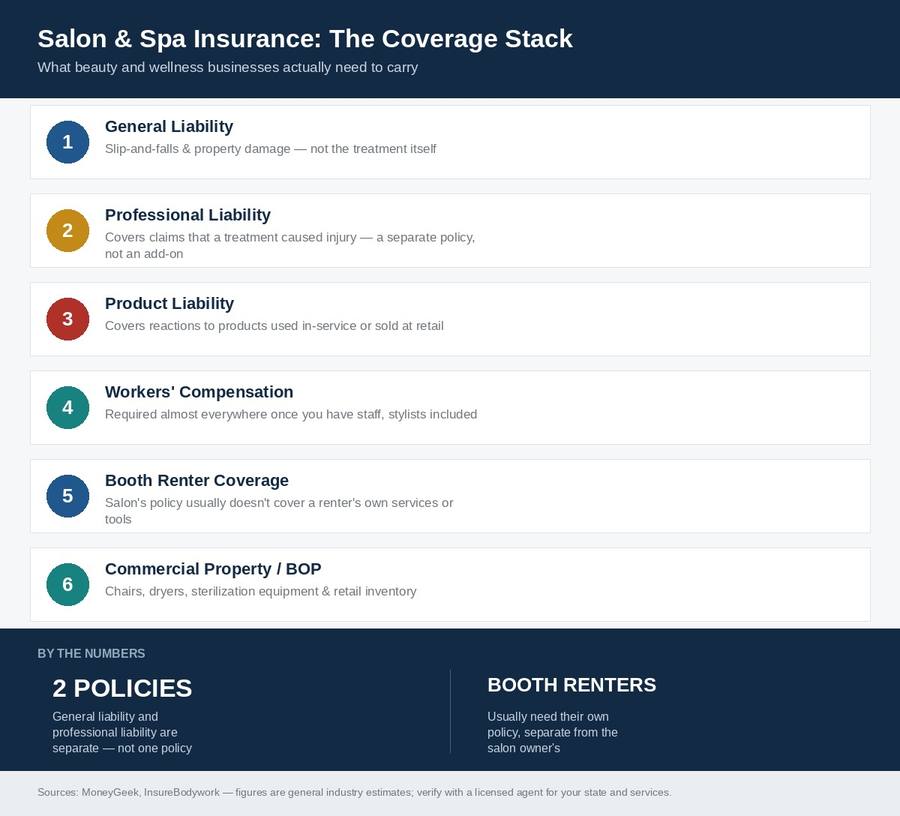
The short version: general liability covers slip-and-falls and property damage, professional liability (sometimes called malpractice coverage) covers claims that a treatment caused injury, workers’ comp is required almost everywhere you have employees, and booth renters usually need their own separate policy rather than relying on the salon owner’s coverage. Here’s what each piece actually does and where the gaps commonly show up.
General liability: the baseline, but not the whole story
General liability covers what happens around a service — a client who slips on a wet floor, a dropped styling tool that damages a client’s phone, a reception area chair that collapses. It’s the coverage almost every landlord and lease agreement requires before you open the doors. What it doesn’t cover is the treatment itself causing harm, which is a much more common claim in this industry than most new owners expect.
Professional liability: covers the service, not just the space
A chemical straightening treatment that burns a client’s scalp, a wax service that causes a skin reaction, a facial that triggers an allergic response to a product — these are claims about the quality and safety of the service itself, and general liability typically excludes them. Professional liability (often called malpractice or errors and omissions coverage in this industry) is what responds instead. It’s a genuinely distinct policy from general liability, not an add-on, and it’s one of the most commonly skipped coverages by new salon owners who assume their BOP has it covered.
Product liability: when what you sell (or use) is the problem
Salons and spas both use professional-grade products on clients and often retail products for home use — and either one can trigger a claim if a product causes an unexpected reaction or is defective. This risk usually falls under general liability or a combined BOP, but it’s worth confirming explicitly with your carrier if retail sales are a meaningful part of your revenue, since some policies scope product liability more narrowly than owners assume.
Workers’ compensation: expect it once you have any staff
Salon and spa work involves real physical strain — repetitive motion, standing for long shifts, exposure to chemical products — and nearly every state requires workers’ comp once you have employees, stylists and estheticians included. Where this gets complicated is classification: a stylist paid a percentage of service revenue is still usually an employee for workers’ comp purposes if the salon controls their schedule and clients, not an independent contractor, regardless of how the pay structure is set up.
Booth renters: a separate insurance question entirely
A large share of salons operate on a booth-rental model, where individual stylists or estheticians rent a chair and run their own small business inside the salon. This is where coverage gaps happen most often — the salon owner’s policy typically does not extend to a booth renter’s own services, tools, or client claims, and assuming otherwise is a mistake I’ve seen catch new booth renters off guard when they’re asked for their own certificate of insurance before signing a rental agreement. Get the responsibility spelled out in writing in the booth rental agreement itself, and don’t assume “the salon has insurance” means you’re covered.
Commercial property (or BOP): protecting the equipment itself
Styling chairs, dryers, sterilization equipment, retail inventory — a commercial property policy, often bundled into a BOP with general liability, covers this against fire, theft, and similar losses. For a solo operator this can usually be handled affordably as part of a bundled BOP; a larger staffed salon with more equipment and inventory on hand needs to size the property limit to what it would actually cost to replace everything, not a rough guess.
What coverage costs actually look like
There’s no single number, since it depends heavily on services offered, staff size, and whether you rent booths or employ stylists directly — but industry estimates commonly put a solo operator somewhere in the low hundreds of dollars a month combined, with a staffed salon running meaningfully higher once workers’ comp and employment practices liability are added in. Talk through your specific service menu with an agent who understands salons — a nail-only studio and a full-service spa offering laser treatments carry very different risk profiles.
Salon and spa insurance isn’t just a landlord requirement to check off — the professional liability and booth-renter pieces in particular are where real gaps show up after something goes wrong. This article is for general informational purposes and isn’t personalized insurance, legal, or financial advice. Coverage rules, costs, and state requirements change, and every salon’s risk profile is different — for decisions specific to your business, talk to a licensed insurance agent. Learn more About BizShieldGuide or reach us via our Contact page.
Related Reading
Average Beauty Salon Business Insurance Cost — MoneyGeek
Spa Business Insurance Guide: Coverage, Costs & Tips — InsureBodywork
General Liability Insurance 101: What It Covers and What It Doesn’t
Workers’ Compensation Insurance 101
General Liability vs. Professional Liability (E&O)
How to Get a Certificate of Insurance (COI) Fast
Professional liability: the core of salon and spa insurance
Professional liability insurance, sometimes called malpractice coverage in this industry, is the centerpiece of any salon and spa insurance program, protecting against claims that a service caused a client physical harm — a chemical burn from a hair treatment, an allergic reaction to a facial product, or a burn from hot wax during a spa treatment are all the kinds of claims salon and spa insurance is built to cover. General liability insurance rounds out the core coverage, addressing claims unrelated to the service itself, such as a client slipping on a wet floor in the reception area.
Product liability coverage, often bundled into salon and spa insurance, matters for any business that sells retail products alongside services, since a defective or mislabeled product sold at the front desk can trigger a claim against the salon even though the salon did not manufacture the product itself. Many salon and spa insurance policies extend this coverage automatically for products sold in small volumes, but larger retail operations should confirm the limit actually matches their retail sales volume.
Coverage for independent booth renters and estheticians
Salons that lease chairs or rooms to independent stylists, estheticians, or massage therapists face a more complex salon and spa insurance picture, since each booth renter is typically responsible for their own professional liability coverage as a separate business, while the salon itself still needs its own salon and spa insurance covering the building, common areas, and any employees on its own payroll. Salon owners should require proof of insurance from every booth renter before allowing them to begin work, since a claim against an uninsured renter can sometimes still draw the property owner into a lawsuit even when the salon itself did not perform the service.
Equipment and business interruption coverage
Salon and spa insurance often includes coverage for specialized equipment — styling chairs, tanning beds, laser hair removal devices, and sauna or steam equipment — that would be expensive to replace after a covered loss like fire or water damage. Business interruption coverage, another common piece of a complete salon and spa insurance package, replaces lost income if the salon has to close temporarily for repairs, which matters given how quickly a salon’s regular clients might otherwise book elsewhere during an extended closure.
Workers’ compensation and how salons classify staff
Workers’ compensation insurance is a required part of salon and spa insurance in nearly every state once a salon has employees, and salons face real physical risks including repetitive strain injuries, chemical exposure, and burns. Salons that classify stylists as independent contractors rather than employees should be careful here, since misclassification is a common issue in the beauty industry, and a salon and spa insurance program built around the assumption of independent-contractor status can leave a real workers’ compensation gap if regulators or a court later determine those workers were actually employees.
How much salon and spa insurance costs
Salon and spa insurance premiums vary based on the specific services offered, with higher-risk services like laser treatments, chemical peels, and injectables typically costing more to insure than basic haircuts and manicures. A small solo practitioner renting a single chair might pay a modest annual premium for basic salon and spa insurance, while a full-service spa offering medical aesthetics, massage, and body treatments pays considerably more to reflect the broader range of services and higher claim potential involved.
Medical spa and injectable services
Medical spas offering injectables, laser treatments, or other procedures performed under a supervising physician need a more specialized salon and spa insurance program that often blends standard beauty industry coverage with medical malpractice-style protection. These businesses should work with an insurer experienced in medical spa risk specifically, since a standard salon and spa insurance policy written for a conventional hair salon or nail studio typically excludes the higher-risk procedures a medical spa performs.
The bottom line on salon and spa insurance
Beauty and wellness businesses handle a level of physical, hands-on risk that few other service industries face — chemicals, heat, sharp tools, and direct contact with a client’s skin are all routine parts of the job. Salon and spa insurance is what stands between an everyday service gone wrong and a claim serious enough to threaten the business. Owners who treat salon and spa insurance as a routine cost of doing business, reviewed annually and adjusted as new services or staff are added, are far better positioned than those who bought a bare-minimum policy at opening and never revisited it.
Property and equipment protection specifics
Salons invest heavily in specialized fixtures — hydraulic chairs, shampoo bowls, styling stations, and increasingly expensive laser and light-based devices — and a salon and spa insurance policy that only covers generic business property may undervalue this equipment significantly. Scheduling higher-value equipment specifically on the policy, rather than relying on a blanket property limit, ensures a full replacement payout if a single expensive device is damaged or stolen. Salons in leased spaces should also confirm whether the landlord’s own insurance covers the building shell only, leaving fixtures and improvements the salon paid for as the tenant’s own responsibility under their salon and spa insurance policy.
Cyber and client data considerations
Many salons and spas now collect client data through booking apps, loyalty programs, and point-of-sale systems that store payment information, which introduces a data breach risk that a traditional salon and spa insurance policy focused only on physical injury and property damage may not address. Adding cyber liability coverage to a salon and spa insurance program has become increasingly common as more of the client relationship — booking, payment, and marketing — moves online, and a breach affecting client payment data can trigger notification costs and reputational damage well beyond what a standard policy anticipates.
Multi-location and franchise considerations
Salon and spa businesses that expand to a second or third location need to revisit their salon and spa insurance program rather than assuming the original single-location policy scales automatically. Each additional location typically needs its own property coverage, and liability limits appropriate for a single small studio may prove inadequate once the same brand is operating across multiple sites with a larger combined client base and staff count.
Franchise salon and spa brands sometimes offer a master insurance program to franchisees, similar to what exists in other franchised service industries, though individual locations should still confirm exactly what that master salon and spa insurance policy does and does not include before assuming full protection.
Working with a specialized insurance agent
Because beauty and wellness services vary so widely — from a simple blow-dry bar to a full medical spa offering injectables — working with an agent who specifically understands salon and spa insurance produces meaningfully better coverage than a generalist small business policy retrofitted for this industry. A specialist agent is more likely to catch service-specific gaps, correctly price higher-risk treatments, and structure a policy that actually matches the mix of services a given salon or spa offers, rather than applying a one-size-fits-all template that may leave real exposure unaddressed.
Documentation habits that support a strong claim
Keeping simple, consistent records — client consultation and consent forms noting known allergies or sensitivities, product batch numbers for any treatment linked to a reaction, and dated photos of a client’s skin or hair condition before certain higher-risk services — protects a salon far more than most owners realize until they actually need that documentation during a dispute. These records cost almost nothing to maintain as a routine part of the service itself, but they can be the deciding factor in whether a claim resolves quickly and fairly or turns into a prolonged, costly dispute over what was actually disclosed and agreed to before a treatment began.
Staff training reinforces this same protection from a different angle: technicians who consistently ask about allergies, follow patch-test protocols for new chemical treatments, and know exactly who to notify the moment something goes wrong during a service create fewer disputes in the first place and produce better documentation when an incident does occur. Building these habits into new-hire training, rather than assuming experienced stylists already know to follow them consistently, keeps the whole team aligned on the practices that actually reduce claims over time.
None of this needs to feel like an added burden layered on top of already-busy service days. A short intake form at the front desk, a habit of snapping a quick photo before certain treatments, and a five-minute team huddle covering any incident from the week are all it takes to build this discipline into a salon’s normal rhythm rather than treating it as extra paperwork bolted on afterward. Over time, these small habits become as routine as sanitizing tools between clients, and they quietly protect both the business and the people who work in it.
Owners who put these habits in place early, before the salon has grown large enough to feel the absence of structure, find it far easier to keep them going as the team expands. Retrofitting good documentation and communication practices onto a busy, established salon is possible but noticeably harder than building them in from the start, which is one more reason to treat insurance readiness as part of opening the business rather than an afterthought addressed only once growth makes it unavoidable.
A short annual checklist keeps this manageable long-term: confirm every current service offering is actually covered under the existing policy, check that equipment values reflect recent purchases or upgrades, verify staff classifications still match how the team actually works, and ask the agent directly whether anything about the business has changed enough to warrant a broader review. Ten minutes spent on this once a year is a small price for the confidence it buys heading into another busy season of appointments.

About the Author: BizShieldGuide Team
The BizShieldGuide team researches and writes plain-language guides to business and personal insurance — general liability, professional liability, workers' compensation, business owners policies, cyber liability, and industry-specific coverage for small business owners, alongside straightforward explainers on auto, home, and renters insurance for everyday readers. Our articles are grounded in publicly available data from insurers and carriers (Insureon, The Hartford, Progressive, State Farm, and others), industry cost surveys, and standard policy language, and we link to primary sources wherever a number or coverage detail could change. We are not licensed insurance agents or brokers, and nothing here replaces a quote or advice from one for your specific situation.