
Short answer: does credit score affect car insurance rate? In most states, yes — dramatically. Insurers use a “credit-based insurance score,” built from your credit report, as one of the biggest pricing factors they have. Drivers with poor credit pay close to double what drivers with excellent credit pay for the same coverage, and at some companies the gap runs into the thousands of dollars a year.
How your credit score affects your car insurance rate isn’t uniform across the industry — it varies enormously by insurer, and it’s banned outright in a handful of states. That makes it one of the few rate factors where simply shopping around, rather than changing anything about your driving, can save real money.
This guide covers what a credit-based insurance score actually is, exactly how much it can move your premium with real dollar examples, which states ban the practice entirely, and what you can do about it if your credit isn’t where you’d like it to be.
What Is a Credit-Based Insurance Score?
To understand how credit score affect car insurance rate, start here: a credit-based insurance score is not the same number your mortgage lender sees. Insurers build their own version from your credit report, weighing factors like payment history, total debt, length of credit history, and collections activity to estimate how likely you are to file a claim. The logic insurers use is that drivers with weaker credit are statistically more likely to file claims, partly because they have less cash on hand to cover a repair out of pocket instead of going through insurance.
How Does Credit Score Affect Car Insurance Rate? The Real Numbers
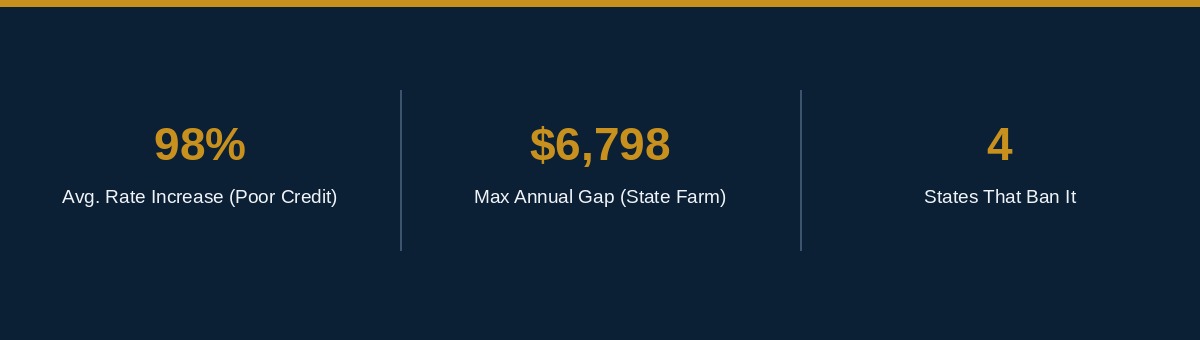
The size of the effect is bigger than most drivers expect. Averaged across the industry, poor credit increases car insurance rates by roughly 98% compared to excellent credit — nearly double. Bad credit adds an average of about $204 a month to full coverage compared to good credit.
The gap varies enormously by company. Nationwide’s increase for poor credit runs around 46%, while State Farm’s runs as high as 336%. In dollar terms, the annual difference between good and bad credit is about $551 at Progressive, $1,663 at GEICO, and a striking $6,798 at State Farm — proof that how credit score affects car insurance rate depends heavily on which insurer you’re comparing.
States Where This Practice Is Banned
Whether credit score affect car insurance rate calculations even apply to you depends partly on geography. Four states don’t allow insurers to use credit-based scoring at all: California, Hawaii, Massachusetts, and Michigan. If you live in one of these states, your credit history has no bearing on your car insurance rate no matter which company you choose. Everywhere else, it’s fair game, which makes comparison shopping across insurers even more valuable if your credit isn’t strong.
Checking Your Rate Doesn’t Hurt Your Credit
One detail that surprises a lot of drivers: when an insurer checks your credit to generate a quote, it’s almost always a soft pull, which does not affect your credit score at all. That means you can request quotes from five or ten different companies in the same afternoon without any credit-score consequence, which makes shopping around one of the lowest-risk ways to find a better rate.
How to Lower Your Rate If Your Credit Is a Problem
The most direct fix is the slow one: pay bills on time and keep balances low relative to your credit limits, since both feed directly into your insurance score the same way they feed your regular credit score. If you need a rate now rather than in six months, a handful of insurers — including Root, Metromile, and a few others — build their pricing around telematics or driving behavior instead of credit, which can be a meaningfully cheaper option if your credit is the main thing working against you.
Frequently Asked Questions
How does credit score affect car insurance rate if I have no credit history at all?
Having no credit history (rather than bad credit) is treated differently by different insurers — some default to an average rate, while others treat “no file” similarly to poor credit. It’s worth asking a specific insurer how they handle it before assuming the worst.
If I improve my credit, how quickly does credit score affect car insurance rate change?
Not automatically or immediately. Most insurers re-check credit at renewal, not mid-term, so an improved score typically shows up in your rate at your next renewal rather than right away.
Does a low credit score affect car insurance rate more than a speeding ticket?
At many companies, yes — the dollar impact of poor credit can exceed that of a single moving violation, which is part of why it’s such a contentious rating factor with consumer advocates.
Is it worth switching insurers just because of credit-based pricing?
Often yes, since the size of the credit penalty varies so much by company — a driver penalized heavily at one insurer for their credit might see a dramatically smaller penalty, or none at all, at another.
Bottom Line: How Does Credit Score Affect Car Insurance Rate?
How does credit score affect car insurance rate in one sentence: it can nearly double your premium at some companies, do almost nothing at others, and it’s banned entirely in four states. Because checking quotes doesn’t hurt your credit, the highest-leverage move if your credit isn’t great is simply comparing quotes across several insurers rather than assuming your current company’s price is the best you can get.
For more detail on state-by-state rules, the National Association of Insurance Commissioners’ overview of credit-based insurance scoring is a solid neutral reference.
Related Reading
Lower Your Car Insurance Premium and Save Big: The Proven 2026 Guide
Renters Insurance 101: What It Covers and Why You Need It

About the Author: BizShieldGuide Team
The BizShieldGuide team researches and writes plain-language guides to business and personal insurance — general liability, professional liability, workers' compensation, business owners policies, cyber liability, and industry-specific coverage for small business owners, alongside straightforward explainers on auto, home, and renters insurance for everyday readers. Our articles are grounded in publicly available data from insurers and carriers (Insureon, The Hartford, Progressive, State Farm, and others), industry cost surveys, and standard policy language, and we link to primary sources wherever a number or coverage detail could change. We are not licensed insurance agents or brokers, and nothing here replaces a quote or advice from one for your specific situation.