Ecommerce business insurance is the coverage online sellers need once they start shipping physical products, taking payments, and dealing directly with customers, since platforms like Amazon and Etsy leave most of that liability with the seller rather than the marketplace. If you sell on Amazon, Etsy, or Shopify and something you shipped injures a customer, the platform’s seller protection policy almost certainly won’t help you — and on Etsy specifically, the terms actually require you to indemnify the platform for legal claims tied to your products, meaning you could end up covering Etsy’s legal costs too.
Marketplace seller protections are built for disputes like non-delivery or “item not as described”; they were never designed to cover product liability, and the platforms are increasingly explicit that this risk sits entirely with the seller.
Amazon has gone further and now requires many sellers to actually prove they carry commercial insurance before they can keep selling.
The Coverage Gap Platforms Leave Open
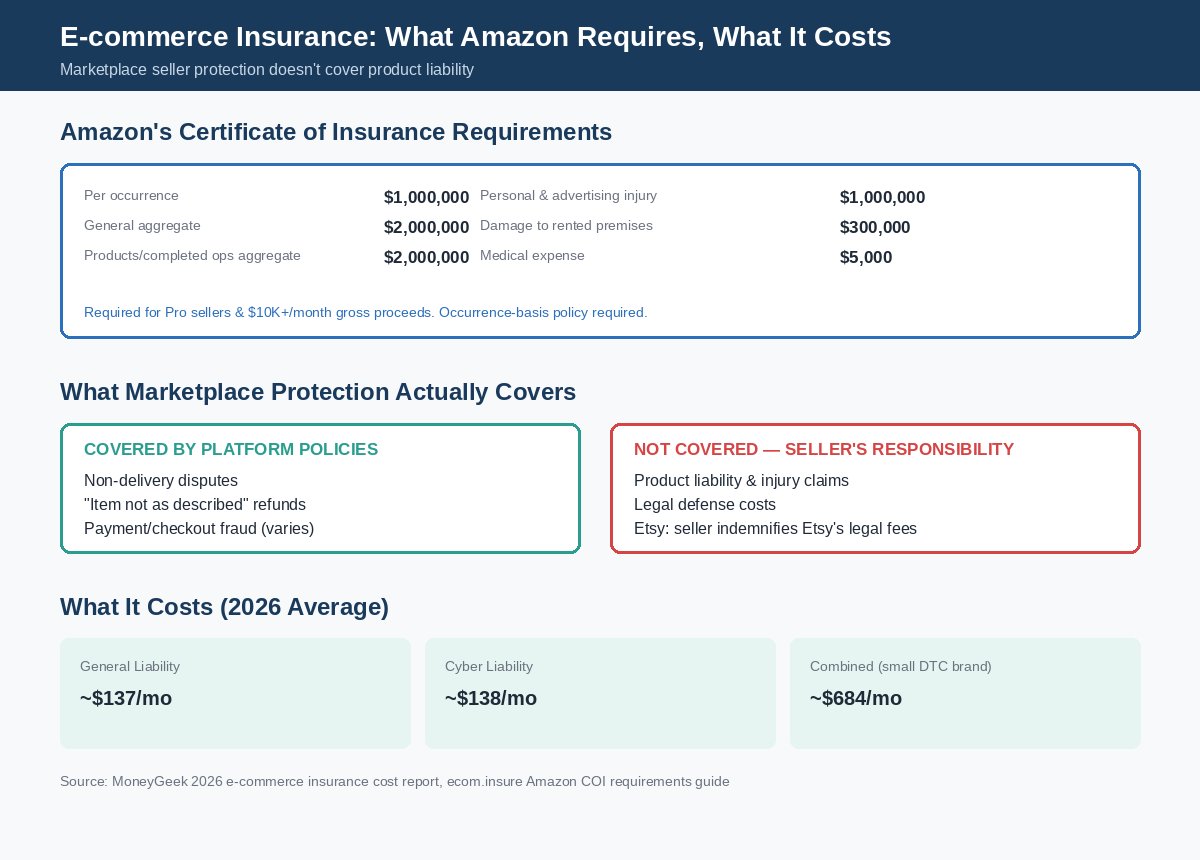
Etsy’s Seller Protection Policy covers non-delivery and not-as-described cases — refund and dispute scenarios — and explicitly does not cover product liability claims. Etsy’s terms go a step further, stating that any legal claim related to a purchased item must be brought directly against the seller, and sellers agree to indemnify Etsy for legal action arising from their products. In practice, that means an uninsured seller isn’t just exposed to a customer’s claim; they could be on the hook for Etsy’s legal fees as well.
Amazon and Shopify carry similar underlying logic even where the language differs: the marketplace facilitates the sale, but liability for what the product actually does sits with the person who made or sold it.
What Amazon Actually Requires
Amazon mandates commercial general liability insurance, with proof via certificate of insurance, for Professional sellers and any seller generating over $10,000 in gross proceeds in two consecutive months. The required limits are specific: $1 million per occurrence, $2 million general aggregate, $2 million products/completed operations aggregate, $1 million for personal and advertising injury, $300,000 for damage to rented premises, and $5,000 in medical expense coverage. The policy has to be written on an occurrence basis rather than claims-made, since claims-made policies require ongoing “tail” coverage after cancellation that occurrence policies don’t.
com Services LLC, its Affiliates and Assignees are listed as additional insureds” — and a COI that gets the wording, limits, or certificate-holder format wrong is commonly rejected, which can delay listings or trigger account suspension until it’s fixed.
Product Liability: The Coverage That Matters Most
General liability and product liability are often bundled into a single policy for online sellers, but the product liability piece is the one doing the real work. Claims tend to involve choking hazards, broken or defective pieces, allergic reactions to materials, or electrical issues — and handmade or small-batch sellers face a specific version of this risk: if you use components sourced from another manufacturer, you can be named in a liability claim alongside that manufacturer even when the defect originated with their part, not your assembly.
Claim costs aren’t small — average product liability claims ran around $25,000 as of recent industry data, and costs have risen substantially over the past decade. I’ve seen sellers assume that because they don’t manufacture anything from scratch, they’re somehow insulated from this; assembling, private-labeling, or even just reselling a product can still put you in the liability chain if it causes harm.
What It Costs
Based on 2026 industry data, e-commerce business insurance averages around $173/month combined, with general liability running about $137/month and cyber insurance around $138/month as standalone policies; a small direct-to-consumer brand bundling general liability, commercial property, workers’ compensation, and cyber coverage together can run closer to $684/month. Cost varies significantly by product category — supplements, electronics, and children’s products carry meaningfully higher liability rates than apparel or home goods — and by how you store and ship inventory, which sales channels you use, and whether you have employees or warehouse operations.
A Practical Checklist for Online Sellers
- Check your specific marketplace’s insurance requirements before assuming there are none — Amazon’s $10,000/month threshold catches sellers off guard because it applies well before “big business” territory.
- Buy product liability specifically, not just general liability — for physical goods, this is the coverage doing the actual work when something you sold causes harm.
- Match your limits to your platform’s exact requirements if you sell through Amazon — an occurrence-basis policy with the correct additional-insured wording avoids the common COI rejection reasons that can pause your listings.
- Add cyber liability if you store customer payment or personal data, which covers most sellers processing their own checkout rather than relying entirely on a marketplace’s payment system.
- Revisit coverage as you scale past a single platform’s threshold — moving from Etsy to your own Shopify store, or crossing Amazon’s revenue trigger, both change what you’re required to carry.
The sellers who get hurt by this gap usually aren’t ignoring the risk out of carelessness — they’re reasonably assuming that because a marketplace handles payments, disputes, and returns, it must also be handling liability. It isn’t, and the terms of service for most platforms say so directly if you read the fine print.
Related Reading
- MoneyGeek’s 2026 e-commerce business insurance cost report
- A breakdown of Amazon’s certificate of insurance requirements for sellers
- Our guide to product liability insurance, for a deeper look at how this coverage works
This article is for general informational purposes and isn’t personalized insurance, legal, or financial advice. Coverage rules, costs, and state requirements change, and every business’s risk is different — for decisions specific to your business, talk to a licensed insurance agent. Learn more About BizShieldGuide or reach us via our Contact page.
What ecommerce business insurance actually covers
Ecommerce business insurance typically starts with product liability coverage, which protects an online seller if a product they sold causes injury or property damage to a customer. This is the single most important piece of ecommerce business insurance for anyone selling physical goods, because platforms like Amazon, Etsy, and Shopify do not accept liability on the seller’s behalf when a customer is hurt by a defective product — that responsibility, and the legal costs that come with it, falls entirely on the seller unless ecommerce business insurance is in place.
General liability insurance is the second core piece of ecommerce business insurance, covering claims unrelated to the product itself, such as a warehouse visitor’s injury or advertising-related disputes like trademark or copyright claims from a competitor. Many ecommerce sellers also add cyber liability insurance as part of their ecommerce business insurance package, since online stores handle customer payment data and are frequent targets of data breaches, and a breach can trigger notification costs, legal fees, and regulatory fines that a standard policy will not cover.
Why marketplace protections are not a substitute for ecommerce business insurance
Amazon requires many third-party sellers to carry commercial general liability insurance once they cross certain sales thresholds, and Amazon itself is typically named as an additional insured on that ecommerce business insurance policy. This requirement exists precisely because Amazon’s own marketplace protections, such as the A-to-z Guarantee, protect buyers, not sellers, and do nothing to shield a seller from a lawsuit filed directly against them over a defective or dangerous product.
Etsy sellers face a similar gap: Etsy’s site itself carries no product liability coverage on behalf of individual shop owners, so any claim arising from a handmade or resold product lands entirely on the seller without ecommerce business insurance in place.
Sellers who assume that operating exclusively through a marketplace platform limits their legal exposure are often surprised to learn that courts have held marketplace sellers personally liable in product injury cases even when the platform processed the sale and payment. Ecommerce business insurance is what actually responds to that kind of claim — the marketplace’s own terms of service typically disclaim any liability for the products sold through it, shifting the entire burden back to the individual seller.
How much ecommerce business insurance costs
Pricing for ecommerce business insurance depends heavily on product category, since a seller of low-risk items like clothing or non-electronic accessories pays considerably less than a seller of items with higher injury potential, such as supplements, cosmetics, children’s products, or anything electrical. Many online sellers can obtain a basic ecommerce business insurance policy with a million dollars in product liability and general liability coverage for a few hundred dollars a year, though sellers in higher-risk categories or with higher sales volume should expect higher premiums and may need higher coverage limits to satisfy marketplace requirements.
Getting started with ecommerce business insurance
Most insurers now offer ecommerce business insurance policies built specifically for online sellers, with applications that can be completed in minutes using basic information about product category, sales volume, and which marketplaces the seller uses. Because Amazon and other marketplaces can request a certificate of insurance on short notice, especially after a seller crosses a sales threshold, having ecommerce business insurance in place before it is required — rather than scrambling to buy it under a compliance deadline — avoids an account suspension or listing restriction while the paperwork is sorted out.
Sellers who source products from multiple manufacturers or use dropshipping arrangements should also confirm that their ecommerce business insurance extends to products they did not manufacture themselves, since some policies limit coverage to products the policyholder actually produces. Reviewing this detail with an insurance agent who understands ecommerce business insurance, rather than assuming a generic small business policy covers every product sold through an online store, prevents a coverage gap from surfacing at the worst possible time — after a claim has already been filed.
Ecommerce business insurance for different platforms
Sellers who operate across several platforms at once — for example listing the same products on Amazon, Etsy, and their own Shopify store — need ecommerce business insurance broad enough to cover the business as a whole rather than one platform in isolation. Some marketplace-specific programs offer discounted group insurance rates for sellers on that platform, but relying solely on a platform-specific program can leave gaps once a seller expands to additional channels.
A standalone ecommerce business insurance policy purchased independently of any single marketplace typically travels with the business regardless of where products are ultimately sold, which is the safer long-term approach for any seller planning to grow beyond one channel.
Etsy sellers in particular sometimes assume that because their products are handmade, they carry less liability risk than mass-manufactured goods, but ecommerce business insurance underwriters do not necessarily see it that way — handmade candles, bath products, children’s toys, and food items can all carry meaningful injury risk, and insurers price ecommerce business insurance for these categories accordingly. Reviewing the specific product categories being sold with an insurance agent, rather than assuming “handmade” or “small batch” reduces the need for ecommerce business insurance, produces a more accurate and complete policy.
Common exclusions and limits to check in ecommerce business insurance
Not every ecommerce business insurance policy automatically extends to every marketplace program a seller might join. Amazon’s Fulfilled by Amazon program, for example, introduces additional parties into the shipping and storage chain, and some ecommerce business insurance policies specifically exclude claims arising from a third-party fulfillment center’s handling errors. Confirming exactly which fulfillment arrangements are covered under a given ecommerce business insurance policy, especially before enrolling in a new fulfillment program, avoids a nasty surprise if a shipping-related claim is later denied.
International sales add another wrinkle: a seller who ships ecommerce products to customers overseas should confirm that their ecommerce business insurance actually responds to claims filed in a foreign jurisdiction, since many domestic product liability policies limit coverage to claims filed within the seller’s home country. Sellers with a meaningful share of international sales often need an endorsement or a separate international coverage rider added to their standard ecommerce business insurance policy to close this gap.
When to increase ecommerce business insurance coverage limits
As an ecommerce business grows in sales volume, product range, or average order value, the coverage limits on an existing ecommerce business insurance policy that felt adequate at launch can quietly become insufficient. A seller who started with a million dollars in product liability coverage while selling a handful of low-risk items should revisit that limit once the catalog expands into higher-risk categories or once total annual revenue crosses a threshold that would make a serious claim proportionally larger.
Many insurers recommend reviewing ecommerce business insurance coverage limits at least once a year, timed around the same review that many sellers already do for their overall business plan and inventory strategy.
The bottom line on ecommerce business insurance
Selling through Amazon, Etsy, or any other marketplace does not transfer meaningful liability protection to the seller — ecommerce business insurance is what actually stands between a single product complaint and a lawsuit that could threaten the entire business. Sellers who treat ecommerce business insurance as a startup cost to minimize, rather than as an ongoing part of running the business responsibly, often learn the hard way that a single claim can cost far more than years of premiums combined.
Building ecommerce business insurance into the basic cost of doing business online, right alongside marketplace fees and shipping costs, is the safer and more sustainable approach for any seller planning to grow.
A few practical steps before the first sale
New online sellers preparing their first product listing sometimes push insurance research to the bottom of a long launch checklist, behind sourcing, photography, and setting up payment processing. Flipping that order, even briefly, is worth the extra day it takes: getting a quote, comparing coverage limits, and understanding what a policy actually excludes before the first order ships means a seller is never caught mid-launch scrambling to produce documentation a marketplace or a business partner suddenly requires.
A short conversation with an agent who works specifically with online sellers, rather than a generalist who mostly handles brick-and-mortar retail, usually surfaces coverage gaps a first-time seller would not think to ask about on their own — things like fulfillment center liability, cross-border shipping exposure, or how a private-label product differs from reselling an established brand. None of this needs to slow down a launch by more than a day or two, and doing it up front avoids the far more disruptive scenario of sorting out coverage after a claim, a marketplace compliance request, or an account suspension notice has already landed.
Reviewing coverage does not have to mean starting from scratch every renewal. Once a policy is in place, the fastest way to keep it accurate is to update the insurer whenever something material changes — a new product category, a new fulfillment partner, a new country added to the shipping map, or a jump in monthly order volume. Most insurers only need a short update rather than a full new application to adjust limits or add an endorsement, and doing this proactively, rather than waiting for the annual renewal to surface the mismatch, keeps the policy aligned with the business as it actually operates day to day.
None of this requires expensive consulting or a dedicated risk manager, even for a growing store. A simple habit — noting insurance-relevant changes in the same place a seller already tracks inventory or supplier updates, and glancing over that list before each renewal — is usually enough to keep a policy current without turning it into a recurring administrative burden.

About the Author: BizShieldGuide Team
The BizShieldGuide team researches and writes plain-language guides to business and personal insurance — general liability, professional liability, workers' compensation, business owners policies, cyber liability, and industry-specific coverage for small business owners, alongside straightforward explainers on auto, home, and renters insurance for everyday readers. Our articles are grounded in publicly available data from insurers and carriers (Insureon, The Hartford, Progressive, State Farm, and others), industry cost surveys, and standard policy language, and we link to primary sources wherever a number or coverage detail could change. We are not licensed insurance agents or brokers, and nothing here replaces a quote or advice from one for your specific situation.