
Commercial umbrella insurance kicks in once a lawsuit or claim exceeds the limits on your underlying general liability, auto, or employer’s liability policy. A commercial umbrella policy doesn’t add new types of coverage — it adds more of the coverage you already have, sitting on top of your general liability, commercial auto, and employer’s liability policies and kicking in once any one of them maxes out. Before you decide, make sure you understand commercial umbrella insurance correctly.
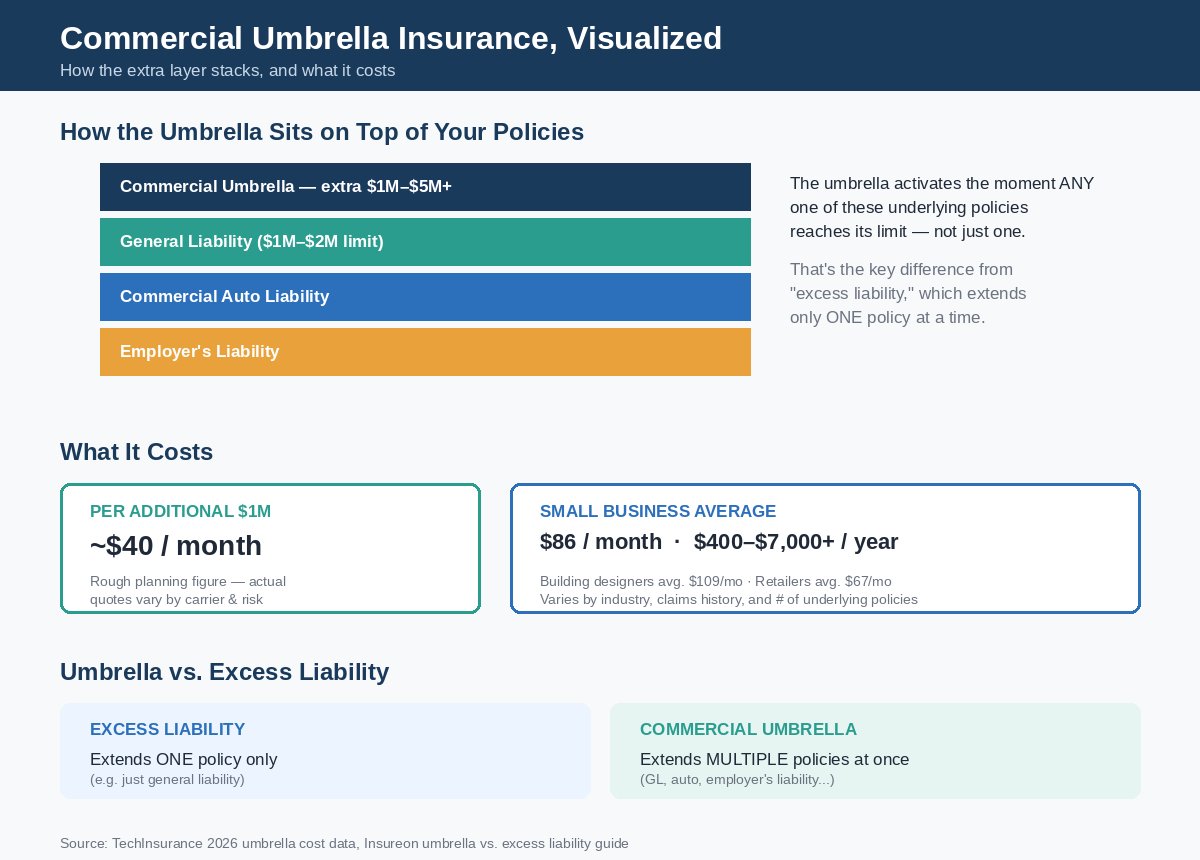
For a small business, that extra protection is surprisingly cheap: roughly $40 a month per additional $1 million in coverage, or about $86/month on average across small businesses that carry it. Many owners overlook this detail when comparing commercial umbrella insurance options.
Given that a single serious lawsuit can blow past a standard $1–2 million liability limit without much difficulty, it’s one of the better value-for-cost additions a growing small business can make — but it’s also one of the more misunderstood, often confused with “excess liability,” which is a narrower, different product. This is one of the most common questions we hear about commercial umbrella insurance.
Why a Standard Liability Limit Isn’t Always Enough
Most small businesses carry $1 million or $2 million in general liability coverage, and for the vast majority of claims — a slip-and-fall, minor property damage — that’s plenty. The exposure shows up in the claims that aren’t typical: a customer with a serious, long-term injury; a multi-vehicle accident involving a company driver; a lawsuit that drags in legal fees on top of the settlement itself. I’ve seen a general liability limit that looked more than adequate on paper get consumed almost entirely by a single injury claim, leaving the business exposed for whatever came after — which is exactly the gap umbrella coverage exists to close.
Umbrella vs. Excess Liability — They’re Not the Same Thing
These two get used almost interchangeably, but they behave differently: This is exactly the kind of scenario where commercial umbrella insurance matters most.
Excess liability extends just one underlying policy — typically general liability or errors & omissions. It’s “following form,” meaning it mirrors that single policy’s terms exactly and only steps in once that specific policy’s limit is exhausted. If you carry a $2 million general liability limit and face $2.5 million in damages, excess liability covers the remaining $500,000 — but only because the claim originated under that one policy. That’s a detail worth double-checking with your broker on commercial umbrella insurance.
Commercial umbrella sits above multiple policies at once — general liability, commercial auto, hired & non-owned auto, employer’s liability — and activates when any one of them hits its limit. It can also broaden coverage in places where an underlying policy has gaps, sometimes subject to a self-insured retention (a deductible-like amount you cover before the umbrella responds). For a business carrying several different liability policies, umbrella is usually the more efficient way to add a layer of protection across all of them at once, rather than buying excess coverage on each policy separately.
What It Costs, and What Moves the Price
Based on 2026 small-business insurance data, commercial umbrella coverage averages around $86 a month, with annual premiums ranging from under $400 to over $7,000 depending on the business. If you’re evaluating commercial umbrella insurance, this distinction is worth remembering.
As a rough planning figure, each additional $1 million in coverage adds roughly $40/month — so a business adding $2 million in umbrella protection on top of its existing policies might expect somewhere in the neighborhood of $80/month, though actual quotes vary by carrier and risk profile. Industry matters: building designers average around $109/month for umbrella coverage, while retailers average closer to $67/month, reflecting the different liability profiles of each.
Claims history, business size, the number of underlying policies you carry, and how often the business handles client property or drives vehicles all factor into the quote as well. Treat these as planning ranges rather than a quote — the only way to know your actual premium is to ask a carrier that’s looked at your specific policies and history. Keep this in mind the next time you shop for commercial umbrella insurance.
Who Actually Needs This
Umbrella coverage isn’t necessary for every small business, but it becomes worth a serious look once any of the following apply: the business has meaningful public foot traffic or hosts events, operates vehicles (owned or employee-owned) for work, employs staff who could be injured on the job, or has simply grown to the point where a single lawsuit could plausibly exceed a $1–2 million limit. It’s also increasingly common for landlords and larger corporate clients to require a specific higher liability limit in a lease or contract — an umbrella policy is often the most cost-effective way to meet that requirement without restructuring every underlying policy.
How to Add It Without Overpaying
- Review your underlying limits first. An umbrella policy is only as strong as what it sits on top of — insurers typically require minimum underlying limits before they’ll write umbrella coverage.
- Consolidate underlying policies with one carrier where possible. Umbrella coverage is often priced more favorably when the carrier also holds your general liability and auto policies.
- Match the limit to your actual exposure rather than defaulting to $1 million — a business with vehicles on the road or frequent public events may reasonably need $2 million or more.
- Ask specifically which underlying policies the umbrella follows. Not every umbrella policy automatically extends over commercial auto or employer’s liability — confirm it in writing.
- Revisit the limit annually as revenue, headcount, or contract requirements change — umbrella needs typically grow faster than owners expect once a business is scaling.
The businesses that end up needing umbrella coverage and don’t have it usually aren’t the ones running unusually risky operations — they’re ordinary small businesses that grew past what a standard policy limit was ever designed to absorb, and didn’t revisit their coverage as that happened. It’s a small detail, but it can make a real difference for commercial umbrella insurance.
Related Reading
- TechInsurance’s 2026 commercial umbrella insurance cost data
- Insureon’s comparison of commercial umbrella vs. excess liability insurance
- Our guide to general liability insurance 101, the policy umbrella coverage most often sits on top of
This article is for general informational purposes and isn’t personalized insurance, legal, or financial advice. Coverage rules, costs, and state requirements change, and every business’s risk is different — for decisions specific to your business, talk to a licensed insurance agent. Learn more About BizShieldGuide or reach us via our Contact page. Understanding this point can save you real money on commercial umbrella insurance.
Commercial umbrella insurance is often the cheapest coverage a business ever buys relative to the protection it provides — an extra $1 million in coverage frequently costs just a few hundred dollars a year, because it only pays out after your underlying policy’s limit is exhausted. That makes commercial umbrella insurance an efficient way to add real protection without paying to raise every underlying policy limit individually.
Businesses with more public exposure — retail locations, restaurants with alcohol service, contractors on active job sites, or any company running a vehicle fleet — tend to need higher commercial umbrella insurance limits than a home-based consultant with no employees and no physical location clients visit. Insurers typically require you to carry certain minimum underlying limits before they’ll sell you commercial umbrella insurance at all.
A single serious injury lawsuit can easily exceed a standard $1 million general liability limit once medical costs, lost wages, and legal fees are added up, which is exactly the situation commercial umbrella insurance is designed to protect against. Most brokers recommend at least $1-2 million in commercial umbrella insurance for any business with employees, vehicles, or regular public foot traffic.

About the Author: BizShieldGuide Team
The BizShieldGuide team researches and writes plain-language guides to business and personal insurance — general liability, professional liability, workers' compensation, business owners policies, cyber liability, and industry-specific coverage for small business owners, alongside straightforward explainers on auto, home, and renters insurance for everyday readers. Our articles are grounded in publicly available data from insurers and carriers (Insureon, The Hartford, Progressive, State Farm, and others), industry cost surveys, and standard policy language, and we link to primary sources wherever a number or coverage detail could change. We are not licensed insurance agents or brokers, and nothing here replaces a quote or advice from one for your specific situation.