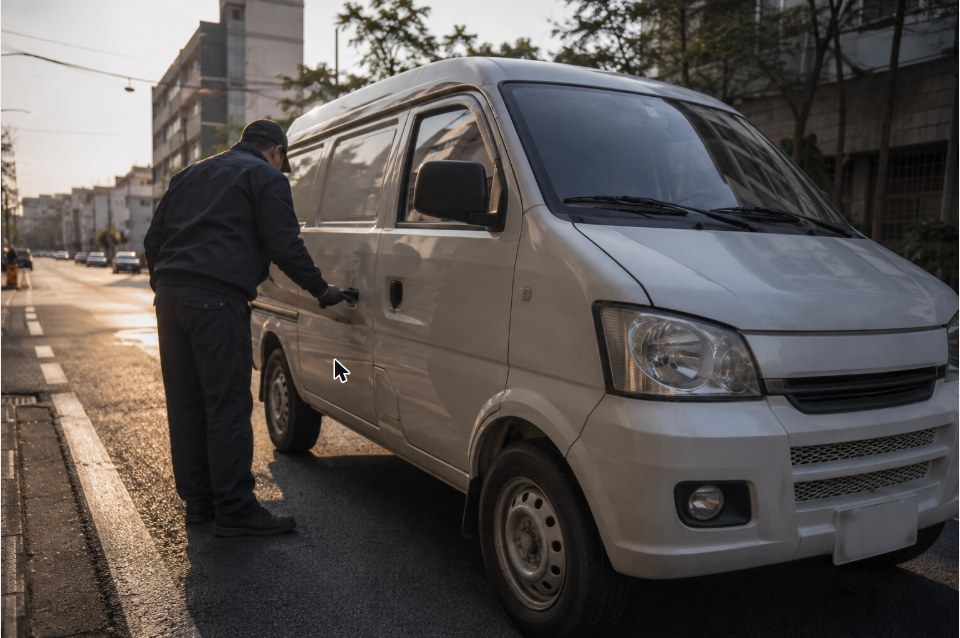
Commercial auto insurance is almost always required the moment a vehicle is titled to your business or used to haul tools, equipment, or paying customers. If you or anyone on your payroll drives anywhere for work — even just running to the post office in a personal car twice a month — your personal auto insurance almost certainly won’t pay out if something goes wrong.
Personal policies carry a standard business-use exclusion, and insurers enforce it.
The fix depends on whether the vehicle is titled to the business (commercial auto) or owned by you or an employee personally (hired and non-owned auto, or HNOA), and getting the wrong one — or skipping it because “we only drive occasionally” — is one of the more expensive gaps small business owners leave open.
The Business-Use Exclusion Most Owners Don’t Know About
Personal auto policies are underwritten around personal-use risk. The moment a vehicle is used to make deliveries, shuttle equipment, drive to client meetings, or run business errands, that use falls outside what the policy was priced for — and outside what it covers. Insureon puts it plainly: personal auto insurance “won’t cover business vehicle use,” full stop, regardless of how the vehicle is titled.
I’ve seen this play out with a home-services client who used his own truck for both weekend personal trips and weekday job-site runs. He assumed his personal policy “probably” covered the truck either way, since he was the one driving it either way. It doesn’t work that way — insurers look at the purpose of the trip at the time of the accident, not who owns the car.
Commercial Auto vs. Hired & Non-Owned Auto — Which One Do You Need?
These solve two different problems, and most small businesses eventually need pieces of both: This is exactly the kind of scenario where commercial auto insurance matters most.
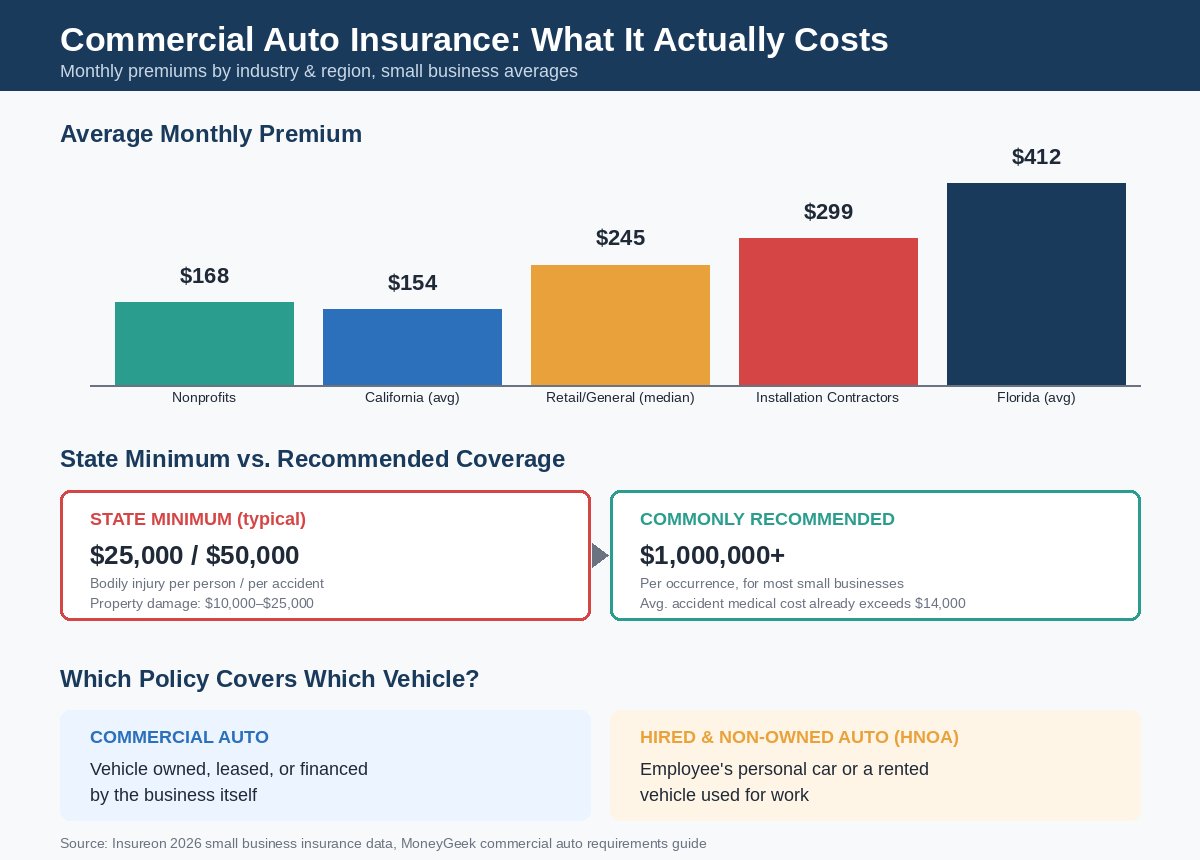
Commercial auto insurance covers vehicles the business itself owns, leases, or finances — a company van, a branded truck, a fleet of delivery cars. It’s typically required in most states once a vehicle is titled to the business. Many owners overlook this detail when comparing commercial auto insurance options.
Hired and non-owned auto (HNOA) covers a different scenario: an employee using their own car, or the business renting a vehicle, for work purposes. It’s liability-only, it’s secondary to the driver’s personal policy (meaning the personal policy pays first, HNOA picks up the rest), and it’s the piece that catches businesses that don’t think of themselves as having “vehicles” at all — event planners renting a van for a weekend, a consultant driving her own car to client sites, a food delivery operation using drivers’ personal cars.
If your business owns even one titled vehicle, you need commercial auto. If employees ever use their own cars for anything work-related — including the “quick supply run” — you likely need HNOA on top of it, or instead of it if the business owns no vehicles at all. Before you decide, make sure you understand commercial auto insurance correctly.
What Commercial Auto Actually Costs
According to Insureon’s 2026 book of small business data, the median small business pays around $245 a month for commercial auto coverage, though the spread is wide — annual premiums range from under $375 to well over $16,000 depending on fleet size, industry, and driving records. About 40% of small businesses pay under $200 a month; another 29% land between $200 and $400. Keep this in mind the next time you shop for commercial auto insurance.
Industry matters more than most owners expect: nonprofits average roughly $168/month, while installation contractors — who drive more, and often haul equipment — average closer to $299/month. Location swings it too; the same coverage can run under $160/month in California and over $400/month in Florida, largely reflecting regional accident and litigation costs. It’s a small detail, but it can make a real difference for commercial auto insurance.
These are industry averages, not quotes — your actual premium depends on your specific drivers, vehicles, and claims history, so treat any number here as a planning baseline rather than what you’ll be charged. If you’re evaluating commercial auto insurance, this distinction is worth remembering.
Why State Minimums Rarely Cover the Real Cost of an Accident
Most states set commercial auto minimums somewhere around $25,000 per person / $50,000 per accident in bodily injury liability, with property damage minimums of $10,000–$25,000 — though this varies by state; Maine requires more ($50,000/$100,000), Louisiana less ($15,000/$30,000), so check your state’s actual figures rather than assuming. The problem is that these floors were set decades ago and haven’t kept pace with medical costs.
Average medical costs from a single vehicle accident now exceed $14,000, and that’s before you factor in lost wages, a lawsuit, or a multi-vehicle pileup. A minimum-limits policy can leave a business paying the difference out of pocket on a bad accident — which defeats the point of carrying insurance in the first place. Most agents I’ve seen work with small businesses recommend at least $1 million per occurrence for anything beyond a single-driver, low-mileage operation.
Higher Federal Minimums for Trucks and Hazmat
If your business runs anything close to a commercial truck — vehicles over 10,001 lbs used in interstate freight — federal rules require a minimum of $750,000 in liability coverage, jumping to $5 million for hazardous materials transport or vehicles carrying 16 or more passengers. These are federal DOT-level requirements layered on top of whatever your state requires, and they apply regardless of how small the operation is.
How to Get Covered Without Overpaying
- Inventory every vehicle that touches your business — company-owned, employee-owned, and rented — before you call an agent. Missing one is the most common reason coverage gaps show up later.
- Match the policy to the ownership: commercial auto for anything titled to the business, HNOA for anything titled to an employee or rented short-term.
- Don’t default to state minimums. Ask for a quote at $1 million per occurrence and compare the premium difference — it’s usually smaller than owners expect.
- Bundle where possible. Commercial auto is often available as part of a package policy alongside general liability, which can bring the combined premium down.
- Re-check coverage when your fleet or driver list changes — a new hire who drives, or a new delivery vehicle, needs to be added before their first trip, not after an accident.
The pattern behind most commercial auto claims that go badly isn’t reckless driving — it’s a business that genuinely didn’t realize its personal or general liability coverage stopped at the curb. If anyone touches a steering wheel for your business, even occasionally, it’s worth a 15-minute call to confirm you’re not running that exposure bare. Understanding this point can save you real money on commercial auto insurance.
Related Reading
- Insureon’s 2026 commercial auto insurance cost data
- MoneyGeek’s commercial auto insurance requirements guide
- Insureon’s hired and non-owned auto insurance FAQ
- Our guide to general liability insurance, which commercial auto is often bundled with in a package policy
This article is for general informational purposes and isn’t personalized insurance, legal, or financial advice. Coverage rules, costs, and state requirements change, and every business’s risk is different — for decisions specific to your business, talk to a licensed insurance agent. Learn more About BizShieldGuide or reach us via our Contact page. This is one of the most common questions we hear about commercial auto insurance.
Commercial auto insurance differs from a personal policy in a few important ways: it covers higher liability limits, extends to employees driving company vehicles, and includes hired and non-owned auto coverage for when staff use their own cars for business errands. Most personal auto policies exclude business use entirely once you cross into regular commercial activity, which is exactly when a claim gets denied.
Pricing for commercial auto insurance depends heavily on vehicle type, driving records, and how the vehicles are used — a fleet of delivery vans costs more to insure than a single pickup truck used occasionally for job sites. Bundling commercial auto insurance with your general liability policy can often bring the combined premium down.

About the Author: BizShieldGuide Team
The BizShieldGuide team researches and writes plain-language guides to business and personal insurance — general liability, professional liability, workers' compensation, business owners policies, cyber liability, and industry-specific coverage for small business owners, alongside straightforward explainers on auto, home, and renters insurance for everyday readers. Our articles are grounded in publicly available data from insurers and carriers (Insureon, The Hartford, Progressive, State Farm, and others), industry cost surveys, and standard policy language, and we link to primary sources wherever a number or coverage detail could change. We are not licensed insurance agents or brokers, and nothing here replaces a quote or advice from one for your specific situation.