
If your business insurance policy is active and paid up, a certificate of insurance should take you minutes to get and cost you nothing. Most carriers and agencies now issue an ACORD 25 — the standard one-page proof-of-coverage form — through an online portal the same day you request it, and sometimes instantly. The people who wait a week for a COI are almost always the ones whose policy has a problem underneath it: a lapsed payment, limits that don’t meet the client’s contract, or a business name that doesn’t match the paperwork. Fix the underlying issue and the certificate itself is the easy part.
What a COI actually is (and isn’t)
A certificate of insurance is a summary document. It lists your business name, the types of coverage you carry, your policy limits, your policy number, and your effective and expiration dates, all issued by your insurer or agent on a standardized form — usually the ACORD 25 Certificate of Liability Insurance, a form developed by the Association for Cooperative Operations Research and Development that virtually every commercial insurer uses. The Hartford describes it plainly as a document that shows “a business or individual has the necessary insurance coverage to protect themselves and others,” and stresses that it’s essentially a snapshot of the policy, not the policy itself (The Hartford, 2025).
That distinction matters more than it sounds. A COI doesn’t add coverage, doesn’t change your policy terms, and doesn’t obligate your insurer to notify anyone if your policy is later canceled, despite what older certificate language implied — it’s proof of what existed at the moment it was printed. If your coverage lapses or your limits change the next day, the certificate sitting in someone’s file drawer is instantly out of date, and nobody gets an automatic alert.
Because it’s just a summary, a COI is free in the vast majority of cases. Progressive Commercial notes that certificates are provided to policyholders “at no charge” (Progressive Commercial) — you’re not buying anything new, just requesting a printout of what you already have. Landlords and general contractors both tend to ask for the same certificate of insurance format.
When you’ll be asked for one
If you run a small business, a COI request is one of those things that shows up at the worst possible moment — usually 48 hours before you need to start work. The most common triggers: Save a digital copy of every certificate of insurance you request, since you’ll likely need it again.
- Commercial landlords before you get keys to a leased space, often requiring general liability limits and sometimes naming the landlord as an additional insured on the lease.
- Clients before a contract kicks off, especially in services and events, where the client’s own risk management team wants proof you’re covered before you’re on-site.
- General contractors requiring proof of coverage from every subcontractor before they’re allowed on a job — close to universal in construction and trades.
- Event venues before you’re permitted to host or vend, typically requiring general liability with the venue named as an additional insured for the event date.
- Lenders or licensing bodies, in some states, as part of business registration or professional licensing (Next Insurance).
These requests are rarely a formality. Whoever is asking usually has a specific limit and specific wording in mind, often buried in a contract clause you signed without reading closely. If your policy doesn’t match, the certificate can’t be issued the way they want it — a coverage problem, not a paperwork problem. A certificate of insurance only reflects coverage in force on the day it’s issued, not guaranteed future coverage.
What you need to request one
Requesting a COI is one of the least document-heavy things you’ll do as a business owner, provided your policy is current. In most cases, you need: Keeping a certificate of insurance on file also makes renewal season much less stressful.
- Your policy number (or your account login with the carrier/agency).
- The exact legal name and mailing address of the “certificate holder” — get this in writing; a misspelled or informal name is a common reason a certificate bounces back for correction.
- Whether they want to be listed only as a certificate holder, or added as an “additional insured” (more on the difference below).
- Any specific coverage types and minimum limits required — general liability, workers’ comp, auto, professional liability, umbrella — usually spelled out in the contract or lease.
- A description of the operations or project, if they want that noted in the description-of-operations field.
That’s it. You don’t need to submit new applications or answer underwriting questions — the certificate just reflects a policy you already bought. Insureon notes customers can typically pull an ACORD certificate “online or on their phone shortly after buying a policy,” and most agencies now offer similar self-serve access (Insureon). Double-check the certificate of insurance for the correct additional insured wording before you send it along.
Additional insured requests, explained
A “certificate holder” is just someone who receives a copy of the certificate for their records. An “additional insured” is different and more consequential — a party actually added to your policy, via an endorsement, so they share in your liability coverage for claims arising out of your work. NerdWallet frames it as a party “added to an insurance policy so that they can be protected alongside the policyholder” (NerdWallet). Landlords and general contractors ask for this constantly, since it means someone hurt on a job connected to your work can potentially be covered under your policy rather than relying solely on their own.
Who approves it, and does it cost anything
Most insurers let you add an additional insured for free, and many agencies process the request in a few minutes through an online portal — no phone call needed. But that’s not universal. Depending on your carrier and policy type, adding an additional insured can require sign-off from the insurer’s underwriting team rather than just your agent, particularly for professional liability or higher-risk operations, and it can sometimes affect your premium if the endorsement is broad or ongoing rather than tied to a single project (NerdWallet). If you’re regularly asked to add clients as additional insureds, ask your agent about a blanket additional insured endorsement, which automatically extends coverage to anyone you’re contractually required to add.
One mistake I see constantly holds up a certificate for days: the business owner asks their agent to “just add them as additional insured” without checking whether the client actually needs that or only needs to be listed as a certificate holder. Those are two different requests with two different processing paths, and conflating them means your agent has to go back and clarify before anything can move — which turns a same-day certificate into a multi-day back-and-forth over email. A well-organized certificate of insurance file saves real time when multiple clients request one in the same week.
Step-by-step: how to get a COI fast
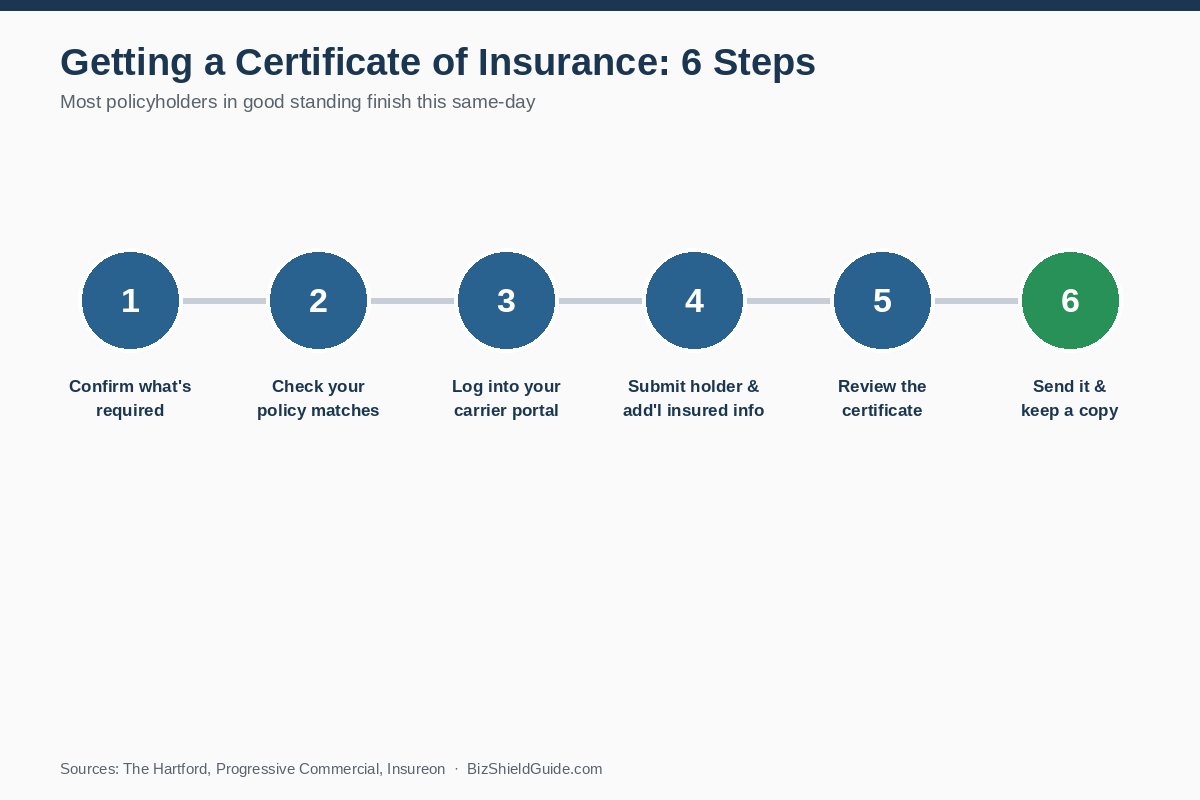
When your policy is in good standing, getting a certificate out the door should follow a predictable sequence: Most clients simply want to see a valid certificate of insurance before work begins.
- Confirm exactly what’s required. Get the certificate holder’s exact legal name, mailing address, required coverage types and minimum limits, and whether they need to be an additional insured or just a listed holder.
- Check your policy against those requirements. Compare your current limits and coverage types before you request anything — catching a shortfall now saves a round trip later.
- Log into your carrier’s or agency’s self-service portal (or call/email your agent). Major carriers, including Progressive Commercial and Next Insurance, offer instant or same-day COI generation through an online account.
- Submit the certificate holder’s details and any additional insured request, in writing, so there’s a record of exactly what was asked for.
- Review the certificate before sending it on. Check the legal name, limits, dates, and additional insured status match what was requested — a wrong field here triggers rejection and a resend.
- Send it directly to the requesting party and keep a copy for your own records, in case you need to reissue after a renewal.
Turnaround expectations vary by carrier, but they’ve compressed a lot in recent years. The Hartford says most policyholders get a certificate “instantly” through their portal (The Hartford); Progressive Commercial estimates “within a day or two” (Progressive Commercial); and Insureon reports most customers get an ACORD certificate “within a couple of hours” of finishing a quote, with higher-risk industries sometimes taking up to 48 hours (Insureon). If your agent quotes you a week or more with no explanation, that’s usually a sign the policy needs attention first — certificates themselves aren’t the bottleneck.
Common delays and how to avoid them
Nearly every slow COI traces back to one of a handful of avoidable problems, and they’re almost never about the certificate itself: A missing certificate of insurance is one of the most common reasons a vendor gets bounced from a job site.
- Lapsed or non-renewed policies. If coverage lapsed even briefly — a missed payment, a canceled auto-pay — no certificate can be issued until it’s reinstated.
- Limits below what’s required. If a contract calls for $2 million in general liability and you’re carrying $1 million, your agent can’t just print a certificate showing $2 million — you’d need to raise your limits first, which may mean an underwriting review and a premium change.
- Entity name mismatches. A policy under “Smith Contracting LLC” won’t satisfy a request for “Smith Contracting, Inc.” Get your legal entity name exactly right, and make sure the certificate holder’s name is exact too.
- Confusing certificate holder with additional insured. Asking for the wrong one — or not specifying — creates avoidable back-and-forth.
- Missing endorsements the client requires, like waiver of subrogation or primary-and-noncontributory wording, which aren’t always automatic.
Agencies that track compliance for a living generally recommend starting renewal reminders at least 60 days out, precisely because catching a limits gap or a lapsed payment with weeks of runway is a non-event, while catching it the day before a job starts is a real problem (Expiration Reminder). I’ve watched a subcontractor lose a start date entirely because workers’ comp lapsed over a payment hiccup nobody caught until the GC’s compliance software flagged it — by the time the policy was reinstated, the crew ahead of schedule had already been reassigned.
Don’t treat the certificate request as the task. Treat it as a trigger to double-check your actual coverage — limits, entity name, payment status, required endorsements — a day or two before you expect to need it, not the morning it’s due. If that’s already in order, most agents and carrier portals can get you a finished, correctly worded COI the same day, often within minutes, and you won’t think about it again until the next client asks.
Related Reading
- General Liability Insurance 101: What It Covers and What It Doesn’t for Small Businesses
- Best Small Business Insurance Bundles by Industry: Retail, Restaurants, Contractors, and Consultants Compared
This article is for general informational purposes and isn’t personalized insurance, legal, or financial advice. Coverage rules, costs, and requirements change, and every business’s risk is different — for decisions specific to your business, talk to a licensed insurance agent. Learn more About BizShieldGuide or reach us via our Contact page. If you ever lose track of a certificate of insurance, most brokers can reissue one within minutes.

About the Author: BizShieldGuide Team
The BizShieldGuide team researches and writes plain-language guides to business and personal insurance — general liability, professional liability, workers' compensation, business owners policies, cyber liability, and industry-specific coverage for small business owners, alongside straightforward explainers on auto, home, and renters insurance for everyday readers. Our articles are grounded in publicly available data from insurers and carriers (Insureon, The Hartford, Progressive, State Farm, and others), industry cost surveys, and standard policy language, and we link to primary sources wherever a number or coverage detail could change. We are not licensed insurance agents or brokers, and nothing here replaces a quote or advice from one for your specific situation.