
Errors and omissions insurance cost varies more by industry than almost any other line of small business coverage. A marketing consultant working solo out of a home office might pay $59 a month for errors and omissions insurance. A financial advisor managing client portfolios can pay $287 a month for the same basic category of coverage — nearly five times as much. That gap isn’t a pricing accident.
E&O cost tracks how much money a mistake can cost your client, how often people in your line of work actually get sued, and how regulators or courts treat those disputes. If you’ve gotten a quote and wondered why your neighbor’s marketing agency pays a fraction of what your engineering firm pays, the profession itself is doing most of the work.
Why E&O Cost Varies So Much by Industry
Underwriters price a policy by estimating two things: how likely a claim is, and how expensive that claim will be if it happens. Those two numbers move independently across professions, which is why cost differences aren’t linear or intuitive. If you’re evaluating errors and omissions insurance cost, this distinction is worth remembering.
A bookkeeper who miscategorizes a few expenses might trigger a claim worth a few thousand dollars in accounting fixes. An engineer who signs off on a faulty structural calculation could be named in a lawsuit tied to a building failure worth millions. Both professionals can get sued for negligence, but the ceiling on damages is wildly different, and insurers price to that ceiling, not just the odds of a claim happening at all. That’s a detail worth double-checking with your broker on errors and omissions insurance cost.
Regulatory exposure adds another layer. Financial advisors and insurance agents operate under SEC, FINRA, or state insurance department oversight, and a client complaint can turn into both a lawsuit and a regulatory inquiry running in parallel — which is part of why Insureon’s data on financial planners shows some of the highest premiums of any profession it tracks. Architects and engineers carry long-tail liability because construction defects can surface years after a project closes, so insurers have to reserve for claims that might not arrive until well after the policy period ends.
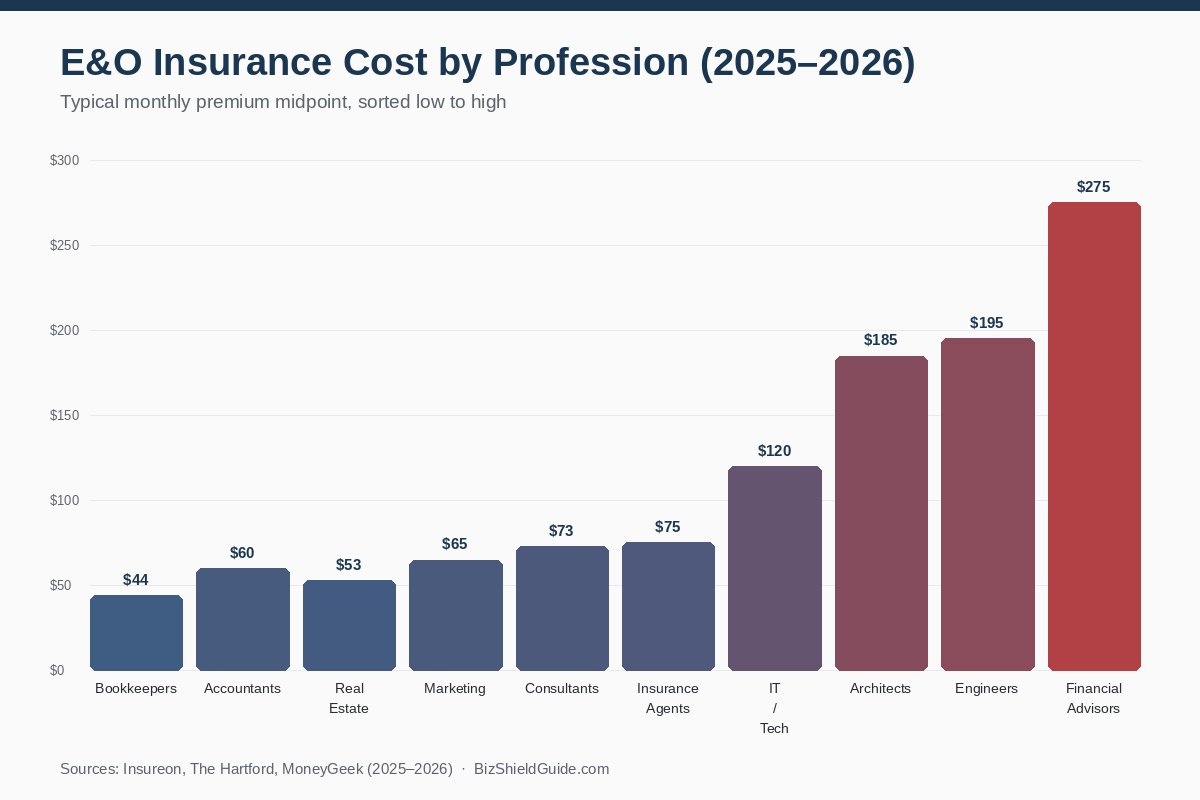
E&O Insurance Cost by Profession: 2025-2026 Data
The clearest published breakdowns come from Insureon, which aggregates median premiums from roughly 100,000 small-business applicants, and The Hartford, which publishes its own averages by category. The two don’t always agree — Hartford’s book skews toward somewhat larger accounts in a few categories — so treat these as directional bands rather than a quote. Understanding this point can save you real money when it comes to errors and omissions insurance cost.
| Profession/Industry | Typical Monthly Cost | Why It Costs What It Costs |
|---|---|---|
| Bookkeepers | $37–$50 | Low dollar amounts per error; disputes usually settle without litigation |
| Accountants/CPAs | $45–$75 | Higher-stakes filings and audits raise the ceiling on claim size |
| Real estate agents | $45–$60 | Frequent small disputes, but limits and payouts stay relatively contained |
| Marketing/creative agencies | $55–$75 | Copyright and campaign-performance disputes, but rarely catastrophic losses |
| General business consultants | $60–$85 | Wide range of advice given makes underwriting more subjective |
| Insurance agents | $50–$100 | Coverage-gap claims can be large; specialty and book size push cost up |
| IT/software/tech companies | $90–$150 | System failures and data loss can cascade into large client financial losses |
| Architects | $130–$240 | Construction defect claims are large and can surface years later |
| Engineers | $150–$240 | Structural and safety failures carry the highest potential severity |
| Financial advisors/planners | $200–$350+ | Market-loss claims, fiduciary duty, and regulatory overlap drive premiums up |
A few things jump out. Financial advisors and engineers sit at the top not because they get sued constantly, but because when a claim lands, it tends to land hard. MoneyGeek’s 2026 analysis, which pulled pricing across 53 professional categories from ten carriers, put financial institutions at the very top of its list at roughly $210 a month for a standard small policy, while notary services sat at the bottom around $19 a month — a more than tenfold spread driven almost entirely by claim severity, not frequency.
A Practitioner’s Note on Where the Surprises Show Up
In my experience comparing quotes across industries for clients in different fields, the biggest surprise for most first-time buyers isn’t that tech and finance cost more — people generally expect that. It’s how much a single factor, like whether you handle other people’s money directly versus just advising on it, can swing the number. Two consultants offering what sounds like similar services on paper can get quotes $100 a month apart because one of them has signing authority on client transactions and the other doesn’t. Most brokers will tell you this is the first thing that affects errors and omissions insurance cost.
What Actually Moves Your Specific Price
Industry sets the baseline, but within any given profession, four variables do most of the remaining work. This is exactly the kind of scenario where errors and omissions insurance cost matters most.
Coverage Limits and Deductible
Most small businesses land on $1 million per occurrence with a $1 million aggregate limit — Insureon reports that 56% of its E&O customers choose exactly that limit, with another 11% stepping up to $2 million/$2 million. Raising your limit or lowering your deductible both push the premium up; the average E&O deductible across Insureon’s book is around $2,500, though it runs lower for lower-risk professions like bookkeeping. Keep this in mind the next time you think through errors and omissions insurance cost.
Revenue and Business Size
Underwriters treat revenue as a rough proxy for the size of a mistake. A $2 million consulting firm and a $200,000 solo practice offering the same services will get different quotes even at identical limits, because the larger firm is presumed to be handling bigger engagements with more at stake per client. Before you decide, make sure you understand errors and omissions insurance cost correctly.
Claims History
A clean claims history is worth real money at renewal. One prior claim, even a small one that settled quickly, tends to follow a business for several renewal cycles and can add 15% to 30% to the premium depending on the carrier and how the claim was resolved. Many owners overlook this detail when comparing errors and omissions insurance cost options.
Years in Business and Experience
Newer businesses generally pay somewhat more, partly because underwriters have less loss history to price against and partly because inexperienced practitioners statistically generate more claims in their first few years. Insureon’s applicant data across most professions skews toward businesses with five or fewer years in operation and under five employees, which is worth keeping in mind when comparing your own quote to a published average — an established 15-person firm won’t map neatly onto those numbers. That’s the single biggest factor that shapes errors and omissions insurance cost.
- Ask what specific services trigger higher underwriting scrutiny in your field (for tech: data handling and system integrations; for finance: discretionary trading authority; for construction-adjacent trades: structural sign-off work)
- Get quotes at two limit levels ($1M and $2M) so you can see the actual dollar cost of doubling your protection
- Ask each carrier how they define “claim” for renewal pricing purposes — some count a reported incident even if no payout occurred
- Confirm whether the quote is claims-made or occurrence-based, since claims-made policies need tail coverage if you switch carriers or close the business
How to Get the Best Price Without Underinsuring
The cheapest policy on a comparison chart is rarely the right one once you factor in what happens after a claim. A common mistake is buying the minimum limit a client contract requires and stopping there, without checking whether that limit would actually cover a worst-case scenario in your specific line of work. This is one of the most common questions we hear about errors and omissions insurance cost.
Start by pricing coverage against your riskiest realistic engagement, not your average one. An IT consultant who occasionally handles a client’s full data migration should size their policy around that project, not around the smaller maintenance contracts that make up most of their calendar. The same logic applies to a marketing agency that occasionally runs paid media budgets in the six figures — that’s the exposure driving the number, even if most retainers are modest. This nuance comes up constantly in errors and omissions insurance cost conversations with clients.
Bundling helps in a specific way worth knowing: pairing E&O with a business owner’s policy or general liability through the same carrier often earns a discount of 5% to 15%, and it also closes coverage gaps that show up when a claim touches both professional negligence and, say, property damage or bodily injury. Paying annually instead of monthly typically shaves a few percentage points too, since carriers price in the administrative cost of monthly billing. It’s worth revisiting errors and omissions insurance cost every year as your business changes.
I’ve also seen business owners shop for E&O the same way they shop for auto insurance — chasing the lowest sticker price across three or four generic online quote tools — and end up with a policy that excludes exactly the service line that generates most of their revenue. A tech consultant who does both software development and IT staffing needs a policy that actually names both; a generic “consulting” E&O form sometimes doesn’t. Reading the named-services list on the quote, not just the limit and premium, is the single highest-value five minutes you can spend before buying.
If your renewal comes in noticeably higher than last year with no claims on file, ask the carrier directly what changed — sometimes it’s a broader market shift affecting your whole industry (tech and financial services have both seen tightening in recent renewal cycles), and sometimes it’s simply that your revenue grew into a new pricing tier. Either way, get a second quote before renewing automatically. A 20-minute comparison against one competing carrier is usually enough to tell you whether the increase is market-wide or specific to your file.
Related Reading
- General Liability vs. Professional Liability (E&O): Which Insurance Do You Actually Need?
- How Much Does Small Business Insurance Actually Cost in 2026?
This article is for general informational purposes and isn’t personalized insurance, legal, or financial advice. Coverage rules, costs, and requirements change, and every business’s risk is different — for decisions specific to your business, talk to a licensed insurance agent. Learn more About BizShieldGuide or reach us via our Contact page. It’s a small detail, but it can make a real difference for errors and omissions insurance cost.
A one-person marketing consultancy and a 20-person software firm can see wildly different errors and omissions insurance cost quotes, even with similar revenue, because underwriters price this coverage on the size and nature of the professional mistake being insured against, not just payroll or square footage.
The fastest way to lower your errors and omissions insurance cost is to tighten your client contracts (limitation-of-liability clauses help), keep a clean claims history, and choose a higher deductible if cash flow allows it. Bundling errors and omissions insurance cost with a business owner’s policy or cyber add-on can also shave a meaningful amount off the combined premium.
Claims history is another factor that swings errors and omissions insurance cost significantly. A firm with a clean five-year record can often qualify for 10-20% off standard rates, while even a single prior claim can push errors and omissions insurance cost up for several renewal cycles afterward, regardless of how the claim was resolved.

About the Author: BizShieldGuide Team
The BizShieldGuide team researches and writes plain-language guides to business and personal insurance — general liability, professional liability, workers' compensation, business owners policies, cyber liability, and industry-specific coverage for small business owners, alongside straightforward explainers on auto, home, and renters insurance for everyday readers. Our articles are grounded in publicly available data from insurers and carriers (Insureon, The Hartford, Progressive, State Farm, and others), industry cost surveys, and standard policy language, and we link to primary sources wherever a number or coverage detail could change. We are not licensed insurance agents or brokers, and nothing here replaces a quote or advice from one for your specific situation.