
If you run a business out of your house, home-based business insurance fills a gap your regular homeowners policy almost certainly doesn’t cover. Your homeowners or renters policy covers almost none of your business risk, and the parts it does cover are capped so low they barely register.
Most standard homeowners policies cap business equipment coverage at around $2,500 on-premises and roughly $500 off-premises, and they exclude business liability entirely — meaning if a client slips on your driveway or your laptop full of client files gets stolen from your car, you are likely on your own.
If you run any kind of business from home, even a small one, you need to know exactly where that homeowners coverage stops and what to buy to fill the gap.
What your homeowners or renters policy actually covers for a home business
Standard homeowners (HO-3) and renters (HO-4) policies were written for households, not businesses, and insurers have kept the business carve-outs narrow for decades. According to the Insurance Information Institute (III), a typical homeowners policy provides only about $2,500 of coverage for business equipment kept in the home — a limit that can sometimes be raised to $5,000 or so for a small added premium, but rarely much further. Coverage for that same equipment away from home is thinner still. Most agents will tell you this is the first thing to check with home-based business insurance.
The Zebra’s breakdown of home business coverage cites similar numbers: up to $2,500 for business equipment at home and just $500 if it’s off-site, with business liability typically excluded outright. Insurance agency Bancorp Insurance notes that most policies also contain a flat exclusion for any structure or contents “used for business,” regardless of scale — the $2,500 sublimit is standard language across carriers. That’s a detail worth double-checking with your home-based business insurance provider.
What that actually means in dollars
A graphic designer with a $4,000 workstation, a candle maker with $3,000 of inventory, or a consultant who just bought a $6,000 conference-room setup for client calls is already underwater on a full loss before liability even enters the picture. And liability is where the real exposure sits — a customer who trips over a shipping box on your porch, a client with an allergic reaction during an in-home consultation, or a delivery driver injured hauling your inventory typically has no coverage path through your homeowners policy at all.
Why insurers exclude business use — and what happens if you don’t disclose it
Insurers price homeowners policies around a specific risk profile: a family living in a house, not commercial foot traffic, business inventory, or professional liability exposure. When a home starts generating income, hosting clients, or storing goods for sale, the actuarial math the insurer used to set your premium no longer applies — so carriers exclude it rather than try to price it into a policy that was never underwritten for commercial activity. That’s the single biggest factor that shapes what home-based business insurance actually covers.
This creates a disclosure problem that catches a lot of home-based business owners off guard. Some insurers, particularly in cases involving business use of a structure, have successfully denied claims after discovering business activity the policyholder never reported. A frequently cited example is Salzi v. Virginia Farm Bureau Mutual Insurance Company (2002), where a Virginia couple’s barn collapsed during a hurricane and the insurer denied the claim after learning a neighbor kept hay in it intended for sale — even though the neighbor paid no rent and had only given the couple $100 as a thank-you. It’s a small detail, but it can make a real difference for home-based business insurance. Many owners overlook this detail when comparing home-based business insurance options.
” That’s a barn and hay, not a home office, but the underlying principle transfers directly to any home business: once an insurer can characterize a loss as connected to business use, the exclusion can wipe out the whole claim, not just the business portion of it. Before you decide, make sure you understand home-based business insurance correctly.
I’ve seen home-based business owners find out the hard way, after a claim, that their policy treated the entire loss as business-related and denied it outright — not just the desk and inventory, but water damage to the house itself, because the claim originated in a room the adjuster classified as commercial space. That’s the real risk of nondisclosure: it isn’t just that your equipment is underinsured, it’s that an undisclosed business can taint an otherwise ordinary homeowners claim and get the whole thing thrown out.
- Insurers can deny claims tied to undisclosed business use even when the loss looks like a routine homeowners claim.
- Business liability — a client injury, property damage you cause while working, product liability — is generally excluded outright, not just capped.
- Failing to disclose a home business can be treated as a material misrepresentation, which can jeopardize coverage beyond the specific claim.
- Some insurers will nonrenew or cancel a policy once they learn of undisclosed commercial activity, even if no claim has been filed.
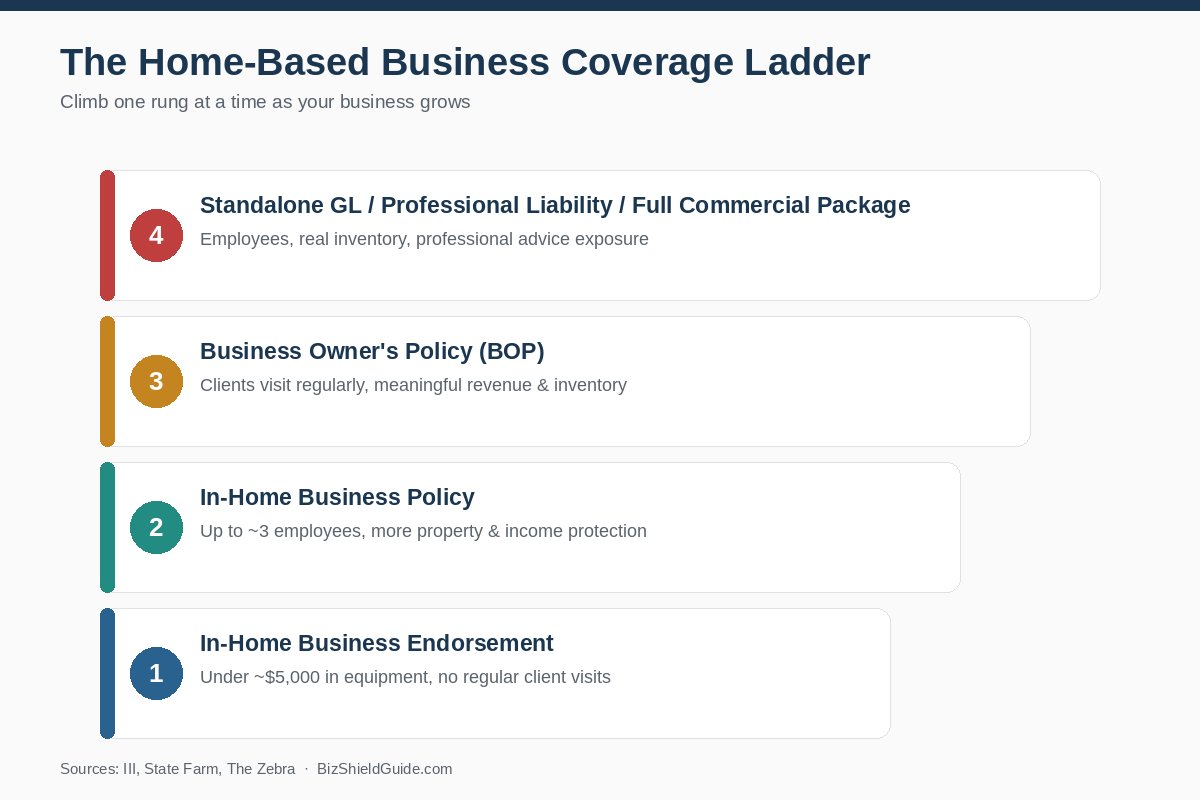
The coverage ladder: endorsement, in-home business policy, BOP, or standalone GL
The good news is that the insurance industry has built a reasonably clear ladder of options, and you don’t need a full commercial package just because you sell candles on Etsy. What you need depends on your revenue, whether clients set foot in your home, whether you have employees, and how much equipment or inventory you’re carrying. Understanding this point can save you real money when it comes to home-based business insurance.
Step 1: In-home business endorsement
For the smallest, lowest-risk operations — a consultant, a writer, someone doing bookkeeping from a laptop — many insurers offer an endorsement that can be added directly to your homeowners or renters policy. State Farm’s guidance on home-based business coverage describes this tier as appropriate when you have less than roughly $5,000 in business property and don’t regularly have customers coming to the house. Keep this in mind the next time you think through home-based business insurance.
The Zebra notes that these endorsements typically come with eligibility rules: annual business earnings usually need to stay under about $250,000, the business has to be owned by the named policyholder, and it generally can’t involve manufacturing or selling food or personal-care products. Coverage under these endorsements usually extends to a modest amount of business personal property, some liability protection, and sometimes lost business income after a covered disaster — though specifics vary meaningfully by carrier, so read the endorsement language rather than assuming. This is one reason home-based business insurance costs vary so much between households.
Step 2: In-home business policy
A step up from the basic endorsement, an in-home business policy (marketed by carriers like Nationwide and Allstate) is a more complete standalone form that still assumes the business operates mainly out of the home. The III notes these policies commonly cover business property, important documents, accounts receivable, and property temporarily off-site, plus loss-of-income and extra-expense coverage if you have to operate elsewhere after a covered loss. Some versions accommodate up to three full-time employees — a reasonable fit for a small studio, salon, or consulting practice that has outgrown a bare-bones endorsement but doesn’t need a full commercial package yet.
Step 3: Business Owners Policy (BOP)
Once clients regularly visit your home, you’re carrying meaningful inventory, or your business income is central to the household budget, a BOP becomes the more appropriate tool. State Farm specifically flags a BOP as the right move when customers visit your workspace, since that’s exactly the liability exposure homeowners exclusions are built to avoid. A BOP bundles general liability and commercial property coverage into a single policy and is typically available to businesses under 25,000 square feet with revenue under roughly $3 million a year, per the same Zebra overview.
Step 4: Standalone general liability, professional liability, or a full commercial package
If you have several employees, substantial equipment or inventory value, or work that involves professional advice (consulting, design, tax prep, coaching), you may need standalone general liability and/or professional liability (errors & omissions) layered onto — or in place of — a BOP. This is also where commercial auto belongs if you use a vehicle for deliveries or client visits, since personal auto policies carry their own business-use exclusions. This nuance comes up constantly in home-based business insurance conversations with clients.
What triggers the need to upgrade
There’s no single dollar figure that applies to every insurer, but a few thresholds show up consistently across the guidance from State Farm, the III, and small-business insurers: This is exactly the kind of scenario where home-based business insurance matters most.
- Inventory or equipment value above roughly $5,000 — near or beyond what a basic homeowners endorsement will cover.
- Clients, customers, or students visiting your home regularly — the single biggest liability trigger insurers point to.
- Hiring even one employee — most endorsements cap out around zero to three employees, and workers’ comp requirements often kick in separately.
- Business income becoming a meaningful share of household income — a sign the operation has outgrown a “hobby-adjacent” coverage tier.
- Storing or selling physical inventory, especially anything involving food, cosmetics, or products used by third parties, which many endorsements explicitly exclude.
If two or more of these apply to you, it’s a reasonable signal to move up at least one rung on the ladder rather than assume your existing endorsement still fits. If you’re evaluating home-based business insurance, this distinction is worth remembering.
What it actually costs
Cost is where a lot of home-based business owners talk themselves out of adequate coverage, but the numbers are smaller than most people expect. According to Insureon’s small-business insurance cost data, standalone general liability averages around $42 a month, with typical annual ranges from about $250 to $1,750 depending on industry and limits. A BOP averages roughly $58 a month, or about $300 to $2,900 a year, and professional liability (relevant if you give advice or a service) averages around $49 a month.
Basic in-home business endorsements are cheaper still — often just an extra $25 to a few hundred dollars a year on top of your existing homeowners premium, depending on the limit you choose and the carrier. The math tends to favor coverage: a denied claim tied to undisclosed business use, or an uninsured client injury lawsuit, will cost far more than a few hundred dollars a year in added premium. It’s worth revisiting your home-based business insurance every year as your business changes.
The bottom line
Treat your homeowners or renters policy as a starting point, not a safety net, for anything you do to earn income from home. Call your agent, tell them exactly what the business involves — inventory, client visits, employees, equipment value — and ask directly whether you need an endorsement, an in-home business policy, or a full BOP. The conversation costs nothing, disclosure protects the rest of your homeowners coverage from being voided over a business-use technicality, and the incremental premium for real protection is modest compared with what an uninsured claim or lawsuit could cost you. The worst time to learn your policy excludes business use is after you’ve already filed the claim.
Related Reading
- Business Owner’s Policy (BOP) vs. Buying Coverage Separately: Which Saves You Money?
- General Liability Insurance 101: What It Covers and What It Doesn’t for Small Businesses
This article is for general informational purposes and isn’t personalized insurance, legal, or financial advice. Coverage rules, costs, and requirements change, and every business’s risk is different — for decisions specific to your business, talk to a licensed insurance agent. Learn more About BizShieldGuide or reach us via our Contact page. This is one of the most common questions we hear about home-based business insurance.
Most homeowners policies cap business-related claims at just a few thousand dollars, or exclude them entirely once a insurer discovers regular commercial activity happening at the address. That’s exactly the gap home-based business insurance is built to close, whether you add it as an endorsement to your existing homeowners policy or buy it as its own small business owner’s policy.
The right amount of home-based business insurance depends mostly on what you actually do: a consultant working from a laptop needs far less than someone storing inventory in the garage or seeing clients in a home office. Either way, telling your insurer about the business protects you from a denied claim later, and it usually costs far less than people expect.

About the Author: BizShieldGuide Team
The BizShieldGuide team researches and writes plain-language guides to business and personal insurance — general liability, professional liability, workers' compensation, business owners policies, cyber liability, and industry-specific coverage for small business owners, alongside straightforward explainers on auto, home, and renters insurance for everyday readers. Our articles are grounded in publicly available data from insurers and carriers (Insureon, The Hartford, Progressive, State Farm, and others), industry cost surveys, and standard policy language, and we link to primary sources wherever a number or coverage detail could change. We are not licensed insurance agents or brokers, and nothing here replaces a quote or advice from one for your specific situation.