
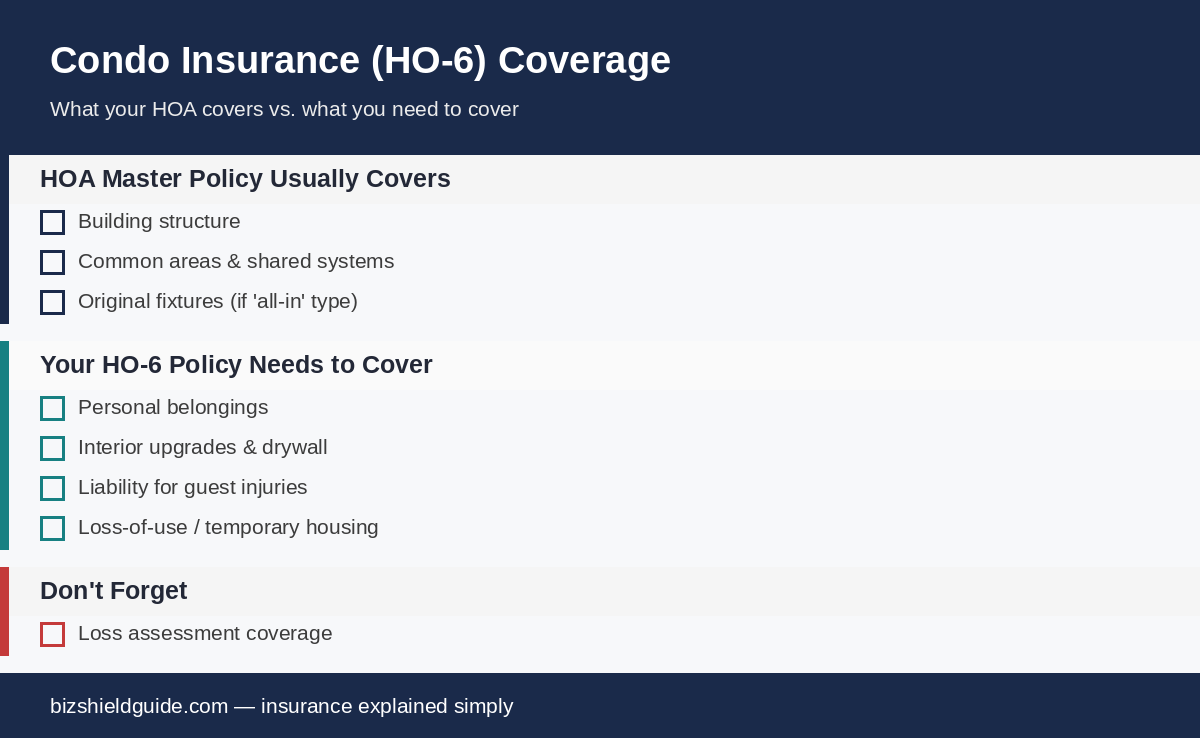
Condo insurance, officially called an HO-6 policy, exists because your HOA’s master policy almost never covers everything inside your unit — and the gap between what people assume is covered and what actually is can be a very expensive surprise. The short version: your HOA’s master policy typically covers the building’s shared structure and common areas, while your HO-6 policy needs to cover your personal belongings, interior walls and fixtures inside your unit, liability if someone’s hurt inside your home, and loss-of-use costs if your unit becomes temporarily unlivable.
A friend of mine found this out after a pipe burst in the unit above hers and water came through her ceiling, ruining a laptop, a rug, and part of her drywall. She assumed the HOA would handle all of it since the leak technically started outside her unit — but the HOA’s master policy only covered the shared plumbing and structural repair. Her own belongings and the interior drywall repair fell to her HO-6 policy, which she thankfully had.
What the HOA Master Policy Actually Covers
Most HOA master policies fall into one of two types: “bare walls” coverage, which insures only the building’s structure and shared areas and stops at the drywall, or “all-in” coverage, which extends a bit further to include original fixtures like cabinets and flooring as they existed when the building was built. Either way, the master policy is designed around the building as a whole, not your personal belongings or any upgrades and improvements you’ve made inside your specific unit.
What Your HO-6 Policy Needs to Fill In
Your condo policy is built to cover four main things: personal property (furniture, electronics, clothing), interior structure that falls inside your unit’s walls (drywall, flooring, cabinets, sometimes upgraded fixtures), liability protection if a guest is injured inside your home, and loss-of-use coverage that pays for temporary housing if your unit becomes uninhabitable after a covered event like a fire or major water damage.
Know Which “Walls In” Coverage Type Your HOA Has
Before buying condo insurance, it’s worth requesting a copy of your HOA’s master policy or at least a summary of its coverage type, since that directly determines how much interior coverage your own HO-6 policy needs to carry. If your HOA only has bare-walls coverage, you’ll want a higher “walls in” or “interior structure” limit on your own policy to cover cabinets, flooring, and built-ins that the master policy won’t touch.
Don’t Skip the Loss Assessment Coverage
Loss assessment coverage is a smaller add-on that many condo owners overlook, but it can matter a lot in a shared building. If a covered loss affects common areas and the HOA’s master policy doesn’t fully cover the repair, the HOA can pass the remaining cost to unit owners as a special assessment — and loss assessment coverage on your HO-6 policy can help offset your share of that bill.
How Much Condo Insurance Coverage Is Typically Enough
There’s no single number that fits every condo, since it depends heavily on your HOA’s master policy type and the value of your belongings and any upgrades you’ve made. A reasonable starting point is to inventory your belongings room by room to estimate personal property value, then talk to your HOA about its coverage type to figure out how much interior structure coverage makes sense on top of that — an independent agent can help translate both numbers into an actual policy limit.
Bottom Line
Your HOA’s master policy and your own HO-6 condo policy are meant to work together, not duplicate each other — which means a gap between the two is easy to miss until you actually need to file a claim. Get a copy of your HOA’s coverage summary, match your personal policy’s interior and belongings coverage to fill the gap, and add loss assessment coverage so a building-wide claim doesn’t land squarely on your own wallet.
Shopping for condo insurance is also a good time to compare quotes across a few carriers, since HO-6 pricing varies more than people expect for similar coverage. The Insurance Information Institute has a helpful overview of what a typical condo insurance policy includes, see this condo insurance guide from III.
Related Reading
- What Does Homeowners Insurance Cover? The Complete 2026 Guide
- How Much Does Renters Insurance Cost in 2026? Avoid Overpaying
- Flood Insurance 101: The Essential Guide to a Critical Homeowners Insurance Gap

About the Author: BizShieldGuide Team
The BizShieldGuide team researches and writes plain-language guides to business and personal insurance — general liability, professional liability, workers' compensation, business owners policies, cyber liability, and industry-specific coverage for small business owners, alongside straightforward explainers on auto, home, and renters insurance for everyday readers. Our articles are grounded in publicly available data from insurers and carriers (Insureon, The Hartford, Progressive, State Farm, and others), industry cost surveys, and standard policy language, and we link to primary sources wherever a number or coverage detail could change. We are not licensed insurance agents or brokers, and nothing here replaces a quote or advice from one for your specific situation.