
As Investopedia explains, traditional life insurance underwriting normally relies on a medical exam to price risk accurately. No medical exam life insurance skips the blood draw and the doctor’s visit, but it is not a free upgrade — you typically trade a faster approval for a higher premium, a lower coverage cap, or both. The short version: there are three different types of no medical exam life insurance, and which one makes sense depends entirely on your health, your age, and how much coverage you actually need.
The Three Types of No Medical Exam Life Insurance
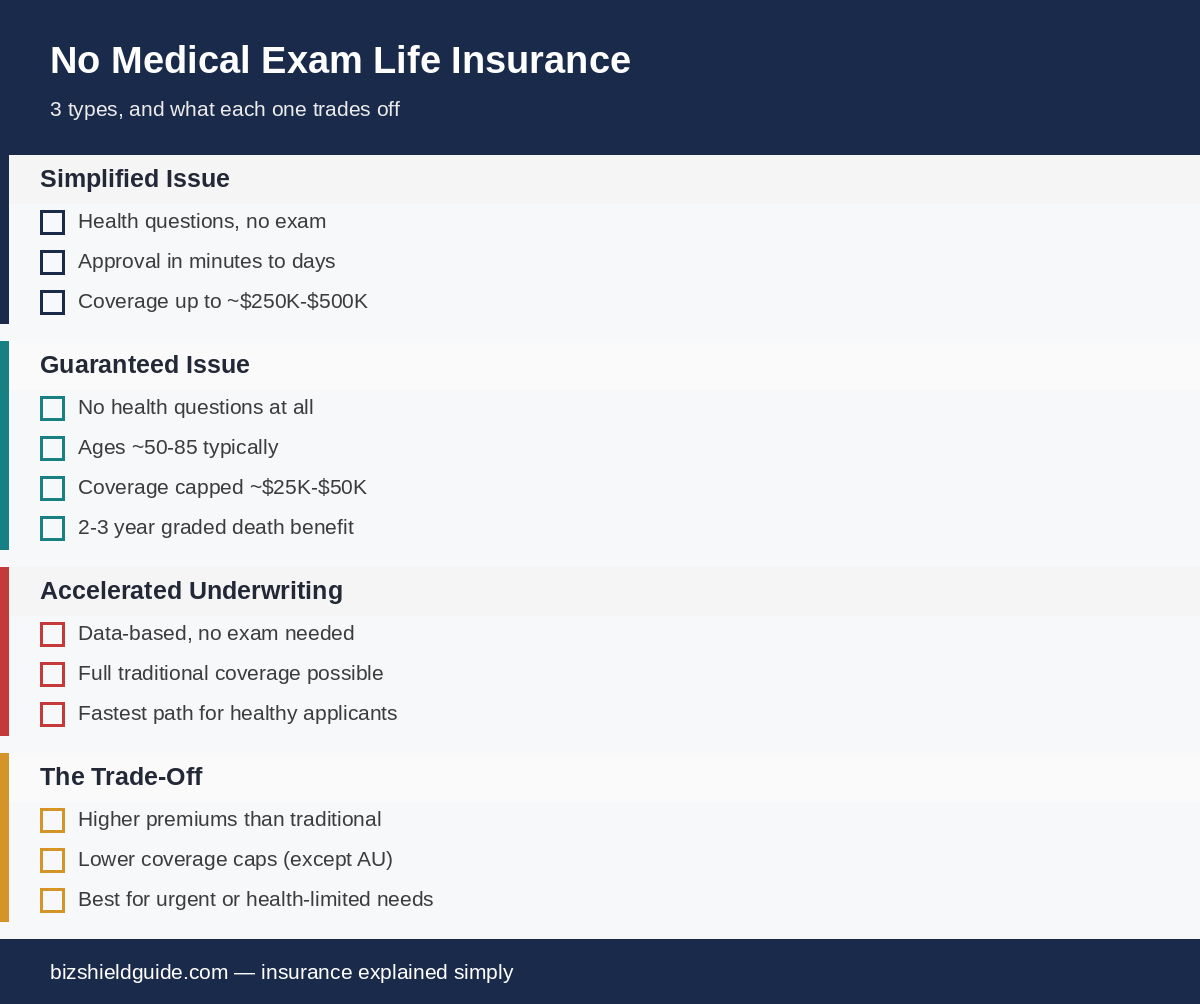
Simplified issue. You answer a set of health questions, sometimes over a short phone interview, but skip the physical exam. Approval can come back in minutes to a few days, and coverage is usually capped somewhere between $250,000 and $500,000. It is not guaranteed — you can still be declined based on your answers.
Guaranteed issue. No health questions and no exam at all. If you fall within the eligible age range, typically 50 to 85, you are approved. The trade-off is a much lower coverage cap, usually $25,000 to $50,000, which is why these policies are mostly marketed as final expense or burial insurance rather than general-purpose coverage.
Accelerated underwriting. Instead of an exam, the insurer evaluates prescription history, driving records, and public data alongside your application. Healthy applicants can qualify for a full traditional policy, sometimes with a death benefit over $1 million, often within days instead of weeks.
What No Medical Exam Life Insurance Actually Costs
No medical exam life insurance consistently costs more per $1,000 of coverage than a fully underwritten policy. Simplified and guaranteed issue policies carry the biggest premium markup, since the insurer is pricing in the risk it can’t verify with lab work or a physical.
Accelerated underwriting narrows that gap the most, because the insurer still has real data to price the policy on — it’s the exam itself that gets skipped, not the underwriting.
The Graded Death Benefit Most People Miss
Many guaranteed issue policies include a waiting period, commonly two to three years, before the full death benefit applies to death from natural causes. If the insured dies during that window, the policy typically pays back the premiums paid plus interest rather than the full face value. Accidental death is usually covered in full from day one. This detail is easy to miss when a policy is marketed on “guaranteed approval” alone, so it’s worth reading the graded benefit terms before you buy.
Who No Medical Exam Life Insurance Actually Makes Sense For
No medical exam life insurance is a reasonable fit for people with pre-existing health conditions, smokers, older adults outside the range traditional insurers favor, or anyone who needs coverage in place quickly and can’t wait weeks for a full underwriting process. It also suits people who simply want to avoid the exam itself.
For a healthy applicant with no urgent timeline, a traditional fully underwritten policy — or accelerated underwriting if it’s offered — will almost always provide more coverage for less money than simplified or guaranteed issue. It is worth getting at least one quote from each path before deciding, since pricing on no medical exam life insurance varies more between insurers than pricing on traditional policies does.
Bottom Line
No medical exam life insurance trades convenience for cost: you get faster approval and no needles, but you generally pay more per dollar of coverage, and guaranteed issue policies cap out at amounts too small for most families’ real needs. It’s the right tool for a specific situation — health issues, urgency, or a small final-expense policy — not a default replacement for traditional coverage.
Related Reading
- How Much Life Insurance Do You Need? The 2026 DIME Method Guide
- Term vs Whole Life Insurance: The Proven Way to Save and Choose Right in 2026

About the Author: BizShieldGuide Team
The BizShieldGuide team researches and writes plain-language guides to business and personal insurance — general liability, professional liability, workers' compensation, business owners policies, cyber liability, and industry-specific coverage for small business owners, alongside straightforward explainers on auto, home, and renters insurance for everyday readers. Our articles are grounded in publicly available data from insurers and carriers (Insureon, The Hartford, Progressive, State Farm, and others), industry cost surveys, and standard policy language, and we link to primary sources wherever a number or coverage detail could change. We are not licensed insurance agents or brokers, and nothing here replaces a quote or advice from one for your specific situation.