
Short answer: first-time home buyer homeowners insurance needs to be shopped for as soon as you’re under contract, not after — your lender will require proof of an active policy before closing, and waiting until the last week often means settling for whatever’s available instead of the best coverage at the best price.
Homeowners insurance isn’t legally required by any state, but it’s a near-universal lender requirement, since the bank has a financial stake in the property until your mortgage is paid off. For a first-time buyer, this is often the first insurance policy you’ve ever shopped for on your own, and the terminology — dwelling coverage, replacement cost, escrow, riders — can be genuinely confusing at the exact moment you’re already juggling inspections, appraisals, and closing paperwork.
This guide walks through when to start shopping, what your lender actually requires, how the cost gets folded into your mortgage payment, and the coverage details first-time buyers most often get wrong.
When to Start Shopping for First-Time Home Buyer Homeowners Insurance
Start shopping for first-time home buyer homeowners insurance as soon as you’ve gone under contract and have a firm address and closing date — not after. Most lenders want a signed policy declaration page a week or more before closing, and depending on your home’s location and construction, getting quotes can take longer than expected, especially in areas with wildfire, flood, or hurricane exposure where fewer insurers are willing to write new policies.
Your loan officer or real estate agent will typically remind you to start this process during underwriting, but don’t wait for that reminder — a first-time buyer who starts shopping only after being asked often ends up with less time to compare quotes and negotiate coverage.
What Lenders Actually Require
Lenders require proof of an active first-time home buyer homeowners insurance policy before they’ll fund your loan, and the policy’s dwelling coverage amount generally needs to at least match your loan balance (sometimes the full replacement cost of the structure, which can be higher than the loan amount). If your down payment is under 20%, you’ll separately need private mortgage insurance (PMI) — a different product that protects the lender, not you, and is not a substitute for homeowners insurance.
None of this is a state legal requirement — it’s entirely a lender condition of the mortgage. Once your loan is paid off, you could technically drop coverage, though doing so leaves your own asset completely unprotected, which is not a realistic option for almost anyone.
How Much Does It Cost, and How Does Escrow Work?
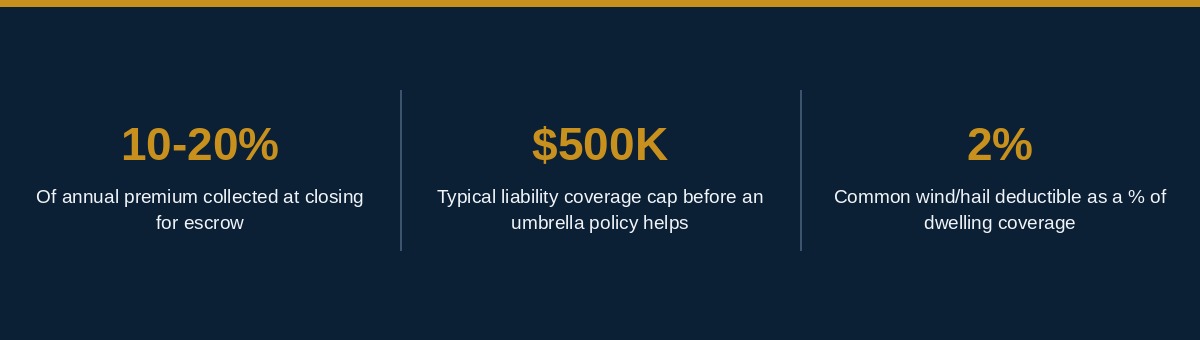
Most lenders collect roughly 10% to 20% of your annual first-time home buyer homeowners insurance premium at closing to seed your escrow account, then build the rest of the annual premium into your monthly mortgage payment alongside property taxes. This is why a first-time buyer’s actual monthly housing payment is usually higher than the mortgage principal-and-interest number alone — insurance and taxes are baked in.
Because your insurer bills the full annual premium once a year (paid automatically from escrow), your monthly payment can shift when your policy renews at a different price — a common surprise for first-time buyers who assumed their payment was fixed for the life of the loan. Reviewing your annual escrow analysis statement each year catches this before it becomes a shortfall.
Dwelling Coverage vs. Replacement Cost vs. Actual Cash Value
Dwelling coverage (Coverage A) insures the structure itself against covered perils like fire and wind. The number that matters most is whether your policy pays out on a replacement cost basis (what it would cost to rebuild today, materials and labor included) or actual cash value (replacement cost minus depreciation). Actual cash value policies are cheaper but can leave you thousands of dollars short after a major loss, since a 15-year-old roof is worth far less on paper than a new one costs to install.
For a first-time buyer, paying the modest premium difference for a replacement-cost policy is almost always worth it — the gap between what an actual-cash-value payout covers and what rebuilding actually costs tends to be far larger than most buyers expect.
Liability Coverage and Why Umbrella Insurance Comes Up
Personal liability coverage (Coverage E) on a standard homeowners policy typically caps around $500,000, covering you if someone is injured on your property or you’re found responsible for damage to someone else’s property. For most first-time buyers, standard limits are adequate at first, but as home equity and savings grow, that cap can start looking thin next to what a serious injury lawsuit could cost — which is exactly the gap an umbrella insurance policy is built to fill once you have more to protect.
Common Exclusions First-Time Buyers Miss
Standard homeowners policies almost universally exclude flood damage and earthquake damage — both require separate policies or riders, regardless of what your lender does or doesn’t require based on your flood zone designation. Sewer backup, sump pump failure, and mold beyond a small cap are also commonly excluded or capped low unless you add a specific endorsement.
Many wind- and hail-prone regions also use a separate, higher deductible for those perils specifically — often a percentage of your dwelling coverage (commonly 1% to 5%) rather than a flat dollar amount. On $300,000 of dwelling coverage with a 2% wind deductible, that’s $6,000 out of pocket before the policy pays a dime on wind damage, a number that surprises many first-time buyers who assumed their standard deductible applied to every claim type.
Mistakes First-Time Buyers Make
The most common mistake is accepting the first quote from a lender-referred insurer without comparing at least two or three other quotes — referral relationships don’t guarantee the best price or coverage terms. The second is under-insuring the dwelling to save on premium, which backfires badly if a total loss occurs and the payout doesn’t cover a full rebuild at current construction costs. The third is not reading the deductible structure closely enough to notice a separate, higher wind or hail deductible buried in the policy.
How to Compare Quotes the Right Way
Compare quotes using identical dwelling coverage amounts, the same deductible, and the same replacement-cost (not actual-cash-value) basis across every insurer — otherwise you’re not comparing like for like, and the cheapest-looking quote may simply have less coverage. Ask each insurer directly whether flood and earthquake coverage is included, excluded, or available as an add-on, since silence on this point is common and easy to miss until a claim is denied.
Frequently Asked Questions
Can I switch first-time home buyer homeowners insurance companies after closing?
Yes — you’re not locked into your closing-day insurer. You can shop and switch at any point, just make sure the new policy is active before canceling the old one so there’s no coverage gap, and notify your mortgage servicer of the change.
Does homeowners insurance cover my personal belongings too?
Yes, personal property coverage (Coverage C) is typically included as a percentage of your dwelling coverage (often 50-70%) and covers furniture, electronics, and other belongings against the same covered perils as the structure.
What if my home is in a high-risk flood or wildfire zone?
You may have fewer private insurer options and could need a state-backed plan (like a FAIR Plan or the National Flood Insurance Program) — start shopping earlier than usual in these areas, since securing coverage can take longer.
Bottom Line: First-Time Home Buyer Homeowners Insurance
Start shopping the moment you’re under contract, get at least three comparable quotes on identical coverage terms, choose replacement cost over actual cash value if the premium difference is reasonable, and ask directly about flood, earthquake, and wind/hail deductible structure before you assume anything is or isn’t covered. Getting this right in your first policy sets the pattern for how well-protected — and how surprised at claim time — you’ll be for as long as you own the home.
For a state-by-state look at what’s actually required and commonly excluded, the Consumer Financial Protection Bureau’s homeowners insurance guide is a solid neutral starting point.
Related Reading
What Does Homeowners Insurance Cover? The Complete 2026 Guide
Renters Insurance 101: What It Covers and Why You Need It

About the Author: BizShieldGuide Team
The BizShieldGuide team researches and writes plain-language guides to business and personal insurance — general liability, professional liability, workers' compensation, business owners policies, cyber liability, and industry-specific coverage for small business owners, alongside straightforward explainers on auto, home, and renters insurance for everyday readers. Our articles are grounded in publicly available data from insurers and carriers (Insureon, The Hartford, Progressive, State Farm, and others), industry cost surveys, and standard policy language, and we link to primary sources wherever a number or coverage detail could change. We are not licensed insurance agents or brokers, and nothing here replaces a quote or advice from one for your specific situation.