
Small business insurance cost is the question every owner asks first, and the honest answer is a range, not a single number. Most small businesses pay somewhere between $500 and $3,500 a year for a core insurance package — general liability plus a business owner’s policy — with the number climbing fast once you add workers’ comp, professional liability, or cyber coverage, or once your industry carries real physical risk.
A solo consultant working from a home office can often bind a full package for under $50 a month. Keep that framing in mind as you read through the numbers below, since your own small business insurance cost will land somewhere on this spectrum depending on where your business sits.
A five-person landscaping crew or a restaurant with a fryer and a liquor license is a different conversation entirely, sometimes running $500-$1,000+ a month once workers’ comp and property coverage are stacked on top. There’s no single “average” that means much across that range, so the honest answer is a set of ranges tied to what you actually do and who works for you. Whichever category you fall into, your final small business insurance cost still depends on the same underwriting factors sitting underneath the sticker price.
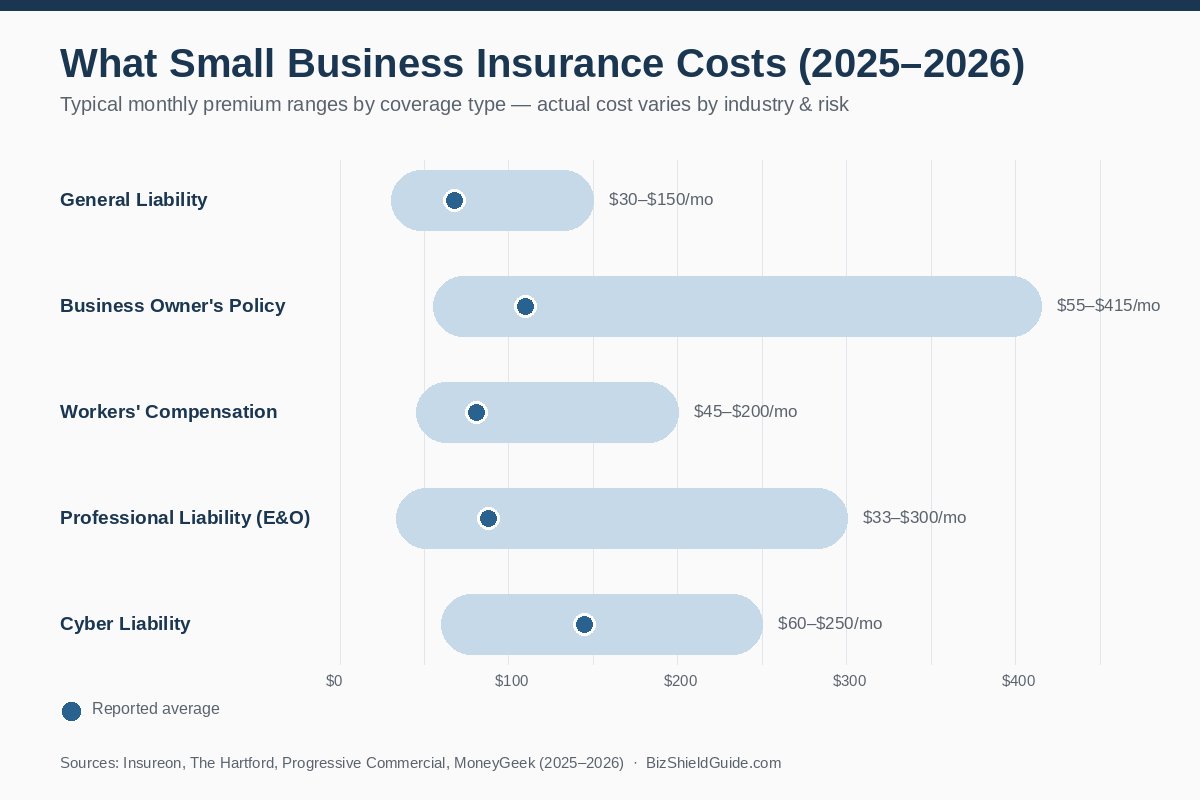
Small Business Insurance Cost by Coverage Type
Small business insurance cost breaks down very differently depending on which policy you’re pricing. Insurers price each policy type differently, and the underlying data doesn’t always agree with itself — different carriers, different customer mixes, different years. Below are the figures currently being cited by the major aggregators and carriers, presented as ranges rather than single numbers, because that’s closer to reality. Use the table below as a sanity check against any small business insurance cost quote you’re handed.
| Coverage type | Typical monthly range | Typical annual range | Source |
|---|---|---|---|
| General liability | $30-$90 | $250-$3,000 | Insureon |
| Business owner’s policy (BOP) | $80-$150 | $1,000-$1,800 | The Hartford, MoneyGeek |
| Workers’ compensation | $35-$160+ | $400-$2,000+ (much higher for high-risk trades) | Insureon |
| Professional liability / E&O | $20-$90 | $250-$1,000+ | NEXT Insurance |
| Cyber liability | $100-$180 | $1,200-$7,000 | Embroker |
General liability
General liability is usually the first policy a business buys, and it’s also the cheapest on average. Insureon’s cost data, drawn from more than 100,000 policies its customers have purchased, puts the median at $45 a month, or about $538 a year, with the full range running from around $250 to over $3,000 annually depending on industry and revenue. Low-risk service businesses — bookkeepers, IT consultants, tutors — tend to land near the bottom of that range. Businesses that work on other people’s property, like contractors or cleaning companies, land higher.
Business owner’s policy (BOP)
A BOP bundles general liability with commercial property coverage, and pricing across sources is noticeably less consistent than for standalone GL. Insureon’s data shows a median around $83-90 a month; The Hartford cites figures ranging from roughly $85 to $141 a month depending on how the number is calculated; and MoneyGeek’s 2026 analysis across 79 industries puts the average closer to $147 a month, using a standardized profile of three employees and $150,000 in payroll.
Treat $80-$150 a month as the realistic band for a small operation, and expect restaurants, retail stores with high foot traffic, and manufacturers to run well above that — The Hartford’s industry breakdown shows restaurants averaging over $400 a month, largely because of the fire and liquor liability exposure.
Workers’ compensation
Workers’ comp is the coverage where “average” is least useful, because pricing is driven almost entirely by payroll, job classification code, and state rules rather than by business type in the abstract. The National Academy of Social Insurance figure often cited is roughly $1 per $100 of payroll nationally, though state rates swing from about $0.41 per $100 in Texas to over $1.80 per $100 in Wyoming.
Insureon’s customer data lands on a median of $54 a month, or about $643 a year, but that masks enormous industry variation: finance and accounting workers average $33-34 a month, while construction and contracting crews average $254 a month per Insureon’s breakdown — and that’s before accounting for claims history.
Professional liability and cyber
Professional liability (errors and omissions) protects service businesses against claims of bad advice, missed deadlines, or negligent work. NEXT Insurance’s 2026 data shows 73% of its active E&O customers paying $45 or less a month, with notaries and tax preparers near $20 and property managers closer to $140. Cyber liability is priced very differently and has been more volatile: Embroker reports that businesses spent between $1,200 and $7,000 annually on cyber coverage in 2024, with a median around $2,000, after a sharp premium spike in 2022 that has since eased for many policyholders.
Insureon’s broader customer base skews smaller and shows a median closer to $129 a month, or roughly $1,550 a year — reasonably consistent with Embroker’s low end.
How Cost Breaks Down by Type of Business
Averages hide the thing that actually matters, which is what your business looks like. Three quick profiles:
- Solo consultant, no employees, works from home: General liability plus professional liability, often bundled as a business owner’s policy add-on, typically runs $50-$100 a month total. No workers’ comp needed in most states with zero employees.
- Retail shop, 10 employees, leased storefront: BOP (property + liability) around $150-$300 a month, workers’ comp adding another $200-$500+ depending on state and payroll, plus possibly commercial auto if there’s delivery. Combined, $400-$900 a month is a realistic planning range.
- Contractor with a small crew: General liability alone can run $80-$150 a month given the property-damage exposure, and workers’ comp is frequently the largest line item — Insureon’s data puts construction workers’ comp near $254 a month on its own. A contractor with four or five employees can easily be looking at $700-$1,500 a month across GL, workers’ comp, and commercial auto.
One mistake I see business owners make repeatedly when comparing quotes is treating a low BOP number as the whole picture and forgetting that workers’ comp gets priced separately, based on actual payroll, not on the flat business description they gave the BOP underwriter. I’ve had clients budget $150 a month for “insurance” based on a general liability quote, then get blindsided when the workers’ comp audit at renewal adds another few hundred dollars because their payroll came in higher than estimated, or because one employee’s job classification code changed mid-year when they started doing installation work instead of just sales.
This is exactly why comparing your own small business insurance cost against real payroll and claims data — not a generic online quote — matters so much before you commit to a policy.
What Actually Moves Your Small Business Insurance Cost
Underwriters price risk, not vibes, and a handful of factors explain most of the spread you’ll see between quotes for businesses that look similar on paper.
Claims history
Even one liability or workers’ comp claim in the past three to five years can push premiums up noticeably at renewal, sometimes 10-30% depending on the carrier and the size of the claim. A clean claims history is the single biggest lever a business owner controls directly.
Location
State workers’ comp rates alone vary by more than 4x, and property/BOP pricing reflects local weather risk, crime rates, and building codes. A shop in a hail- or hurricane-prone state will pay more for property coverage than an identical shop somewhere calmer, independent of anything the owner does.
Payroll and employee count
Workers’ comp is priced per $100 of payroll within a given classification code, so a raise, a new hire, or a shift in job duties changes the premium — sometimes retroactively, through an end-of-year audit. This is the factor owners most often underestimate when budgeting.
Coverage limits and deductibles
Moving from $1 million/$2 million liability limits to $2 million/$4 million might add only 10-20% to a GL premium, which is often worth it for businesses with contracts requiring higher limits. Raising a property deductible from $500 to $2,500 can meaningfully lower a BOP premium if the business can absorb a larger loss out of pocket.
Industry classification
The class code an underwriter assigns — not the name of your business — drives a large share of the price. A “consulting” business that occasionally does hands-on installation work may get classified (and priced) closer to a contractor than a pure advisory firm, which is worth flagging to an agent before binding, not after a claim.
Getting Quotes That Actually Reflect Your Risk
The fastest way to get an inaccurate quote is to answer application questions generically. Underwriters ask specific questions about payroll, subcontractor use, revenue by service line, and prior claims because those answers feed directly into the classification code and rating tables — vague or rounded answers tend to produce a quote that either falls apart at audit or overstates your real cost.
A second thing worth doing before shopping: pull three years of loss runs from your current carrier, even if you’re happy with them. Every quote conversation goes faster and lands more accurately when the agent has real claims data instead of your recollection of “we’ve never had a claim, I think.” I’ve watched quotes swing by several hundred dollars a year simply because an owner remembered a claim differently than the loss run showed it.
Get at least three quotes from a mix of a direct carrier (The Hartford, NEXT, Progressive Commercial) and an independent agency or aggregator (Insureon, Embroker) that can shop multiple carriers at once — the same risk profile can price differently across carriers by 20-40% depending on how each one weighs your specific industry and location.
Ask each quote to itemize the classification code used for workers’ comp and the liability limits included in the base BOP price, since those two line items are where “cheap” quotes most often cut corners that show up later as coverage gaps or audit surprises. Bottom line: your real small business insurance cost is set by your claims history, location, payroll, and industry — not by a single quoted number, so shop it every renewal.
Related Reading
- General Liability Insurance 101: What It Covers and What It Doesn’t for Small Businesses
- Business Owner’s Policy (BOP) vs. Buying Coverage Separately: Which Saves You Money?
This article is for general informational purposes and isn’t personalized insurance, legal, or financial advice. Coverage rules, costs, and state requirements change, and every business’s risk is different — for decisions specific to your business, talk to a licensed insurance agent. Learn more About BizShieldGuide or reach us via our Contact page.

About the Author: BizShieldGuide Team
The BizShieldGuide team researches and writes plain-language guides to business and personal insurance — general liability, professional liability, workers' compensation, business owners policies, cyber liability, and industry-specific coverage for small business owners, alongside straightforward explainers on auto, home, and renters insurance for everyday readers. Our articles are grounded in publicly available data from insurers and carriers (Insureon, The Hartford, Progressive, State Farm, and others), industry cost surveys, and standard policy language, and we link to primary sources wherever a number or coverage detail could change. We are not licensed insurance agents or brokers, and nothing here replaces a quote or advice from one for your specific situation.