
Freelancer insurance is the coverage that protects independent contractors, consultants, and other self-employed workers from the financial risks that come with running a one-person business. Most freelancers assume business insurance is something for companies with a storefront and employees — not a one-person operation working from a laptop. Then a client contract lands with an insurance requirement clause, or a coworking space asks for a certificate before handing over a key, or a single dissatisfied client threatens to sue over a missed deadline that cost them money. None of that requires a big business; it just requires a client relationship and a mistake.
The two policies that actually matter for most freelancers and self-employed professionals are general liability and professional liability (errors & omissions) — and increasingly, it’s clients rather than freelancers themselves who are driving the decision to get covered.
The Two Policies Freelancers Actually Need
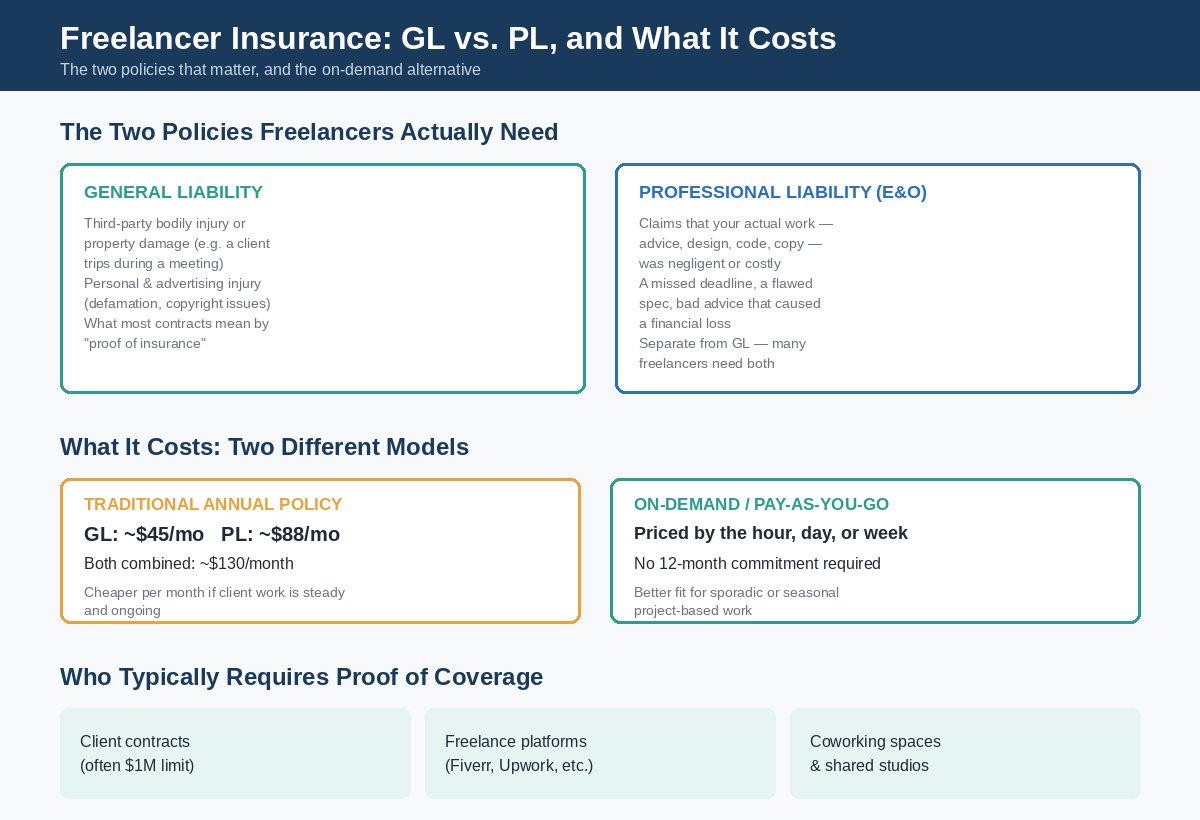
General liability insurance covers third-party bodily injury and property damage — a client who trips over your equipment during an in-person meeting, or your laptop bag knocking over an expensive display at a client’s office. It also typically covers “personal and advertising injury” claims like defamation or accidentally using someone else’s copyrighted material in your marketing. This is the policy most freelance platforms and client contracts are actually asking about when they require “proof of insurance.”
Professional liability insurance (also called errors & omissions, or E&O) is the one general liability doesn’t cover: claims that your actual work — the advice, the design, the code, the copy — was negligent or caused the client a financial loss. A missed deadline that cost a client a launch window, a marketing plan that didn’t disclose a material assumption, a contractor’s spec error — this is the coverage that responds. I’ve seen freelancers assume general liability covers “getting sued by a client” broadly; it doesn’t, and the two policies really do need to be evaluated separately even though many freelancers end up buying both.
Why Clients Are Asking for This Now
This shift isn’t freelancers deciding independently that they need coverage — it’s increasingly a condition of getting or keeping the work. Client contracts more often specify a minimum liability limit (commonly $1 million per occurrence) and require a certificate of insurance (COI) before work starts. Freelance marketplaces including Fiverr and Upwork have added language around sufficient general liability coverage for certain categories of gig work. Coworking spaces and shared studios frequently require proof of coverage before issuing a badge or key, the same way a commercial landlord would for any small business tenant.
If you’ve never had a client ask for a COI, it’s less a sign you don’t need coverage and more a sign you haven’t yet hit the kind of client (larger company, formal procurement process, coworking landlord) that asks for one — and when it happens, you generally don’t have time to shop for a policy from scratch. See our guide to getting a COI fast.
What It Costs — and the On-Demand Option Most Small Businesses Don’t Have
Based on 2026 industry data, freelancers typically pay around $45/month for general liability and $88/month for professional liability as standalone annual policies — together, roughly $130/month if you carry both. Where freelancers have an option most small businesses don’t: on-demand, pay-as-you-go coverage built specifically for gig and project-based work, priced by the hour, day, or week rather than as a 12-month commitment. That model makes sense if your client work is genuinely sporadic — a single project, a seasonal spike — rather than a steady stream of client engagements, where an annual policy usually ends up cheaper per month covered.
How to Get Covered Without Overpaying
- Check what your actual contracts require before buying anything — a $1 million general liability limit is the most common ask; buying far above what any client has requested is money spent on a limit you may not need yet.
- Match the policy structure to how you actually work. Steady, ongoing client work usually favors an annual GL+PL bundle; sporadic or seasonal project work can cost less with on-demand, pay-as-you-go coverage.
- Don’t assume general liability covers professional mistakes. If your work is advice, creative deliverables, or technical work a client could claim was negligent, professional liability is a separate, necessary purchase.
- Check platform-specific requirements early if you work through freelance marketplaces — some categories of gig work now carry their own insurance language, and it’s better to know before you’re mid-contract.
- Get your certificate of insurance ready before a client asks, not after — most insurers issue a COI immediately after purchase, so there’s no reason to be caught without one when a procurement department requests it.
The freelancers who get hurt by this aren’t usually the ones who ignored insurance out of recklessness — they’re the ones who reasonably assumed a one-person business was too small to need it, right up until a client’s legal team or a coworking space’s leasing office asked for something they didn’t have.
Related Reading
- Insureon’s guide to freelancer business insurance and costs
- Thimble’s breakdown of on-demand freelancer and consultant insurance pricing
- Our guide to getting a certificate of insurance (COI) fast, for when a client asks for proof of coverage
This article is for general informational purposes and isn’t personalized insurance, legal, or financial advice. Coverage rules, costs, and state requirements change, and every business’s risk is different — for decisions specific to your business, talk to a licensed insurance agent. Learn more About BizShieldGuide or reach us via our Contact page.
What freelancer insurance actually covers
Freelancer insurance is not a single policy but a bundle of coverages that independent workers typically assemble to match their specific risks. The most common starting point is professional liability insurance, also called errors and omissions insurance, which protects against claims that the freelancer’s advice, design, code, or other deliverable caused a client financial harm. A freelance web developer whose site update accidentally took down a client’s e-commerce store during a sale weekend, or a marketing consultant whose campaign recommendation missed a regulatory disclosure requirement, are the kinds of situations freelancer insurance in the form of professional liability is built to respond to.
General liability insurance is the second pillar of freelancer insurance for anyone who meets clients in person, works on-site, or handles physical products. It covers bodily injury or property damage claims, such as a client tripping over a freelancer’s equipment during an in-home photo shoot, or a contractor’s tools damaging a client’s floor. Many client contracts, especially from larger companies, now explicitly require freelancers to carry a minimum amount of general liability coverage before work can begin, which makes freelancer insurance less of an optional extra and more of a prerequisite for landing certain gigs.
Beyond liability coverage, freelancer insurance often extends to health insurance, since self-employed workers lose access to an employer’s group health plan and must buy coverage on the individual market or through a marketplace exchange. Disability insurance is another piece many freelancers overlook until an injury or illness stops them from working. Because a freelancer has no employer-provided sick leave or short-term disability benefit, income protection through freelancer insurance can be the only thing standing between a health setback and a serious cash flow crisis.
Why clients increasingly require freelancer insurance
It has become common for mid-size and large companies to ask freelancers for a certificate of insurance before signing a contract. This shift reflects the same governance logic that drives businesses to require insurance from any vendor: it transfers risk away from the company and onto a party that has specifically priced and accepted that risk. A freelancer who cannot produce proof of freelancer insurance when asked may lose the contract entirely, regardless of how strong their portfolio or references are, simply because the client’s legal or procurement department has a blanket policy requiring it.
The cost of freelancer insurance varies by profession and coverage limits, but professional liability policies for many service-based freelancers start in the range of a few hundred dollars a year, which is often less than a single day of lost income if a client dispute goes unresolved without coverage. Freelancers can typically buy freelancer insurance directly online through insurers that specialize in gig-economy and independent-contractor coverage, without needing to go through a traditional commercial insurance broker, which keeps the process fast enough to fit around client work.
Choosing the right amount of freelancer insurance
Freelancers just starting out sometimes assume that a small operation with no employees and a handful of clients does not need freelancer insurance yet. In practice, the size of a claim is rarely tied to the size of the business that caused it — a single mistake on a high-value client project can generate a lawsuit or settlement demand well into six figures, regardless of how small the freelancer’s own revenue is. Matching the freelancer insurance coverage limit to the size of the largest contract or client relationship, rather than to the freelancer’s total annual revenue, is a more reliable way to size the policy correctly.
Freelancers who work across multiple disciplines, such as a photographer who also does light video editing and social media consulting, should confirm that a single freelancer insurance policy actually extends to every service they perform, since some professional liability policies are written narrowly around one specific profession. Bundling freelancer insurance into a business owner’s policy, once a freelancer’s revenue and client roster grow large enough, can also reduce the total premium compared to buying each coverage separately.
Tax treatment of freelancer insurance premiums
One practical advantage of freelancer insurance that many self-employed workers do not realize until tax season is that premiums for business-related coverage are generally deductible as an ordinary business expense. Professional liability insurance, general liability insurance, and business property coverage purchased specifically for freelance work typically reduce taxable income dollar for dollar, which effectively lowers the real cost of freelancer insurance compared to its sticker price.
Health insurance premiums paid by a self-employed individual can also often be deducted under the self-employed health insurance deduction, separate from the business-expense deduction that applies to liability coverage, so it is worth tracking freelancer insurance costs by category rather than lumping every premium together when preparing a return.
Keeping clean records of freelancer insurance payments throughout the year, rather than trying to reconstruct them at tax time, also matters if a client or a tax preparer ever asks for documentation. Most insurers that specialize in freelancer insurance provide an annual summary or a certificate of insurance on request, which doubles as both proof for clients and a paper trail for tax purposes.
Common exclusions in freelancer insurance policies
Freelancer insurance, like most liability coverage, comes with exclusions worth understanding before relying on the policy in a real dispute. Intentional misconduct, work performed outside the scope described on the application, and claims arising from services provided before the policy started are standard exclusions across most freelancer insurance products. Freelancers who take on a new type of project outside their usual specialty, such as a copywriter accepting a first-time video production gig, should check whether their existing freelancer insurance actually extends to that new service line or whether it needs to be added as an endorsement.
Freelancer insurance policies written on a claims-made basis, which is standard for professional liability coverage, also require attention when a freelancer stops working or switches insurers, since a gap in coverage can leave earlier client work unprotected against claims that surface later. Asking an insurer about extended reporting options before canceling a freelancer insurance policy protects against this exact scenario.
Freelancer insurance versus a business owner’s policy
As a freelance operation grows, hires subcontractors, or starts renting dedicated office or studio space, a standalone freelancer insurance policy sometimes gives way to a broader business owner’s policy that bundles general liability, property coverage, and business interruption protection into one package. The decision usually comes down to complexity and cost: a solo freelancer working from home with a handful of clients is often well served by a simple professional liability and general liability combination, while a freelancer who has effectively become a small agency with employees and a physical location benefits from the more comprehensive structure a business owner’s policy provides.
Reassessing freelancer insurance needs whenever the nature of the work changes significantly, rather than renewing the same policy year after year without review, keeps the coverage matched to the actual risk being run.
Freelancers working with international clients should also confirm that their freelancer insurance responds to claims filed outside their home country, since many domestic professional liability policies limit or exclude foreign jurisdiction claims by default. This detail is easy to miss when a freelancer’s client base gradually shifts from mostly domestic to increasingly global, and confirming it with an insurer before taking on the first major international contract avoids an unpleasant surprise if a dispute ever arises.
How to buy freelancer insurance
Buying freelancer insurance today is usually a matter of answering a short online questionnaire about the type of work performed, annual revenue, and the size of typical client contracts, after which most specialized insurers can issue a quote and a policy within minutes rather than the days or weeks a traditional commercial insurance application might take. This speed matters for freelancers who are sometimes asked to produce a certificate of insurance on short notice before a new client engagement can start.
Comparing two or three quotes for freelancer insurance before committing to a renewal is worth the extra few minutes, since pricing and coverage details can vary meaningfully between insurers that specialize in gig-economy and independent-contractor coverage versus general small business carriers that treat freelancers as an afterthought.
Freelancers who belong to a professional association, guild, or union sometimes have access to group rates on freelancer insurance that beat what is available buying individually, so it is worth checking whether any existing membership includes this benefit before shopping the open market. Whatever the source, the goal is the same: freelancer insurance that actually matches the work being performed, at a limit that reflects the size of the contracts being signed, kept continuously in force so that a gap in coverage never becomes the reason a legitimate claim goes unprotected.
The bottom line on freelancer insurance
Freelancer insurance is not a luxury reserved for large agencies; it is a practical cost of doing business for anyone who works independently and depends on client relationships for income. Skipping freelancer insurance to save a few hundred dollars a year can look reasonable right up until the first client dispute, missed deadline with financial consequences, or on-site accident, at which point the absence of coverage becomes the single most expensive decision a freelancer ever made. Reviewing freelancer insurance options early, before a client contract requires it, gives freelancers time to compare quotes and pick the right combination of coverage instead of scrambling under a deadline.
Independent workers who take on freelancer insurance early in their career, rather than waiting until a client demands proof of coverage, often find the process far less stressful and the pricing more favorable, since insurers generally reward a clean claims history that starts from day one. Building freelancer insurance into the standard cost of doing business, alongside accounting software, invoicing tools, and other routine overhead, keeps it from feeling like a surprise expense whenever a new client contract requires it.

About the Author: BizShieldGuide Team
The BizShieldGuide team researches and writes plain-language guides to business and personal insurance — general liability, professional liability, workers' compensation, business owners policies, cyber liability, and industry-specific coverage for small business owners, alongside straightforward explainers on auto, home, and renters insurance for everyday readers. Our articles are grounded in publicly available data from insurers and carriers (Insureon, The Hartford, Progressive, State Farm, and others), industry cost surveys, and standard policy language, and we link to primary sources wherever a number or coverage detail could change. We are not licensed insurance agents or brokers, and nothing here replaces a quote or advice from one for your specific situation.