
Directors and officers insurance protects the personal assets of a company’s leaders when they’re sued over decisions made on the company’s behalf, not the company itself.
If your business has a board of directors, outside investors, or even just a couple of co-founders making strategic decisions together, the people making those decisions can be sued personally for how they made them — wrongful termination, breach of fiduciary duty, misrepresentation to investors, shareholder disputes.
General liability doesn’t touch this; it covers third-party injury and property damage, not the decisions leadership makes running the company.
Directors and officers insurance (D&O) is the policy that responds, and it’s no longer just a large-corporation product — it’s increasingly a condition venture capital and private equity firms attach to funding, which means plenty of small companies end up needing it well before they expect to.
The Three “Sides” of a D&O Policy
D&O coverage is typically structured in three parts, and understanding the difference matters because each pays a different party: This is exactly the kind of scenario where directors and officers insurance matters most.
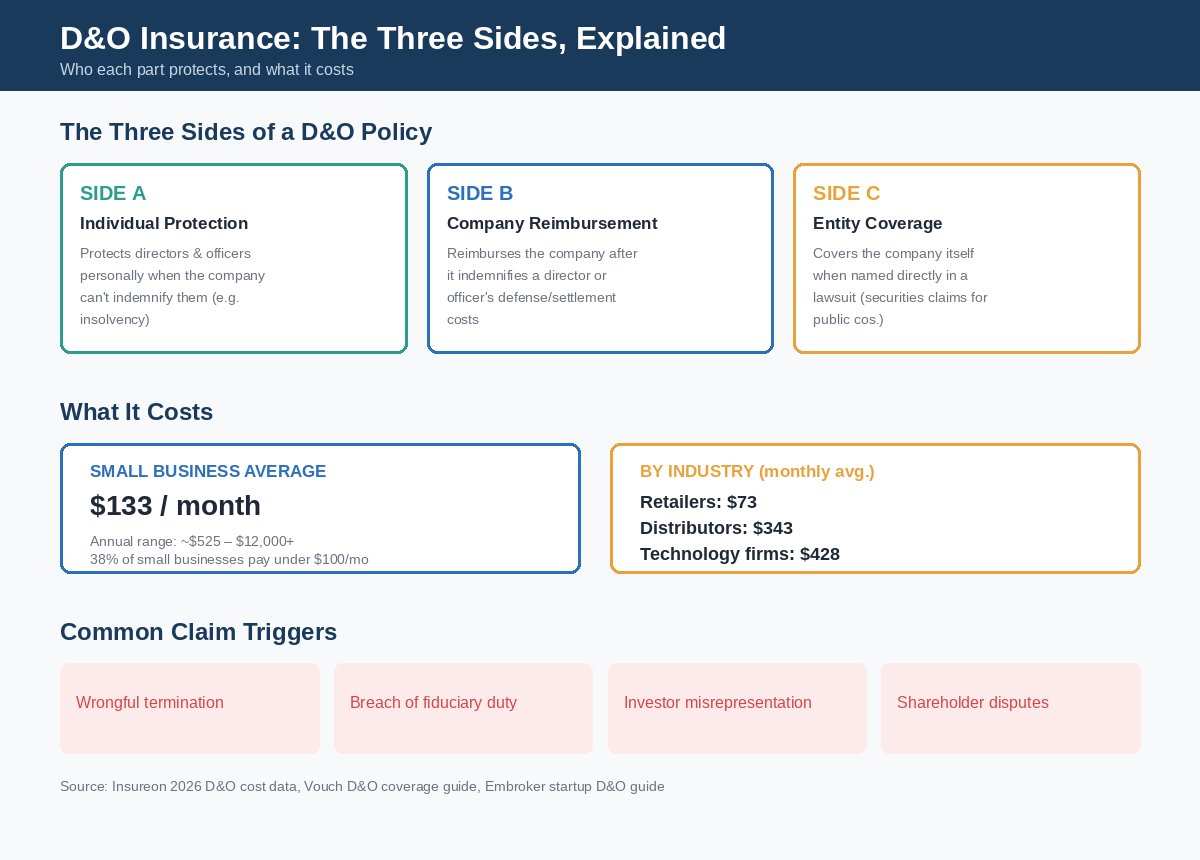
Side A protects individual directors and officers personally, specifically in situations where the company can’t indemnify them — most commonly during insolvency, or when indemnification is legally restricted. This is the piece that protects a founder’s personal assets when the company itself can’t step in to cover their defense. This is one of the most common questions we hear about directors and officers insurance.
Side B reimburses the company itself, after the company has already indemnified a director or officer — meaning the business paid for a leader’s legal defense or settlement out of pocket, and Side B pays the company back. Many owners overlook this detail when comparing directors and officers insurance options.
Side C covers the entity itself when the company (not just an individual) is named in a lawsuit. For public companies this is mostly about securities claims; for private companies, the scope can be considerably broader depending on how the policy is written. Before you decide, make sure you understand directors and officers insurance correctly.
Most small-business D&O policies bundle all three into one policy rather than selling them separately, but knowing which side responds to which scenario matters when you’re comparing quotes or reading exclusions. If you’re evaluating directors and officers insurance, this distinction is worth remembering.
Why This Isn’t Just a Big-Company Problem
The claims that trigger D&O policies aren’t exotic — they’re the ordinary friction points of running a company with more than one decision-maker. Wrongful termination claims against a manager who also sits on the board. A misrepresentation claim from an investor who says they were given inflated numbers before writing a check. A breach of fiduciary duty claim from a co-founder who feels frozen out of decisions. Regulatory compliance issues that name the leadership team, not just the company. None of these require a Fortune 500 org chart — a five-person startup with two co-founders and an angel investor on the cap table has all the ingredients.
I’ve seen early-stage companies treat D&O as something to “deal with later,” right up until a term sheet from a VC firm arrives with a requirement to carry it as a condition of the round closing. At that point it’s not really optional — it’s a checkbox that has to get filled before the money moves, which is a worse time to be shopping for coverage than well before you need it.
What D&O Insurance Costs
Based on 2026 small-business data, the average small company pays around $133 a month for D&O coverage, with annual premiums ranging from roughly $525 to over $12,000. Cost splits heavily toward the lower end for most small businesses — about 38% pay under $100/month, another third pay $100–$300/month — but industry moves the number a lot: retailers average around $73/month, distributors closer to $343/month, and technology companies (which attract more investor scrutiny and regulatory attention) average $428/month. As with the other coverages here, these are planning ranges — your actual premium depends on company stage, revenue, board composition, and whether you’ve taken outside investment.
How to Approach D&O Without Overpaying or Under-Covering
- Get it before a funding round requires it. Shopping for D&O under a term sheet deadline gives you far less leverage than getting quotes on your own timeline.
- Confirm all three sides are included, not just Side A — a policy that only protects individuals personally leaves the company itself exposed on entity-level claims.
- Tell your broker about your cap table honestly. Outside investors, especially VC/PE money, change the risk profile and the coverage recommendation — this isn’t something to gloss over to save on premium.
- Coordinate with your EPLI coverage. Wrongful termination and discrimination claims can implicate both D&O and employment practices liability insurance — ask your agent how the two policies interact so you’re not assuming coverage that isn’t actually there.
- Revisit limits as the company grows. A policy sized for a two-person startup won’t match the exposure of the same company two funding rounds later.
The companies that get caught without adequate D&O coverage usually aren’t reckless — they’re small teams who assumed liability protection was a problem for bigger companies with bigger boards, and found out during their first real governance dispute or investor conflict that “small” doesn’t mean “not personally exposed.” It’s a small detail, but it can make a real difference for directors and officers insurance.
Related Reading
- Insureon’s 2026 D&O insurance cost data
- Vouch’s guide to D&O insurance coverage (Side A/B/C)
- Embroker’s guide to D&O insurance for startups
This article is for general informational purposes and isn’t personalized insurance, legal, or financial advice. Coverage rules, costs, and state requirements change, and every business’s risk is different — for decisions specific to your business, talk to a licensed insurance agent. Learn more About BizShieldGuide or reach us via our Contact page. This is exactly the kind of scenario where directors and officers insurance matters most.
Directors and officers insurance matters even for very small, privately held companies, not just large public corporations. Investors, employees, vendors, and even competitors can all sue individual directors and officers personally over decisions like a layoff, a failed merger, a hiring decision, or a disclosure to investors, and directors and officers insurance is what pays their legal defense and any settlement.
Without directors and officers insurance, a lawsuit against a company’s leadership can reach into a founder’s personal savings, home equity, and other assets, since corporate liability protection generally doesn’t shield individual officers from claims tied to their own decisions or alleged mismanagement.
Startups raising outside investment are often required by their investors to carry directors and officers insurance before a funding round closes, since VCs and other investors want assurance that a founder’s poor judgment call won’t personally bankrupt the people running the company they just funded. Premiums for directors and officers insurance are usually modest for an early-stage company and rise with revenue, headcount, and how much outside capital has been raised.
Directors and officers insurance policies are typically split into three parts: Side A protects individual directors and officers when the company can’t indemnify them, Side B reimburses the company when it does indemnify them, and Side C (entity coverage) protects the company itself, usually only for securities claims. Understanding which side of directors and officers insurance actually responds to a given claim is exactly why founders should read the policy with a broker rather than assume it works like general liability.
Real-world directors and officers insurance claims often start with something that felt routine at the time: a vendor contract dispute, a hiring decision that turned into a discrimination lawsuit, or a merger negotiation that a minority shareholder later claimed undervalued the company. In each case, the plaintiff argued that the people making the decision, not just the business itself, should be held personally accountable. Without directors and officers insurance in place, defending against even a meritless version of these claims can cost tens of thousands of dollars before a single deposition is taken, and a judgment or settlement can reach into personal assets like homes, retirement accounts, and savings.
- Wrongful termination, discrimination, or retaliation claims brought against individual managers
- Shareholder or investor lawsuits alleging a breach of fiduciary duty in a merger, sale, or funding round
- Regulatory investigations into financial reporting, tax compliance, or industry-specific rules
- Creditor claims following insolvency or bankruptcy proceedings
- Disputes with business partners or competitors over contract terms or unfair competition
The cost of directors and officers insurance depends on several factors insurers weigh together: the company’s industry and risk profile, its revenue and employee count, whether it has outside investors or a board with fiduciary duties to shareholders, its claims history, and the amount of coverage requested. A small private company with no outside investors might pay a few hundred dollars a year for a modest limit, while a venture-backed startup preparing for a funding round or eventual acquisition often needs significantly higher limits because investors and new board members typically require it as a condition of joining.
Employment practices liability insurance is a closely related but distinct coverage that many small businesses confuse with directors and officers insurance. Employment practices liability responds to claims like wrongful termination, harassment, or discrimination brought by employees against the company as an employer. Directors and officers insurance responds to claims that leadership breached a duty owed to the company, its shareholders, or other stakeholders in making a business decision. Many insurers bundle both coverages into a single management liability policy, which is often the most cost-effective way for a small business to close both gaps at once.
When shopping for directors and officers insurance, it helps to compare not just price but the structure of coverage across Side A, Side B, and Side C protection, the size of the retention or deductible, and whether the policy is written on a claims-made basis, which is standard for this type of coverage and requires keeping continuous coverage in force to avoid gaps that could leave older claims uninsured.
Small business owners sometimes assume that because their company is privately held, with no public shareholders to answer to, directors and officers insurance is unnecessary. In practice, private companies face many of the same exposures. Minority investors, co-founders who later disagree over company direction, and even employees serving on an advisory board can bring claims alleging that a decision maker breached a duty owed to the business. Banks and commercial lenders also increasingly ask whether a borrower carries directors and officers insurance as part of their underwriting review before extending a line of credit or a term loan, since it signals that the company has thought through its governance risk.
Buying directors and officers insurance for the first time does not have to be complicated. Most small businesses start with a base policy limit of one million to three million dollars, layered with employment practices liability and sometimes fiduciary liability for retirement plan oversight. Working with a broker who specializes in management liability coverage, rather than a generalist commercial agent, usually produces better terms because these policies are underwritten differently from general liability or property coverage. Renewing directors and officers insurance annually and reviewing the limit as the company grows, adds board members, or takes on outside investment keeps the protection aligned with the company’s actual risk.
Claims-made coverage and why continuity matters
Directors and officers insurance is almost always written on a claims-made basis rather than an occurrence basis. That means the policy in force at the time a claim is filed responds, not the policy that was active when the underlying conduct happened. If a company lets its directors and officers insurance lapse, even for a short gap between renewals or after switching carriers, a claim filed during that gap may go completely uninsured, even if the events that led to it occurred years earlier while coverage was active.
This is why brokers strongly recommend keeping directors and officers insurance continuous, and why buying tail coverage, also called an extended reporting period, matters so much whenever a company is sold, merges, or otherwise ends its policy.
Tail coverage extends the window during which a claim about past conduct can still be reported under an expiring directors and officers insurance policy, typically for one to six years depending on what the buyer negotiates. Acquirers frequently require the selling company to purchase a six-year tail as a condition of closing, specifically so that former directors and officers remain protected from claims that surface after the deal closes but relate to decisions made while they were still in charge.
Most directors and officers insurance policies carry standard exclusions worth understanding before a claim happens: intentional fraud or criminal acts (once finally adjudicated, not merely alleged), bodily injury and property damage claims that belong under general liability, and in many cases claims arising from prior known circumstances that existed before the policy started. Reading the exclusions section with a broker, rather than assuming directors and officers insurance covers everything a leadership team might face, prevents an unpleasant surprise when a claim is denied on a technicality that could have been addressed at renewal time.
Who actually needs directors and officers insurance first
Not every small business needs to buy directors and officers insurance on day one, but a few situations push it up the priority list quickly. Any company that has taken outside investment, even a modest friends-and-family round structured as equity rather than a loan, now has investors who could later claim the founders mismanaged their capital. Any company with a formal board, including nonprofit boards where volunteer directors serve without pay, needs directors and officers insurance because board members can be named personally in a lawsuit regardless of whether they were compensated for their service.
Companies preparing to raise a priced equity round, apply for certain government contracts, or bring on independent directors from outside the founding team should expect to be asked for proof of directors and officers insurance before those relationships move forward, since sophisticated counterparties treat its absence as a governance red flag rather than a minor formality.
For a solo founder with no outside investors, no formal board, and no employees, directors and officers insurance may reasonably wait until the business adds one of those elements. The moment any of those conditions changes, revisiting the decision with a broker who understands directors and officers insurance, rather than defaulting to a generic business owner’s policy that never quotes it, is the safer path forward.
The bottom line
Directors and officers insurance is one of those coverages that feels optional right up until the moment a claim arrives, at which point it becomes the single most important policy a small business owns. The cost of a policy is modest compared to the cost of defending even a single lawsuit out of pocket, and the protection extends to the personal assets of the people who agreed to lead the company, not just the business itself. Reviewing whether the company’s current insurance program actually includes directors and officers insurance, rather than assuming a general business policy already covers it, is worth doing before a claim forces the question.

About the Author: BizShieldGuide Team
The BizShieldGuide team researches and writes plain-language guides to business and personal insurance — general liability, professional liability, workers' compensation, business owners policies, cyber liability, and industry-specific coverage for small business owners, alongside straightforward explainers on auto, home, and renters insurance for everyday readers. Our articles are grounded in publicly available data from insurers and carriers (Insureon, The Hartford, Progressive, State Farm, and others), industry cost surveys, and standard policy language, and we link to primary sources wherever a number or coverage detail could change. We are not licensed insurance agents or brokers, and nothing here replaces a quote or advice from one for your specific situation.