
Understanding LLC vs sole proprietorship insurance differences matters before choosing how to structure a new business, since the entity type directly changes which risks fall on personal assets and which coverages become essential. Forming an LLC gets sold, informally, as a kind of instant force field — pay the state filing fee, and suddenly your house and savings are untouchable if the business gets sued. That’s not quite how it works.
An LLC does create real separation between you and your business, but that shield has specific limits, has to be actively maintained to keep working, and — this is the part that surprises people — doesn’t actually replace the need for business insurance. Sole proprietors and LLC owners end up needing largely the same core coverages; they’re just protecting against different things when they buy them.
What an LLC Actually Protects (and What a Sole Proprietorship Doesn’t)
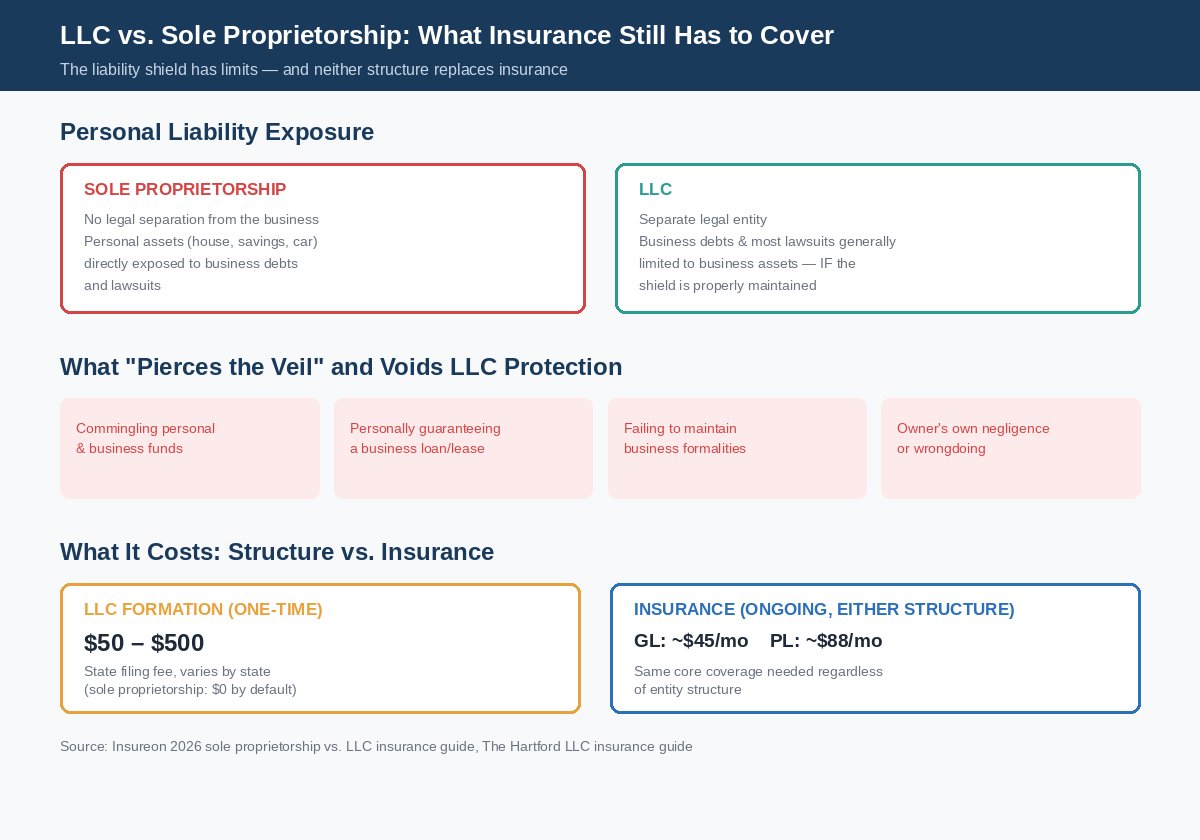
As a sole proprietor, there’s no legal separation between you and the business — you and it are the same entity in the eyes of the law. If the business is sued or can’t pay a debt, your personal assets (your house, your car, your personal savings) are directly exposed, not just whatever the business owns. An LLC creates a separate legal entity: business debts and most lawsuits are generally limited to what the business itself owns, leaving personal assets outside the reach of most business creditors and claimants.
That’s the real, meaningful benefit of forming one — and it’s why many freelancers and small business owners eventually convert from sole proprietor to LLC as the business grows.
The Limits of the LLC Shield
” This tends to happen when an owner commingles personal and business funds (using the business account to pay personal bills, or vice versa), personally guarantees a business loan or lease, fails to maintain basic business formalities, or when the claim involves the owner’s own negligence or wrongdoing rather than a general business debt. I’ve seen owners assume that simply filing LLC paperwork was the whole job — then keep using one bank account for everything, which is exactly the kind of commingling that gives a court grounds to set the protection aside when it matters most.
There’s also a category of risk the LLC structure was never designed to touch in the first place: if your work injures someone, damages their property, or a mistake in your professional services costs a client money, that’s an operational risk the business itself faces regardless of how it’s legally structured. The LLC protects your personal assets from the business’s liabilities; it does nothing to stop the business from being liable, or to pay for the legal defense and settlement costs when it is.
Why Both Structures Need the Same Core Insurance
General liability insurance and professional liability (E&O) insurance respond to the operational risk itself — the injury, the property damage, the professional mistake — not to whether you’re a sole proprietor or an LLC. Both structures typically need the same core policies for the same underlying reasons: general liability for third-party injury and property damage claims, professional liability if your work is advice, design, or technical services a client could claim was negligent, and a Business Owner’s Policy bundling both with property coverage once there’s a physical location or meaningful equipment involved.
The difference is what happens after a claim exceeds what insurance pays: as a sole proprietor, the gap comes out of your personal assets directly; as a properly maintained LLC, it’s generally limited to what the business owns. Insurance and entity structure are solving two different problems, which is exactly why you need both rather than treating one as a substitute for the other.
What It Costs
Forming an LLC is mostly a one-time (plus modest annual renewal) cost — state filing fees typically range from $50 to $500 depending on the state, compared to $0 to become a sole proprietor by default. Insurance is the ongoing cost that doesn’t change based on entity structure: general liability typically runs around $45/month and professional liability around $88/month for a solo or small operation, based on 2026 industry data. Owners sometimes treat the LLC filing fee as if it were “the insurance,” when in practice it’s a one-time legal structuring cost that sits alongside — not instead of — the recurring insurance premium.
A Practical Checklist for Either Structure
- Don’t treat your LLC as an insurance substitute. It protects your personal assets from the business’s liabilities; it doesn’t stop the business from being liable in the first place.
- Keep business and personal finances genuinely separate — a dedicated business bank account and no personal use of business funds — since commingling is one of the most common ways owners accidentally void their own liability protection.
- Buy general liability and professional liability based on your actual work, not your entity structure — a sole proprietor and an LLC doing the same consulting work need essentially the same coverage.
- Add workers’ compensation once you have employees, regardless of entity type — it’s a legal requirement in most states independent of whether you’re a sole proprietor or an LLC.
- Revisit your insurance when you convert from sole proprietor to LLC — the paperwork changes your personal liability exposure, not your day-to-day operational risk, so don’t assume the switch itself reduces what you need to insure.
The owners who get caught out here usually aren’t ignoring the issue — they formed the LLC specifically to protect themselves, then reasonably (but incorrectly) assumed that filing was the end of the liability conversation rather than the beginning of a second, separate one.
Related Reading
- Insureon’s guide to sole proprietorship vs. LLC insurance considerations
- The Hartford’s guide to why LLCs still need business insurance
- Our guide to freelancer and self-employed insurance, for readers still operating as a sole proprietor
This article is for general informational purposes and isn’t personalized insurance, legal, or financial advice. Coverage rules, costs, and state requirements change, and every business’s risk is different — for decisions specific to your business, talk to a licensed insurance agent. Learn more About BizShieldGuide or reach us via our Contact page.
How business structure changes the insurance conversation
The core issue in any LLC vs sole proprietorship insurance comparison is personal liability protection. A sole proprietorship offers no legal separation between the owner and the business, which means a lawsuit against the business is effectively a lawsuit against the owner’s personal assets, including a home, personal savings, and other property. An LLC creates a separate legal entity, so in most cases a claim against the business cannot reach the owner’s personal assets directly, provided the LLC is properly maintained with its own bank account and finances kept separate from personal funds.
This structural difference is exactly why the LLC vs sole proprietorship insurance question comes up so often: business insurance becomes the primary backstop for a sole proprietor, since there is no legal wall protecting personal assets the way an LLC provides.
That said, forming an LLC does not eliminate the need for insurance, and this is the part of the LLC vs sole proprietorship insurance discussion that catches new business owners off guard. Courts can and do pierce the LLC’s liability shield, sometimes called “piercing the corporate veil,” when an owner mixes personal and business finances, fails to maintain the LLC properly, or personally guarantees a business debt.
General liability insurance, professional liability insurance, and other business coverages remain just as necessary for an LLC as for a sole proprietorship, because the LLC protects personal assets from certain claims but does nothing to pay for a lawsuit’s legal defense, a client’s injury, or a professional mistake — that is what insurance is for, regardless of entity type.
General liability insurance under either structure
General liability insurance covers third-party bodily injury and property damage claims, and every business needs it whether it operates as a sole proprietorship or an LLC. In the LLC vs sole proprietorship insurance comparison, this is one coverage where the entity type makes little practical difference to the decision to buy it — a customer who slips and falls, or a client whose property is damaged during a service call, can sue the business regardless of how it is legally structured, and general liability insurance is what pays the resulting legal and settlement costs rather than the owner’s personal or the LLC’s business assets.
Professional liability and errors and omissions coverage
For service-based businesses, professional liability insurance, sometimes called errors and omissions insurance, protects against claims that a mistake, missed deadline, or bad advice caused a client financial harm. This coverage matters in the LLC vs sole proprietorship insurance decision because professional negligence claims are exactly the kind of claim most likely to pierce an LLC’s protection if the owner personally performed the negligent work — many states allow a plaintiff to sue the individual professional directly for their own malpractice even when that professional operates through an LLC. Professional liability insurance, not the business structure, is what actually pays for these claims.
Workers’ compensation and the moment structure starts to matter more
Once a sole proprietorship or LLC hires its first employee, workers’ compensation insurance typically becomes mandatory under state law, and this is another point in the LLC vs sole proprietorship insurance conversation where the entity type has real consequences. Sole proprietors are often exempt from carrying workers’ compensation on themselves (though many choose to anyway), while the requirement to cover employees kicks in the same way regardless of whether the employer is a sole proprietorship or an LLC.
Where the entity type matters more is in personal liability if a workplace injury claim escalates into a lawsuit alleging negligence beyond what workers’ compensation covers — an LLC provides a layer of protection here that a sole proprietorship does not.
Cost differences and how insurers price each structure
Insurers generally do not charge dramatically different premiums purely because a business is an LLC instead of a sole proprietorship; pricing is driven far more by industry, revenue, claims history, and coverage limits than by entity type alone. Where the LLC vs sole proprietorship insurance decision affects cost indirectly is through the umbrella or excess liability conversation: because a sole proprietor’s personal assets are directly exposed, many sole proprietors choose to buy higher liability limits or an umbrella policy on top of a standard business owner’s policy specifically to compensate for the missing legal protection an LLC would otherwise provide.
Converting from a sole proprietorship to an LLC
Business owners who convert from a sole proprietorship to an LLC should treat it as a trigger to review every existing insurance policy, not just a paperwork exercise. Policies are typically written in the name of the insured entity, and a mismatch between the policy holder name and the actual legal structure can create a coverage gap or even give an insurer grounds to deny a claim.
Updating a business owner’s policy, professional liability policy, and any auto or property coverage to reflect the new LLC name and structure is the single most commonly overlooked step in the LLC vs sole proprietorship insurance transition, and skipping it can undo much of the protection the conversion was meant to provide.
LLC vs sole proprietorship insurance: frequently asked questions
Business owners weighing LLC vs sole proprietorship insurance questions often ask whether forming an LLC lets them drop business insurance altogether. It does not. An LLC changes who can be sued directly and what assets are exposed, but it does nothing to pay a claim once one is filed — that function belongs entirely to insurance, and skipping it leaves the LLC itself, including any cash and equipment it owns, fully exposed to a judgment even though the owner’s personal home and savings are shielded.
Another common LLC vs sole proprietorship insurance question is whether switching structures affects an existing insurance policy’s renewal price. In most cases the answer is no, because premiums are driven by industry risk, revenue, and claims history rather than legal entity type. What does change is the paperwork: the policy must be reissued or endorsed in the LLC’s legal name, and failing to do this promptly after converting from a sole proprietorship is one of the most common gaps small business owners create for themselves without realizing it.
A third frequent LLC vs sole proprietorship insurance question involves multi-member LLCs, where two or more owners share the business. In that structure, a dispute between members over business decisions can itself become a source of liability, which is why many multi-member LLCs also carry management liability or directors and officers insurance in addition to standard general liability coverage — a layer of protection that rarely comes up for a single-owner sole proprietorship, since there is no other member to have a dispute with in the first place.
Choosing the right coverage regardless of entity type
Whether operating as a sole proprietorship or an LLC, the practical starting point for coverage is usually the same: a business owner’s policy that bundles general liability and commercial property coverage, layered with professional liability insurance for service-based work and workers’ compensation once employees are hired. The LLC vs sole proprietorship insurance decision mainly changes how much emphasis to place on liability limits and umbrella coverage, since a sole proprietor carries more personal exposure and often benefits from higher limits than an LLC owner might otherwise choose.
Working through this comparison with an insurance agent who understands both structures, rather than assuming the entity choice alone solves the liability problem, produces a more complete and accurate coverage plan.
The bottom line on LLC vs sole proprietorship insurance
The LLC vs sole proprietorship insurance decision ultimately comes down to two separate but related questions: which legal structure best protects personal assets, and which insurance policies actually pay for a claim when one happens. Forming an LLC answers the first question by creating a liability shield around personal assets, but it leaves the second question completely unanswered — only insurance does that.
Sole proprietors who never form an LLC can still protect themselves reasonably well with the right combination of general liability, professional liability, and umbrella coverage, while LLC owners who assume the entity alone makes them safe are often surprised the first time a claim exceeds what their thin insurance coverage was ever designed to pay. Getting the LLC vs sole proprietorship insurance question right means treating entity structure and insurance coverage as two separate layers of protection that work together, not as substitutes for one another.
Reviewing both the business structure and the insurance program together at least once a year, especially as revenue grows or the business adds employees or partners, keeps the LLC vs sole proprietorship insurance answer aligned with how the business actually operates rather than how it was set up on day one.
Some business owners delay this LLC vs sole proprietorship insurance review for years, assuming that whatever coverage they bought at startup will still fit the business as it grows. Revenue growth, new hires, additional locations, and new service lines all change the risk profile in ways the original policy may never have anticipated, so treating that first policy as permanent rather than as a starting point is a common and avoidable mistake. A short annual check-in with an insurance agent, timed around the same season as a tax or business-license renewal, is usually enough to catch these gaps before they turn into an uninsured claim.
Quick recap: LLC vs sole proprietorship insurance at a glance
To summarize the LLC vs sole proprietorship insurance comparison in a few practical takeaways: an LLC shields personal assets from most business debts and lawsuits, while a sole proprietorship offers no such wall; both structures still need general liability and professional liability insurance regardless of the LLC vs sole proprietorship insurance choice made at formation; workers’ compensation becomes mandatory for either structure once employees are hired; and the LLC vs sole proprietorship insurance decision has little direct effect on premium pricing but a significant effect on how much umbrella or excess liability coverage makes sense.
Business owners who keep these LLC vs sole proprietorship insurance basics in mind when setting up or reviewing their coverage tend to avoid the two most common mistakes: assuming an LLC alone is enough protection, and assuming a sole proprietorship cannot be adequately protected without one.
Insurance agents who field LLC vs sole proprietorship insurance questions every week often say the same thing: the entity paperwork protects the owner’s house, but only the LLC vs sole proprietorship insurance policy itself protects the business’s ability to keep operating after a claim. A well-chosen LLC vs sole proprietorship insurance package, matched to the actual work being done and reviewed at least annually, does more to prevent a claim from becoming a crisis than the choice between an LLC and a sole proprietorship ever will on its own.
That is the central lesson of any serious LLC vs sole proprietorship insurance comparison: structure and coverage are partners, not substitutes, and skipping either one leaves a real gap that a claim will eventually find.
Every LLC vs sole proprietorship insurance guide worth reading circles back to this same point: LLC vs sole proprietorship insurance is a package deal, not an either-or choice. Getting the LLC vs sole proprietorship insurance combination right protects both the business and the owner personally.

About the Author: BizShieldGuide Team
The BizShieldGuide team researches and writes plain-language guides to business and personal insurance — general liability, professional liability, workers' compensation, business owners policies, cyber liability, and industry-specific coverage for small business owners, alongside straightforward explainers on auto, home, and renters insurance for everyday readers. Our articles are grounded in publicly available data from insurers and carriers (Insureon, The Hartford, Progressive, State Farm, and others), industry cost surveys, and standard policy language, and we link to primary sources wherever a number or coverage detail could change. We are not licensed insurance agents or brokers, and nothing here replaces a quote or advice from one for your specific situation.