
Business interruption insurance replaces the income you lose when a covered event forces you to shut down temporarily, not just the physical damage that caused the closure.
If a fire, burst pipe, or wind damage shuts your storefront for three months, your property insurance pays to fix the building — but nothing pays your rent, your payroll, or your loan installments while you’re closed.
That’s a separate coverage: business interruption insurance (also called business income coverage), and it’s the piece that determines whether a bad property claim is a temporary setback or the end of the business.
It’s rarely sold on its own; it’s typically bundled into a Business Owners Policy (BOP) alongside property and general liability, which is exactly why so many owners don’t realize how thin their version of it actually is until they need it.
What Business Interruption Actually Pays For
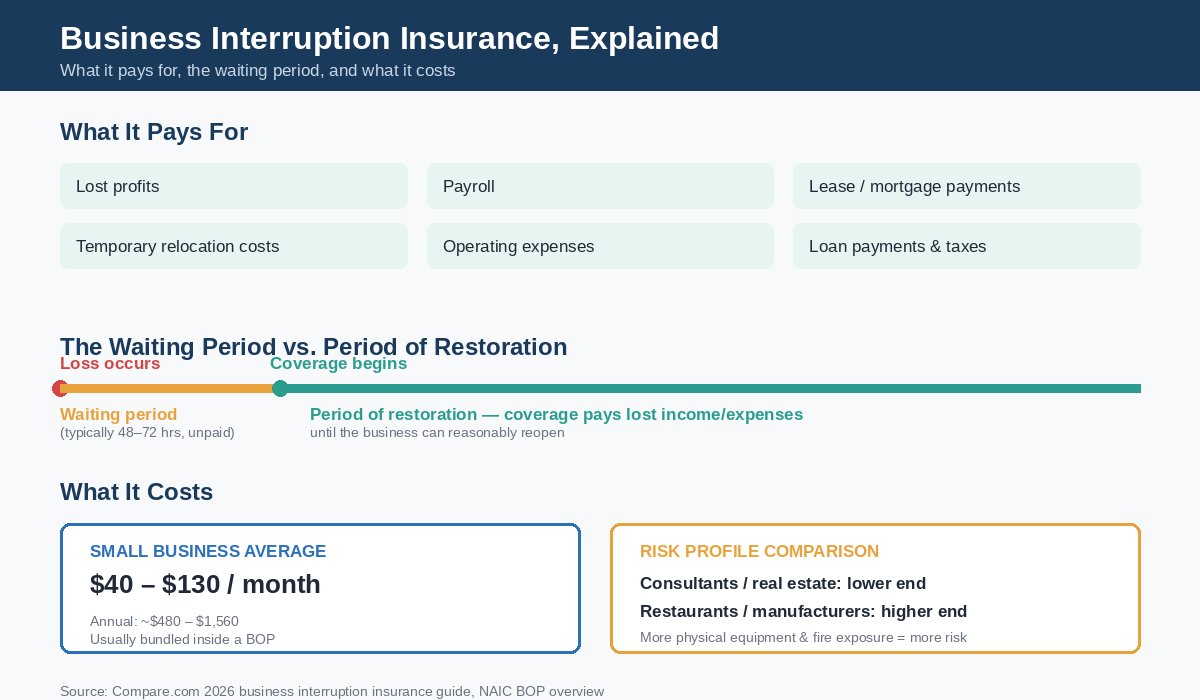
Coverage is built around keeping the business’s finances intact while it can’t operate, not just replacing the damaged property. That typically includes lost profits (calculated from your historical financials), payroll — so you can keep staff on rather than losing them to another job during the closure — lease or mortgage payments on the location, temporary relocation costs if you set up somewhere else, ongoing operating expenses like equipment and software, and fixed obligations like loan payments and taxes that don’t pause just because the business did.
What it does not cover trips up more businesses than any other part of this policy. It only responds if the interruption stems from a peril your property policy actually covers — if the underlying damage isn’t a covered cause, the income loss that follows isn’t covered either. Pandemics are excluded on essentially every standard policy. An outage at a utility company’s off-site equipment isn’t covered unless you’ve specifically added a utility services endorsement. Cyberattacks need a separate cyber liability policy. And civil authority shutdowns — the government blocking access to your area — are only covered when they’re tied to actual nearby property damage, not a blanket order with no direct damage nearby.
The Waiting Period and Why It Catches Owners Off Guard
Most policies have a waiting period — commonly 48 to 72 hours — before coverage kicks in, similar in spirit to a deductible but measured in time rather than dollars. I’ve seen a retail client assume coverage would pay from day one of a closure, only to realize during a claim that the first two or three days were on the business regardless. For a short closure, that waiting period can end up being most of the loss.
The other number that matters is how coverage limits are set: insurers typically size the policy around your expected “period of restoration” — how long it would realistically take to reopen — multiplied by your monthly income loss. A business with $600,000 in annual revenue expecting a worst-case six-month rebuild might need something in the neighborhood of $300,000 in coverage. Underestimating that restoration timeline is the most common way businesses end up under-insured on this coverage without realizing it until the claim is already in progress.
What It Costs
Based on 2026 small-business data, business interruption coverage typically runs $40 to $130 a month, or roughly $480 to $1,560 a year, layered on top of the rest of a BOP. Where a business lands in that range depends heavily on risk profile: lower-risk service businesses like consultants and real estate agents tend to sit at the lower end, while restaurants, manufacturers, and other operations with more physical equipment and higher fire/damage exposure sit closer to the top. As with any coverage discussed here, these are planning figures — the real number depends on your revenue, industry, location, and how long a realistic shutdown would take to recover from.
How to Make Sure You’re Actually Covered When It Matters
- Check whether it’s included in your BOP at all, and at what limit — some package policies include only a modest sublimit for business income, not full replacement of lost revenue.
- Estimate your real restoration timeline honestly. Talk to a contractor or your landlord about realistic rebuild time for your specific space and industry, rather than guessing low.
- Ask about the waiting period and whether a shorter one is available — it usually costs more, but for a business with thin cash reserves, those first 48–72 hours matter.
- Add a utility services endorsement if your business genuinely can’t operate without power or connectivity and your area has a history of outages.
- Review the civil authority language specifically if you’re in an area prone to wildfire, flooding, or hurricane evacuation orders — this is one of the most commonly misunderstood exclusions.
The businesses that get hurt most by this gap aren’t the ones that skipped insurance entirely — they’re the ones with a BOP that technically includes business interruption, just at a limit and waiting period nobody actually checked against what a real closure would look like. This is exactly the kind of scenario where business interruption insurance matters most.
Related Reading
- Compare.com’s 2026 guide to business interruption insurance
- NAIC’s overview of business interruption coverage and BOPs
- Our guide to BOP vs. buying coverage separately, where business interruption is most often bundled in
This article is for general informational purposes and isn’t personalized insurance, legal, or financial advice. Coverage rules, costs, and state requirements change, and every business’s risk is different — for decisions specific to your business, talk to a licensed insurance agent. Learn more About BizShieldGuide or reach us via our Contact page. If you’re evaluating business interruption insurance, this distinction is worth remembering.
Business interruption insurance is almost always sold as an add-on to a property or business owner’s policy rather than a standalone product, and it only pays out when the interruption is caused by a covered peril — typically fire, storm damage, or another event already covered under the underlying property policy. Flood and earthquake damage usually require separate coverage before business interruption insurance will respond to a closure caused by either.
To get paid promptly, business interruption insurance claims need documentation: prior financial statements, tax returns, and a clear record of ongoing expenses like rent and payroll that continue during the shutdown. Insurers typically calculate the payout based on the income you would have earned had the interruption not happened, minus any expenses you didn’t have to pay while closed.
Most business interruption insurance policies also include a waiting period (often 48-72 hours) before coverage kicks in, and a maximum “period of restoration” — usually 12 months — during which the policy will keep paying. Businesses in disaster-prone areas often extend this period, since rebuilding and reopening can take considerably longer than the standard restoration window.
One detail worth confirming with your agent: business interruption insurance typically covers “extra expense” too, such as the cost of a temporary location or expedited equipment repair, on top of straight lost income. That extra expense provision can be just as valuable as the income replacement itself, since it often lets a business reopen faster and shortens how long business interruption insurance has to keep paying out.
Before you buy business interruption insurance, ask your agent to run a worksheet estimating how many months it would realistically take to reopen after a total loss, since underinsuring this period is one of the most common mistakes small business owners make. It’s far cheaper to buy an extra few months of business interruption insurance coverage up front than to run out of payouts halfway through a slow rebuild.

About the Author: BizShieldGuide Team
The BizShieldGuide team researches and writes plain-language guides to business and personal insurance — general liability, professional liability, workers' compensation, business owners policies, cyber liability, and industry-specific coverage for small business owners, alongside straightforward explainers on auto, home, and renters insurance for everyday readers. Our articles are grounded in publicly available data from insurers and carriers (Insureon, The Hartford, Progressive, State Farm, and others), industry cost surveys, and standard policy language, and we link to primary sources wherever a number or coverage detail could change. We are not licensed insurance agents or brokers, and nothing here replaces a quote or advice from one for your specific situation.