
Employment practices liability insurance, often shortened to EPLI, protects your business against claims from employees alleging wrongful termination, discrimination, harassment, or retaliation.
The moment you hire your first employee, you take on a risk that has nothing to do with slip-and-falls or defective products: the risk that an employee — or former employee — sues you over how they were treated at work. Discrimination, harassment, wrongful termination, and retaliation claims are covered by none of your other policies.
General liability responds to third-party injuries and property damage; workers’ comp responds to on-the-job physical injuries.
A claim that an employee was fired because of their age, or that a manager ignored a harassment complaint, falls into a gap that only employment practices liability insurance (EPLI) fills — and small businesses are sued over this more often than most owners expect.
What EPLI Actually Covers
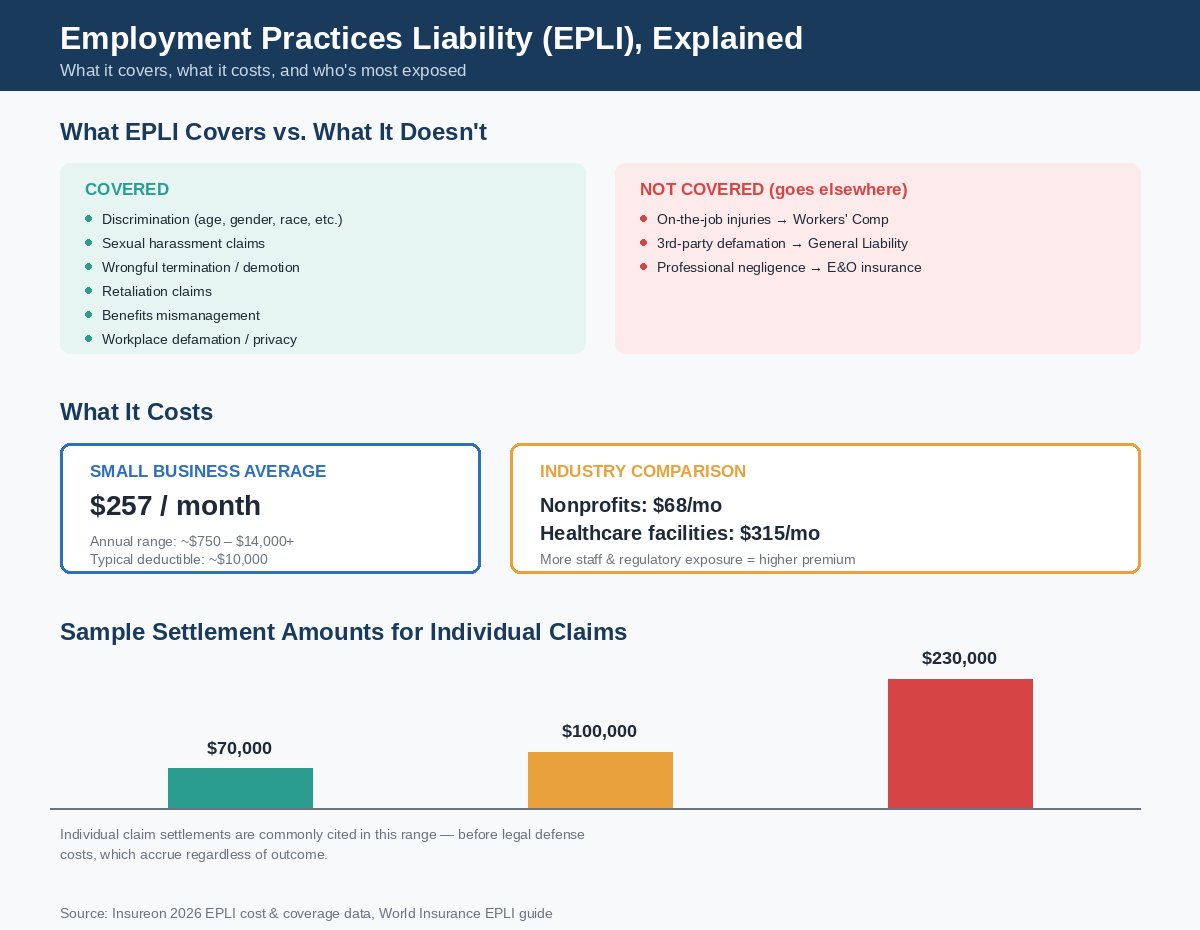
EPLI responds to lawsuits alleging violations of an employee’s workplace rights. That’s a wide net: discrimination based on age, gender, race, religion, disability, or other protected characteristics; sexual harassment, including claims that a complaint was raised and mishandled; wrongful termination, discipline, or demotion; retaliation against an employee who reported a problem; mismanagement of benefits like health coverage, PTO, or sick leave; breach of an employment contract; and even workplace defamation or invasion of privacy claims, such as improper monitoring. Coverage typically pays for attorney fees, court costs, witness fees, settlements, and judgments — which matters because even a claim that goes nowhere still generates legal bills from day one.
What it doesn’t cover is just as important to understand. On-the-job physical injuries stay with workers’ compensation. A defamation claim from someone outside the company — a customer, a competitor — falls under general liability, not EPLI. And professional negligence (giving bad professional advice, making a costly error in client work) is an errors & omissions matter. EPLI is specifically about the employer-employee relationship.
Why Small Businesses Underestimate This Risk
I’ve talked to small business owners who assumed employment claims were something that happened to large corporations with HR departments and thousands of employees. The data doesn’t support that assumption — employees are statistically more likely to sue their employer than the business is to have an office fire, and claims are both common and expensive to resolve regardless of company size.
A five-person shop firing someone for poor performance can still end up defending a wrongful termination claim if the termination wasn’t documented consistently with how other employees were treated. Settlements in the range of $70,000 to $230,000 aren’t unusual for individual claims, and that’s before factoring in the legal defense costs that accumulate whether or not the claim has merit. Understanding this point can save you real money on employment practices liability insurance.
Retail, food service, healthcare, professional services, and manufacturing tend to see this most often — industries with higher turnover, more hourly staff, and more day-to-day management decisions (scheduling, discipline, termination) that can become the basis of a claim. But no business with employees is fully exempt; EPLI isn’t legally required anywhere, which is exactly why so many small businesses go without it until the first claim arrives.
What EPLI Costs
Based on 2026 small-business insurance data, the median small business pays around $257 a month for EPLI, with annual premiums ranging from roughly $750 to over $14,000 depending on the business. Cost splits fairly evenly across a wide band — about 38% of businesses pay under $200 a month, another third pay $200–$400. Before you decide, make sure you understand employment practices liability insurance correctly.
Industry drives a lot of the variation: nonprofits average a relatively low $68/month, while healthcare facilities — with more staff, more regulatory exposure, and historically more claims — average closer to $315/month. A typical policy carries a deductible around $10,000, meaning the business absorbs the first portion of any claim before coverage responds. It’s a small detail, but it can make a real difference for employment practices liability insurance.
As always, these are planning figures rather than quotes — actual premiums depend on employee count, revenue, claims history, and location (states with stronger labor protections, like California, New York, and Massachusetts, tend to run higher). This is exactly the kind of scenario where employment practices liability insurance matters most.
Turnover rate and hiring/termination practices matter more here than in most other insurance lines. A business with high staff turnover or inconsistent documentation around discipline and termination reads as higher risk to underwriters — and, not coincidentally, is also genuinely more exposed to a real claim. If you’re evaluating employment practices liability insurance, this distinction is worth remembering.
How to Reduce Your Actual Exposure — Not Just Your Premium
- Write down your policies and follow them consistently. An employee handbook that’s actually applied the same way to everyone is the single strongest defense against a discrimination or wrongful termination claim — inconsistency is what turns a routine termination into a lawsuit.
- Document performance issues as they happen, not retroactively after you’ve decided to let someone go. A termination with a documented history behind it is far harder to characterize as retaliatory or discriminatory.
- Train managers on harassment and discrimination basics, and make sure complaints have a clear reporting path that gets followed — “we didn’t know” is rarely a viable defense once a complaint was raised and not acted on.
- Get EPLI before you think you need it. Coverage doesn’t apply retroactively to a claim that’s already brewing, and it’s far cheaper to add before the first difficult termination than to shop for it during one.
- Ask whether your policy includes third-party coverage if your employees interact with the public or clients — some EPLI policies extend to claims of harassment or discrimination by an employee against a non-employee, which is a separate add-on in many cases.
The businesses that get caught without EPLI usually aren’t the ones with obviously toxic workplaces — they’re ordinary small businesses that assumed a good relationship with their staff was protection enough, and found out during a single difficult termination or complaint that goodwill isn’t a legal defense. Many owners overlook this detail when comparing employment practices liability insurance options.
Related Reading
- Insureon’s guide to employment practices liability insurance
- Insureon’s 2026 EPLI cost data
- World Insurance’s 2026 EPLI coverage and cost guide
- Our guide to general liability insurance 101, which does not cover employment-related claims
This article is for general informational purposes and isn’t personalized insurance, legal, or financial advice. Coverage rules, costs, and state requirements change, and every business’s risk is different — for decisions specific to your business, talk to a licensed insurance agent. Learn more About BizShieldGuide or reach us via our Contact page. This is one of the most common questions we hear about employment practices liability insurance.
Employment practices liability insurance matters even for very small teams, since a single wrongful termination or harassment claim can cost tens of thousands of dollars in legal defense alone, regardless of whether the claim is ultimately found to have merit. Most general liability and business owner’s policies specifically exclude these employment-related claims, which is exactly why employment practices liability insurance has to be purchased separately.
Underwriters price employment practices liability insurance mainly on headcount, industry, and whether the business has documented HR policies (an employee handbook, a clear complaint procedure, and consistent disciplinary records). Businesses that can show these basics in place typically qualify for meaningfully lower employment practices liability insurance premiums than those without any formal HR documentation.

About the Author: BizShieldGuide Team
The BizShieldGuide team researches and writes plain-language guides to business and personal insurance — general liability, professional liability, workers' compensation, business owners policies, cyber liability, and industry-specific coverage for small business owners, alongside straightforward explainers on auto, home, and renters insurance for everyday readers. Our articles are grounded in publicly available data from insurers and carriers (Insureon, The Hartford, Progressive, State Farm, and others), industry cost surveys, and standard policy language, and we link to primary sources wherever a number or coverage detail could change. We are not licensed insurance agents or brokers, and nothing here replaces a quote or advice from one for your specific situation.