Cyber liability insurance exists because a data breach or ransomware attack creates costs that neither your general liability policy nor your property policy was ever built to pay: forensic investigators, breach notification letters, credit monitoring for customers whose data leaked, a ransom demand, and lost income while your systems are down. Small businesses are not too small to be a target — they’re the target, precisely because they tend to have weaker defenses and no dedicated IT security staff.
If you handle customer payment data, store client records, or simply run on email and a website, a single incident can cost more than a year of premiums many times over, and the policies most owners already carry won’t touch it.
What Cyber Liability Insurance Actually Covers
Cyber policies are usually built from two distinct halves, and it’s worth understanding both before you assume you’re covered. If you’re evaluating cyber liability insurance, this distinction is worth remembering.
First-party coverage: your own losses
First-party coverage pays for costs your business incurs directly after an incident. Depending on the carrier, this typically includes: Many business owners overlook this detail when comparing cyber liability insurance options.
- Forensic investigation to determine how attackers got in and what they accessed
- Data breach notification costs — the letters, call centers, and legal review required under state breach notification laws
- Credit monitoring and identity theft protection for affected customers or employees
- Business interruption losses when a cyber event takes your systems, website, or point-of-sale offline
- Ransomware payments and extortion response, often including a negotiator
- Data restoration — rebuilding or recovering systems and records after an attack
- Public relations and crisis communication costs to manage the fallout
Third-party coverage: liability to others
Third-party coverage responds when someone else — a customer, a client, a regulator — comes after you because your breach exposed their data. It generally covers legal defense costs, settlements and judgments, and, where state law allows it to be insured, regulatory fines and penalties tied to privacy statutes. According to Insureon’s breakdown of first-party versus third-party cyber coverage, third-party protection becomes especially important for any business that stores client data or provides technology or professional services, since a single lawsuit alleging negligent data handling can run into six figures in defense costs alone before a settlement is even discussed.
I’ve talked to small business owners who assumed their general liability policy already handled this because it covers “liability” broadly. It doesn’t. GL policies are written around bodily injury and property damage — a customer slipping on a wet floor, not a customer’s Social Security number showing up on the dark web.
Why Small Businesses Are Actually Being Targeted
The idea that hackers only bother with large corporations is outdated and, frankly, backwards. Small and medium businesses are attractive precisely because they hold real customer data and payment information but typically lack a security team, endpoint monitoring, or an incident response plan. Understanding this point can save you real money on cyber liability insurance.
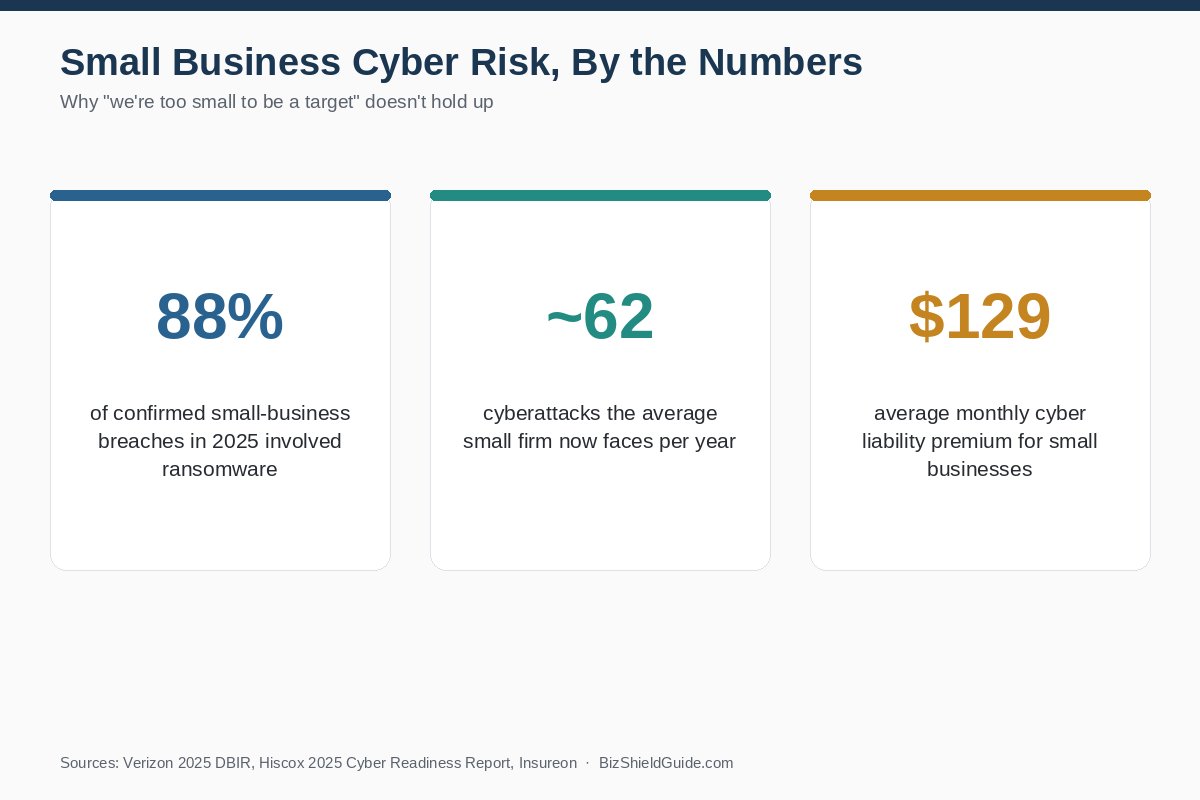
The numbers back this up. Verizon’s 2025 Data Breach Investigations Report SMB snapshot found that ransomware was involved in 88% of confirmed breaches at small and medium businesses, compared with 39% at larger organizations — a striking gap that reflects how attackers pick softer targets. The same analysis identified more than 3,000 incidents affecting small businesses in the study period, with external actors responsible for 98% of them and financial motives behind 99%. System intrusions, social engineering (phishing, in plain terms), and basic web application attacks together accounted for 96% of the breach patterns.
Hiscox’s 2025 Cyber Readiness Report adds another angle: 69% of U.S. companies surveyed reported an increase in cyberattacks compared with the prior year, with firms facing roughly 62 attempted incidents annually — more than one a week. Ransomware accounted for about a third of the most damaging outcomes, and only 7% of organizations that paid a ransom recovered all their data, while 10% still had data leaked despite paying. Reputational fallout is real too: 43% of attacked businesses in the Hiscox survey said they struggled to attract new clients afterward.
44 million, down 9% from the year before — encouraging at the macro level, but that figure blends enterprises with mom-and-pop shops. For a small operation, even a breach costing a fraction of that average can wipe out a year’s profit. It’s also worth pushing back on one number that circulates constantly in this space: the claim that 60% of small businesses close within six months of a cyberattack. SC World traced that figure back to fabricated origins and found only 35 documented small-business closures tied to breaches worldwide since 2001 — not the thousands the myth would imply.
The honest takeaway isn’t “you’ll go out of business,” it’s “you’ll face a large, disruptive bill you didn’t budget for,” which is a more useful reason to carry coverage than a scare statistic. Before you decide, make sure your cyber liability insurance actually covers this scenario.
What It Costs in 2025–2026
Pricing has stabilized compared to the sharp increases carriers pushed through a few years ago, and small business premiums remain modest relative to the exposure. According to Insureon’s 2025–2026 cyber insurance cost data, drawn from its own small business policyholders, the average cost runs about $129 per month, or roughly $1,552 annually, with premiums ranging from around $400 to more than $8,000 a year depending on the business.
Technology companies pay more — around $179 a month on average — because they handle more sensitive data and carry more downstream liability, while finance and accounting firms, despite handling sensitive financial data, sometimes see lower average rates depending on their risk controls and claims history.
Premiums are shaped by a handful of factors carriers weigh consistently: This is exactly the kind of scenario where cyber liability insurance matters most.
- Policy limits and deductible — typical small business limits fall between $1 million and $5 million, with deductibles commonly in the $1,000–$2,500 range
- Industry and the sensitivity of the data you handle
- Number of employees and number of records stored
- Existing cybersecurity controls, such as multi-factor authentication, encrypted backups, and endpoint detection
- Prior claims history
A business with basic security hygiene — MFA on email and financial accounts, regular backups tested for restoration, a written incident response plan — will consistently see better pricing and fewer coverage restrictions than one without. This is one of the most common questions we hear about cyber liability insurance.
What’s Typically Excluded
Cyber policies are not blank checks, and the exclusions catch owners off guard more than almost any other part of the policy. Common carve-outs include prior known vulnerabilities you failed to remediate before binding coverage, acts of war or state-sponsored attacks (a live issue since major carriers tightened war exclusion language in recent years), losses stemming from a vendor’s or supplier’s breach rather than your own systems, and the cost of upgrading your technology or security infrastructure after an incident — insurers will help you recover, not modernize.
Social engineering and fraudulent fund transfer scams are another frequent gap: many policies limit or exclude coverage for wire fraud induced by a convincing phishing email unless you’ve purchased a specific endorsement, and outright theft of funds is often better handled by a commercial crime policy. Government fines tied to certain regulatory violations, intentional acts by the business itself, and bodily injury or physical property damage (which stay with general liability or property coverage) round out the standard exclusion list. Reading the exclusions section before a loss, not after, is the only way to know what you’re actually carrying.
How Cyber Insurance Relates to General Liability and Tech E&O
These three coverages sit next to each other, and small business owners routinely assume overlap that doesn’t exist. General liability covers bodily injury and property damage — the classic slip-and-fall or a contractor damaging a client’s property. It was never designed to respond to a data breach, and most GL policies explicitly exclude cyber-related losses. Some insurers now let you attach limited data breach coverage to a general liability policy or business owner’s policy, but the limits are usually thin compared to a standalone cyber policy.
Technology errors and omissions (tech E&O) insurance is a different animal again: it protects you when a client sues because your professional service or software failed and cost them money — a botched implementation, a missed deadline that damaged their business, faulty code. Cyber liability protects your own business from the direct costs of an attack on you. If you’re a technology vendor, consultant, or managed service provider responsible for a client’s systems or data, you typically need both, and many carriers now sell them bundled as “tech E&O plus cyber” packages specifically because the risks overlap so often in practice.
If you’re deciding where to start, don’t try to buy comprehensive coverage in one sitting — get a broker who specializes in small commercial accounts to run your actual numbers: how many customer records you hold, whether you take card payments directly, and what a week of downtime would cost you in lost revenue. That conversation, more than any statistic in this article, is what determines whether you need a $1 million policy or a $5 million one, and whether tech E&O belongs on the same binder.
Pair the policy with basic controls — MFA, tested backups, a one-page incident response plan — and you’ll not only pay less for coverage, you’ll actually be positioned to survive the incident it’s there for. It’s a small detail, but it can make a real difference for your cyber liability insurance.
Common Cyber Liability Insurance Claims Scenarios
Seeing how a cyber liability insurance policy actually responds to a real incident makes the coverage easier to evaluate than reading a list of covered perils. A typical claim starts when an employee clicks a phishing link and ransomware locks down the file server; the cyber liability insurance policy then pays for a forensic investigation, a negotiator to handle the ransom demand, the ransom itself in many policies, and the cost of rebuilding systems from backups. Another common scenario involves a lost or stolen laptop containing customer records, which triggers the notification and credit-monitoring costs a cyber liability insurance policy is specifically designed to cover.
A third scenario is a business email compromise, where a fraudulent wire transfer request slips past normal checks; some cyber liability insurance policies include social engineering fraud as an add-on, while others exclude it entirely, so it is worth confirming before a claim is ever needed.
- Ransomware and extortion — a cyber liability insurance policy typically covers forensics, negotiation, and system restoration.
- Data breach notification — a cyber liability insurance policy pays for legal review, customer notices, and credit monitoring.
- Business email compromise — coverage varies, so confirm whether the cyber liability insurance policy includes social engineering fraud.
- Third-party lawsuits — a cyber liability insurance policy can cover defense costs when a client sues over a breach that started on your network.
Cyber Liability Insurance for Remote and Hybrid Teams
Remote and hybrid work has changed what a cyber liability insurance underwriter actually asks about during renewal. A workforce logging in from home networks and personal devices widens the attack surface that a cyber liability insurance policy is ultimately priced against, which is why many insurers now ask detailed questions about multi-factor authentication, endpoint protection, and VPN usage before binding or renewing a cyber liability insurance policy.
Small businesses that can document these controls often see meaningfully better cyber liability insurance pricing than those that cannot, and a growing number of carriers will decline to offer a cyber liability insurance policy at all to applicants without multi-factor authentication enabled on email and remote access systems.
Do sole proprietors need cyber liability insurance? Yes, in most cases — a sole proprietor handling any customer payment or personal data faces the same breach-notification obligations as a larger company, and a cyber liability insurance policy is often the only affordable way to cover those costs.
Can a cyber liability insurance policy be bundled with a business owner’s policy (BOP)? Many insurers now offer cyber liability insurance as an endorsement to a BOP, though a standalone cyber liability insurance policy usually provides broader limits and fewer exclusions than an endorsement.
How to Choose a Cyber Liability Insurance Policy
Not every cyber liability insurance policy is built the same way, and comparing quotes on price alone tends to miss the details that matter most when a claim is filed. Limits, sub-limits, and the size of the retention (deductible) all shape how much a cyber liability insurance policy actually pays out in practice, and a lower premium often correlates with a smaller sub-limit on the coverage a small business is most likely to use, such as ransomware payments or notification costs. It also helps to check whether the cyber liability insurance policy requires pre-approved vendors for breach response, since using an outside forensic firm without insurer sign-off can jeopardize reimbursement.
| Factor | Why it matters for a cyber liability insurance policy |
|---|---|
| Retention size | Higher retention lowers the cyber liability insurance premium but raises out-of-pocket cost per claim. |
| Sub-limits | Ransomware and notification sub-limits inside a cyber liability insurance policy can be far lower than the headline limit. |
| Panel vendors | Most cyber liability insurance policies require using insurer-approved breach-response firms. |
| Prior acts coverage | Confirms whether a cyber liability insurance policy responds to incidents that started before the policy period. |
Frequently Asked Questions About Cyber Liability Insurance
Does general liability insurance replace the need for cyber liability insurance? No — general liability responds to bodily injury and property damage, not data breaches, so a cyber liability insurance policy fills a gap standard policies were never designed to cover.
How much does a cyber liability insurance policy typically cost a small business? Premiums vary by revenue, industry, and the amount of customer data handled, but most small businesses budget for a cyber liability insurance policy as a modest addition to their existing insurance program rather than a major expense.
Is cyber liability insurance required by law? Few states mandate a cyber liability insurance policy outright, though many industries face contractual or regulatory requirements that make carrying one effectively necessary.
The Bottom Line on Cyber Liability Insurance
A cyber liability insurance policy is no longer a specialty product reserved for large enterprises — it has become a standard part of how small businesses manage the financial fallout of a breach, a ransomware attack, or a simple lost laptop. The right cyber liability insurance policy pairs a manageable premium with limits and sub-limits that actually match how the business operates, rather than the cheapest quote on the page. Reviewing the cyber liability insurance policy at every renewal, keeping security controls current, and understanding exactly what triggers a claim are the three habits that make a cyber liability insurance policy worth the money when an incident actually happens.
Related Reading
- Best Small Business Insurance Bundles by Industry: Retail, Restaurants, Contractors, and Consultants Compared
- General Liability vs. Professional Liability (E&O): Which Insurance Do You Actually Need?
This article is for general informational purposes and isn’t personalized insurance, legal, or financial advice. Coverage rules, costs, and requirements change, and every business’s risk is different — for decisions specific to your business, talk to a licensed insurance agent. Learn more About BizShieldGuide or reach us via our Contact page.
Documentation to Keep With Your Cyber Liability Insurance Policy
When a claim actually happens, the speed of the payout under a cyber liability insurance policy often depends on documentation gathered long before the incident. Keep a current network diagram, a list of software and vendors with access to customer data, and a written incident-response plan alongside the cyber liability insurance policy documents themselves, since most insurers ask for exactly this material within the first days of a claim. It also helps to keep a signed copy of any security questionnaire submitted at binding, because a cyber liability insurance policy can be contested later if the answers on that questionnaire turn out to be inaccurate.
A short annual review — checking that the cyber liability insurance policy’s limits still match current revenue and data volume, and that the named contacts for reporting a claim are still accurate — takes less than an hour and meaningfully reduces friction if the policy is ever actually used.

About the Author: BizShieldGuide Team
The BizShieldGuide team researches and writes plain-language guides to business and personal insurance — general liability, professional liability, workers' compensation, business owners policies, cyber liability, and industry-specific coverage for small business owners, alongside straightforward explainers on auto, home, and renters insurance for everyday readers. Our articles are grounded in publicly available data from insurers and carriers (Insureon, The Hartford, Progressive, State Farm, and others), industry cost surveys, and standard policy language, and we link to primary sources wherever a number or coverage detail could change. We are not licensed insurance agents or brokers, and nothing here replaces a quote or advice from one for your specific situation.