
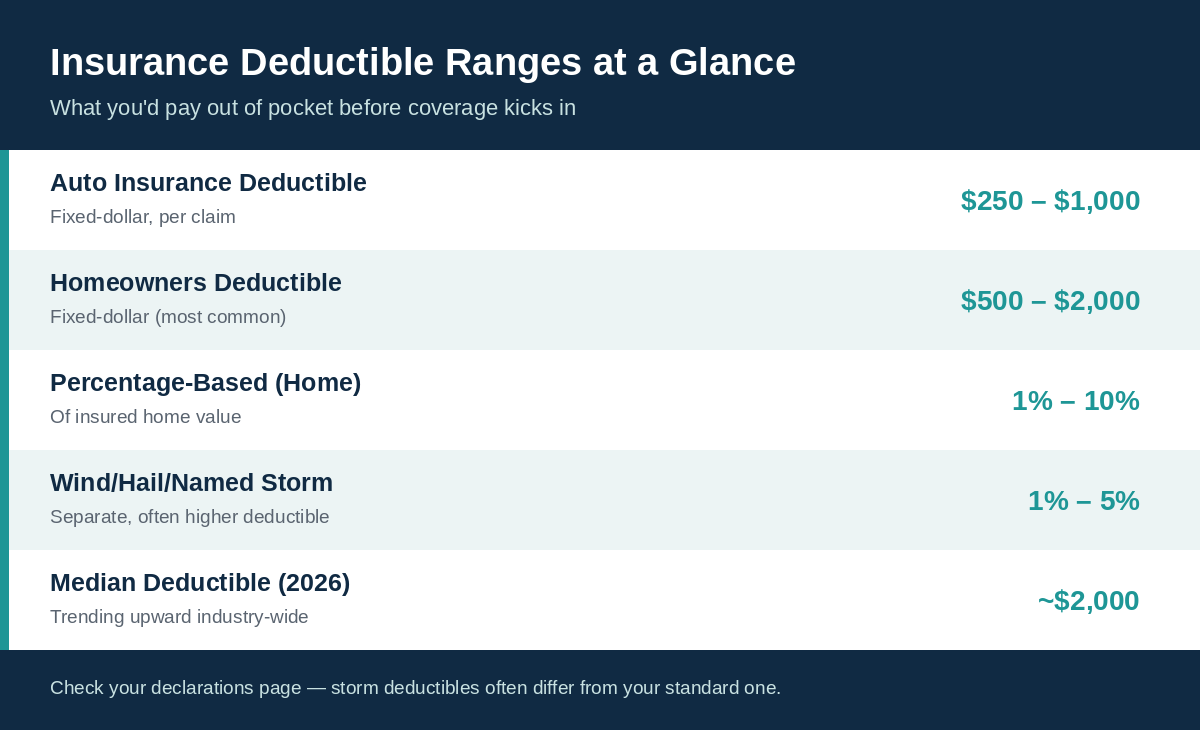
Short answer: an insurance deductible is the amount you pay out of pocket before your insurer covers the rest of a claim, and choosing the right amount means balancing a lower monthly premium against a higher bill if you ever need to file. Most homeowners carry a fixed-dollar insurance deductible between $500 and $2,000, while auto policies typically run $250 to $1,000, and the median deductible has crept up toward $2,000 in recent years as insurers push more cost onto policyholders upfront.
This guide breaks down how a deductible actually works, the difference between fixed-dollar and percentage-based deductibles, and how to pick an amount that fits your actual finances rather than just the lowest advertised premium.
How an Insurance Deductible Actually Works
When you file a claim, the insurer subtracts your deductible from the payout and covers the remainder up to your policy limit. If a covered loss costs $5,000 and your insurance deductible is $1,000, you receive $4,000 and pay the first $1,000 yourself. This applies per claim, not per year, on most home and auto policies, meaning a second unrelated claim in the same year triggers the deductible again.
The core tradeoff is straightforward: choosing a higher deductible lowers your premium because you’re absorbing more of the small-to-medium losses yourself, while a lower deductible raises your premium but reduces what you owe if something goes wrong.
Fixed-Dollar vs. Percentage-Based Deductibles
Most auto insurance deductibles and many homeowners deductibles are fixed-dollar amounts — a flat $500 or $1,000 regardless of the claim size. Percentage-based deductibles, more common on homeowners policies in disaster-prone regions, are instead calculated as a percentage of your home’s insured value, typically 1% to 10%.
On a $300,000 home with a 2% percentage deductible, that works out to $6,000 out of pocket — often far more than a comparable fixed-dollar deductible would require, which is why reading your declarations page carefully matters more than just knowing the percentage.
Separate Deductibles for Wind, Hail, and Named Storms
In states prone to hurricanes, hailstorms, or other severe weather, many homeowners policies carry a separate, higher percentage-based deductible specifically for wind, hail, or named-storm damage, layered on top of your standard fixed-dollar deductible for everything else. This means a single policy can have two different deductible amounts depending on what caused the damage, and homeowners are frequently surprised to discover the storm-specific deductible only after filing a claim.
How to Choose the Right Insurance Deductible for You
The right insurance deductible amount depends on how much cash you could comfortably pay out of pocket on short notice, not on which option shows the lowest monthly premium. A common rule of thumb is to keep at least your deductible amount in an accessible emergency fund specifically earmarked for that purpose, separate from other savings goals.
If raising your deductible from $500 to $1,000 only saves a small amount per month, the higher deductible usually isn’t worth the added risk. But if the premium difference is substantial and you have the cash reserve to cover it, a higher insurance deductible can be a reasonable way to lower your ongoing costs.
What Happens If You Can’t Pay the Deductible
If you can’t cover your deductible when a claim happens, most insurers won’t process the repair or payout until you do, since the deductible is subtracted from the claim amount rather than billed separately in most cases. According to the Insurance Information Institute, this is one of the most common reasons homeowners underinsure themselves by choosing a deductible they can’t actually afford when the time comes, purely to chase a lower premium quote.
Bottom Line
An insurance deductible is the amount you commit to paying out of pocket before coverage kicks in, and the right amount balances your monthly premium against what you could realistically afford if you filed a claim tomorrow. Fixed-dollar deductibles are simpler to budget for, while percentage-based deductibles on homeowners policies can produce a much larger bill than the number itself suggests. Check your specific declarations page rather than assuming your deductible works the same way as a policy you had before.
Related Reading
- Bundling Home and Auto Insurance: How Much Can You Really Save?
- What Does Homeowners Insurance Cover? The Complete 2026 Guide
- Lower Your Car Insurance Premium and Save Big: The Proven 2026 Guide

About the Author: BizShieldGuide Team
The BizShieldGuide team researches and writes plain-language guides to business and personal insurance — general liability, professional liability, workers' compensation, business owners policies, cyber liability, and industry-specific coverage for small business owners, alongside straightforward explainers on auto, home, and renters insurance for everyday readers. Our articles are grounded in publicly available data from insurers and carriers (Insureon, The Hartford, Progressive, State Farm, and others), industry cost surveys, and standard policy language, and we link to primary sources wherever a number or coverage detail could change. We are not licensed insurance agents or brokers, and nothing here replaces a quote or advice from one for your specific situation.