
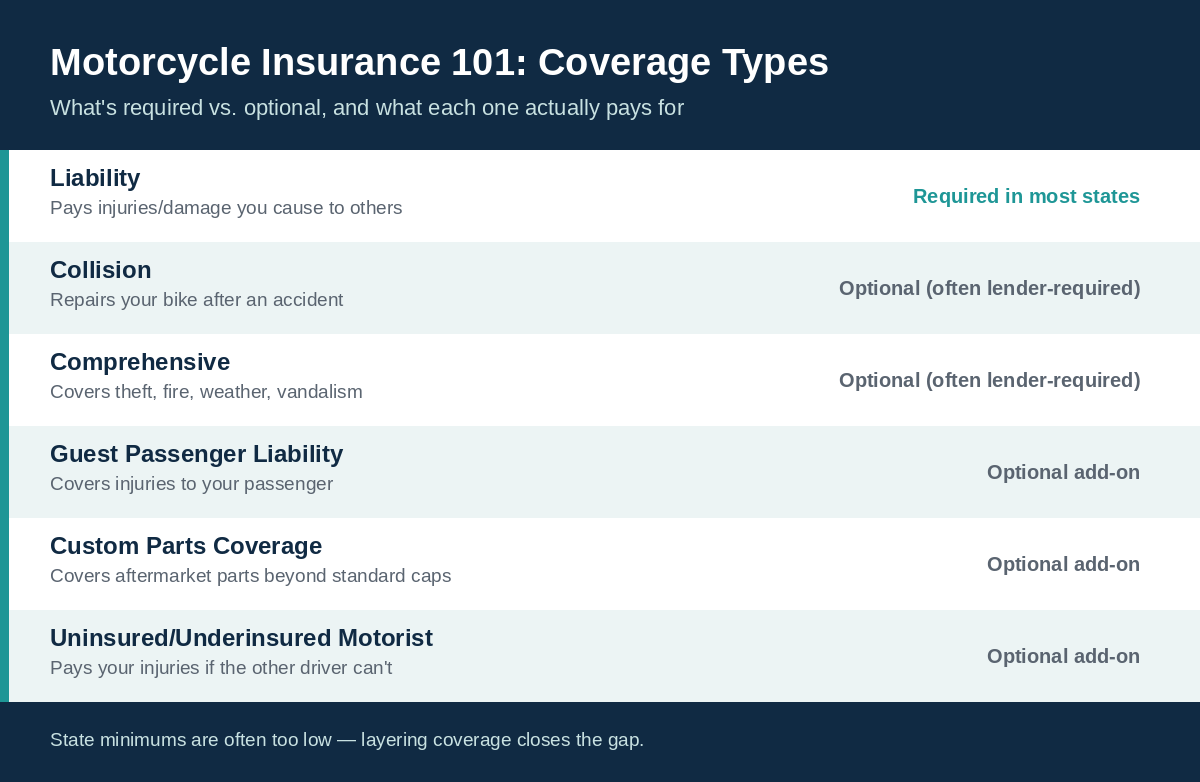
Short answer: motorcycle insurance 101 boils down to five coverage types that matter — liability, collision, comprehensive, uninsured/underinsured motorist, and custom parts coverage — and most riders are underinsured on at least one of them because state minimum liability limits are often far too low to cover a serious accident. A solid motorcycle insurance 101 policy layers these five together rather than relying on the state-mandated minimum alone.
This guide breaks down what each coverage type actually protects, which ones are legally required versus optional, and how to decide what you actually need for your bike and riding habits.
Liability Coverage: The Legal Minimum That Isn’t Enough
Every state that requires motorcycle insurance mandates some level of liability coverage, which pays for injuries and property damage you cause to others in an accident. The problem is that state minimums — often as low as $25,000 per person for bodily injury — can be exhausted quickly by a single serious injury claim, leaving you personally responsible for the remainder. Motorcycle insurance 101 experts generally recommend liability limits well above the state minimum, especially since motorcycle accidents tend to produce more severe injuries than car accidents relative to the vehicle’s value.
Bodily injury and property damage liability are typically sold as split limits, shown as three numbers like 100/300/50, representing per-person injury, per-accident injury, and property damage maximums in thousands of dollars.
Collision and Comprehensive: Protecting Your Own Bike
Collision coverage pays to repair or replace your motorcycle after an accident, regardless of fault, while comprehensive coverage handles non-collision losses like theft, vandalism, fire, and weather damage. Neither is legally required, but both matter more for motorcycles than for cars because bikes are disproportionately targeted for theft and because financing companies almost always require both as a condition of a loan. Most motorcycle insurance 101 guides list these two as the first upgrade past state-minimum liability.
If you own your motorcycle outright and it has a low resale value, dropping collision and comprehensive can make sense, but for anything financed or worth more than a few thousand dollars, the coverage is usually worth the added premium.
Guest Passenger Liability and Custom Parts Coverage
Two more items round out a complete motorcycle insurance 101 checklist: guest passenger liability and custom parts coverage. Guest passenger liability specifically covers injuries to a passenger riding with you, which standard liability coverage doesn’t always include on a motorcycle policy the way it automatically does on a car policy — this is an easy gap to miss if you regularly ride with a passenger. Custom parts coverage is the other motorcycle-specific add-on worth knowing about: standard comprehensive and collision coverage typically caps payouts for aftermarket parts like custom paint, exhaust systems, and saddlebags at a few hundred dollars, so if you’ve modified your bike, this rider closes that gap.
Uninsured and Underinsured Motorist Coverage
Uninsured/underinsured motorist coverage pays for your injuries when the at-fault driver either has no insurance or not enough to cover your damages, which happens more often than most riders expect — roughly one in eight U.S. drivers carries no insurance at all according to the Insurance Information Institute. Because motorcyclists face higher injury severity in collisions with cars, this coverage is one of the least skippable items on a motorcycle insurance 101 checklist, even though it’s often sold as an optional add-on rather than bundled by default.
How Much Motorcycle Insurance Actually Costs
Premiums vary widely based on the bike’s engine size, your riding history, your state, and how many of the coverage types above you select, but a full package with reasonable liability limits plus collision, comprehensive, and uninsured motorist coverage typically costs more than state-minimum-only liability, sometimes by two to three times. That gap is usually smaller in dollar terms than riders expect, since motorcycle premiums start from a lower base than car insurance premiums for a comparably priced vehicle.
The best way to see the real cost difference is to get a quote at state-minimum liability only, then a second quote with the full recommended package, and compare the two side by side before deciding where to cut. This one comparison does more to clarify motorcycle insurance 101 pricing than any general rule of thumb.
Bottom Line
Motorcycle insurance 101 really comes down to not stopping at the state-mandated liability minimum: layering in collision, comprehensive, guest passenger liability, custom parts coverage, and uninsured/underinsured motorist protection closes the gaps that state minimums leave wide open. Given how much more severe motorcycle injuries tend to be compared to car accidents, the extra premium for full coverage is usually a small price for the protection it adds.
Related Reading
- Bundling Home and Auto Insurance: How Much Can You Really Save?
- Lower Your Car Insurance Premium and Save Big: The Proven 2026 Guide
- Cheapest Car Insurance Companies: The 2026 State-by-State Guide

About the Author: BizShieldGuide Team
The BizShieldGuide team researches and writes plain-language guides to business and personal insurance — general liability, professional liability, workers' compensation, business owners policies, cyber liability, and industry-specific coverage for small business owners, alongside straightforward explainers on auto, home, and renters insurance for everyday readers. Our articles are grounded in publicly available data from insurers and carriers (Insureon, The Hartford, Progressive, State Farm, and others), industry cost surveys, and standard policy language, and we link to primary sources wherever a number or coverage detail could change. We are not licensed insurance agents or brokers, and nothing here replaces a quote or advice from one for your specific situation.