
If you have even one employee, workers’ compensation insurance is likely required by law in your state. If you have even one W-2 employee, there’s a good chance the law already requires you to carry workers’ compensation insurance — not as a best practice, but as a legal mandate with real penalties attached. The catch is that “the law” isn’t one law; it’s fifty different state systems, and the rules on who must carry it, starting at how many employees, vary enough that a rule of thumb from an owner in Ohio can be flatly wrong for one in Texas or Alabama.
This post covers what the coverage actually pays for, how state requirements differ, how insurers price it, what happens if you skip it, and how it’s different from general liability and health insurance — two policies people confuse it with constantly. Before you decide, make sure you understand workers’ compensation insurance correctly.
What workers’ compensation actually covers
Workers’ comp is a no-fault system: if an employee is hurt or becomes ill because of their job, the policy pays out regardless of who caused the accident, and in exchange the employee generally gives up the right to sue the employer directly for those injuries. According to The Hartford’s coverage overview, the core benefits are: That’s a detail worth double-checking with your workers’ compensation insurance carrier.
- Medical expenses — emergency room visits, surgery, prescriptions, physical therapy, and ongoing treatment for repetitive-motion injuries like carpal tunnel.
- Lost wages / disability benefits — a percentage of the employee’s average weekly wage while they recover, with the exact percentage and minimum/maximum payments set by each state (not a flat national number).
- Death benefits — payments to a deceased worker’s family, including funeral costs, if a job-related injury or illness is fatal.
- Vocational rehabilitation — retraining support if an employee can’t return to their previous role.
The part people forget: employer’s liability
A standard workers’ comp policy also includes an “employer’s liability” component (Part Two of the standard policy, in industry terms). This is what protects you if an injured employee’s family sues claiming the injury happened because of employer negligence, or if a third party — say, an equipment manufacturer — gets pulled into the case and turns around and sues you. It’s easy to overlook because it isn’t marketed on its own, but it’s often the piece that keeps a single serious injury from turning into a company-ending lawsuit.
To put the scale of this system in context: the National Academy of Social Insurance’s 2023 data report found that workers’ comp programs paid out $64.1 billion in combined medical and cash benefits nationally, covering nearly 150 million jobs and close to $11 trillion in wages. Medical benefits made up more than 47% of that total. This isn’t a niche product — it’s one of the largest employer-funded safety nets in the country, and it’s been running, state by state, for over a century.
State-by-state requirements: there is no single national rule
This is the section where I have to be blunt: do not take a number you read on a blog (including this one) as gospel for your specific state without checking your state’s labor or workers’ comp agency directly, because thresholds and exemptions change and vary widely. It’s a small detail, but it can make a real difference for workers’ compensation insurance.
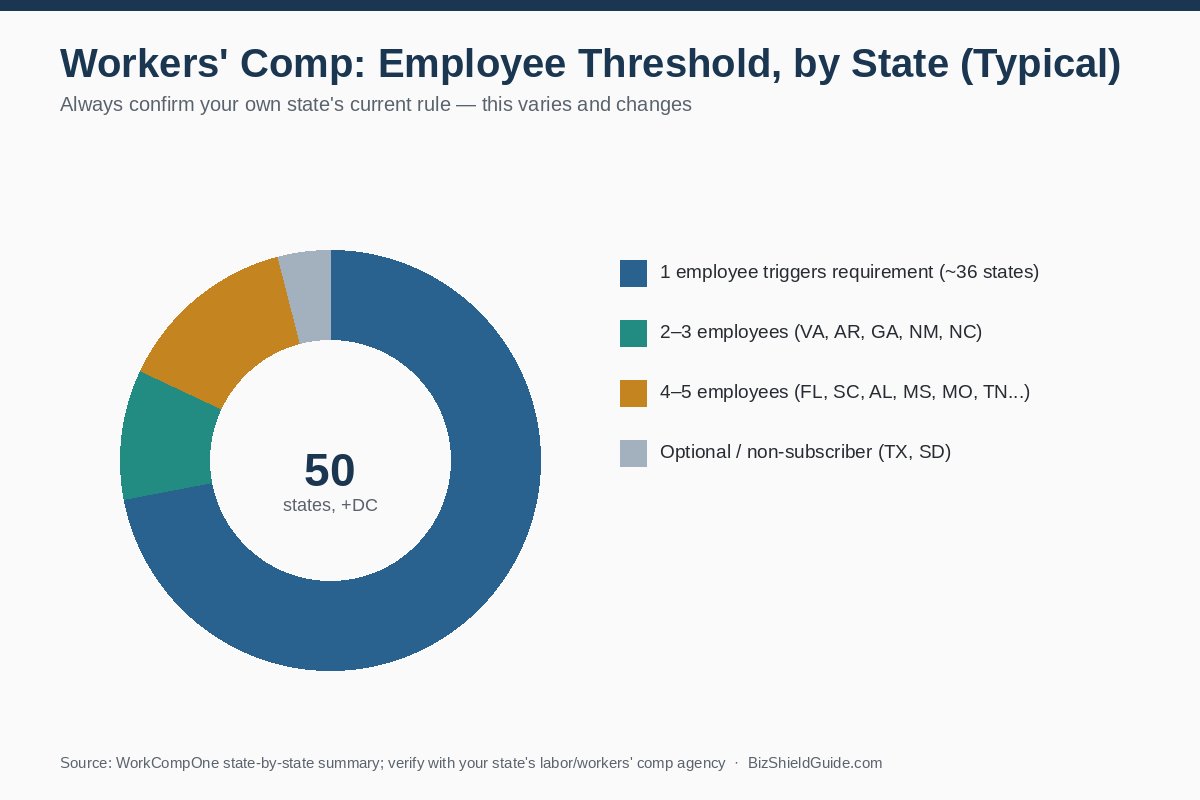
That said, here’s the general shape of it, based on a state-by-state breakdown compiled by WorkCompOne: This is exactly the kind of scenario where workers’ compensation insurance matters most.
- Most states (roughly three dozen, including California, Illinois, and Pennsylvania) require coverage starting with your very first employee — full- or part-time.
- A handful of states set higher thresholds. Virginia requires it at two or more employees; Arkansas, Georgia, New Mexico, and North Carolina generally require it at three or more; Florida and South Carolina at four or more; and Alabama, Mississippi, Missouri, New York (for some employer types), and Tennessee commonly cite a five-employee threshold, though exceptions apply by industry — construction employers, for example, are often held to first-employee rules even in states with higher general thresholds.
- Texas is the notable outlier — it’s the only state where most private employers can legally opt out of the workers’ comp system entirely and become a “non-subscriber,” though doing so exposes the business to direct employee lawsuits without the usual legal protections, and government-contract work still requires it. South Dakota doesn’t mandate it either, though carrying it is still strongly advised.
Industry matters too — construction is treated more strictly than almost any other sector, often requiring coverage from the first hire regardless of a state’s general threshold — and sole proprietors and LLC members can frequently exempt themselves personally while still being required to cover their employees. This is one of the most common questions we hear about workers’ compensation insurance.
One mistake I see new employers make constantly is assuming a single part-time hire doesn’t trigger the requirement. In most one-employee-threshold states, it absolutely does — “employee” in workers’ comp law almost never distinguishes between full-time, part-time, or even certain contractor arrangements where the worker is functionally treated as staff. I’ve talked to owners who hired a part-time assistant for ten hours a week, assumed they were under some invisible small-business exemption, and only found out otherwise after an injury and a very uncomfortable call with their state’s fund.
How premiums, class codes, and the e-mod work
Workers’ comp pricing isn’t a flat rate — it’s built from a formula, and understanding the pieces helps explain why two businesses with the same revenue can pay wildly different premiums. If you’re evaluating workers’ compensation insurance, this distinction is worth remembering.
Class codes
Every job function in your business is assigned a classification code that reflects its risk level — a roofer’s code carries a very different rate than a bookkeeper’s, even at the same company. Rates are quoted per $100 of payroll for that class code, which is why payroll (not revenue) is the base number insurers care about most.
Experience modification rating (e-mod)
Once a business has enough claims history (typically after a few years), it gets an experience modification factor — commonly called an “e-mod” or “x-mod” — that compares its actual claims costs to what’s expected for similar businesses in its class codes. An e-mod of 1.0 is average; below 1.0 means better-than-expected claims history and a premium discount; above 1.0 means worse-than-expected history and a surcharge. As Pinnacol Assurance explains, this factor gets multiplied directly into the premium calculation, so a bad injury year can raise costs for several years afterward even after the immediate claim is closed.
What it actually costs
Figures vary by source and heavily by state and industry, but The Hartford reports that small business customers pay around $81 a month on average, or roughly $1,032 a year, though lower-risk businesses can start well below that and high-risk trades run much higher. State averages differ sharply too — Hartford’s data cites averages ranging from around $557 (West Virginia) to $1,721 (Rhode Island) for comparable coverage. National employer costs, per NASI’s 2023 data, averaged $0.98 per $100 of covered payroll across the whole system — a useful benchmark, not a quote.
What happens if you skip it
Going without required coverage isn’t a quiet risk you can absorb quietly if something goes wrong — it typically triggers penalties on two separate tracks: regulatory and financial exposure from an actual injury. Many business owners overlook this detail when comparing workers’ compensation insurance options.
On the regulatory side, according to Insureon’s summary of state penalties, consequences range from civil fines to criminal charges depending on the state and whether the lapse looks intentional. New Jersey treats it as a criminal offense carrying fines up to $10,000 or imprisonment up to 18 months; California can impose penalties reaching $100,000; Pennsylvania classifies willful noncompliance as a third-degree felony with up to $15,000 in fines and seven years in jail; and Illinois can escalate an initial misdemeanor to a felony for willful violations. States can also issue stop-work orders that shut down your business until you obtain coverage.
On the financial side — arguably the scarier one — going uninsured usually means you personally, or your business without the shield workers’ comp normally provides, owe the full cost of an injured employee’s medical care, lost wages, and any related legal judgment, out of pocket. That’s the trade the whole system is built around: employees give up the right to sue for negligence in most cases in exchange for guaranteed no-fault benefits; skip the insurance and you can lose that protection while still owing everything it would have covered.
How it’s different from general liability and health insurance
The key difference: GL protects you against claims from customers, vendors, or other third parties — the classic example is a customer slipping on a wet floor. If your own employee gets hurt on the job, that’s a workers’ comp claim, not a GL claim, and a GL policy will typically deny it outright. Insureon’s comparison puts it simply: general liability protects you if a customer or third party gets hurt; workers’ comp covers costs for employees when they get hurt at work. They’re complementary, not overlapping, and most small businesses need both.
Health insurance is a separate mix-up. Group health plans cover employees’ medical needs generally, regardless of where or how an illness or injury happened, and they’re usually funded partly by employee premium contributions. Workers’ comp only applies to injuries or illnesses connected to the job, is entirely employer-funded, and additionally replaces lost wages and pays disability and death benefits — none of which a standard health plan does. An employee with a work-related back injury files with workers’ comp; the same employee’s unrelated flu visit goes through their health plan.
Getting this right for your business
” If you’re a Texas employer weighing non-subscriber status, or you’re in a state with a five-employee threshold and hovering near that number, talk to a licensed agent or your state fund before deciding — the cost of being wrong isn’t a late fee, it’s uncapped personal exposure to a real injury claim. Understanding this point can save you real money when it comes to workers’ compensation insurance.
Common Workers’ Compensation Insurance Claim Scenarios
Seeing real examples makes workers’ compensation insurance easier to reason about than reading a policy definition. A warehouse employee who strains their back lifting a box files a workers’ compensation insurance claim that covers medical treatment and a portion of lost wages while they recover. An office employee who develops carpal tunnel syndrome over months of repetitive typing can also file a workers’ compensation insurance claim, since the coverage applies to gradual injuries and not just sudden accidents.
A delivery driver injured in a car accident while making deliveries is covered by workers’ compensation insurance for the injury itself, even though the same accident might separately involve an auto liability claim against the vehicle’s insurance. In each case, workers’ compensation insurance is designed to be a no-fault system — the employee generally does not need to prove the employer was negligent to receive benefits.
- Lifting or strain injuries — the most common trigger for a workers’ compensation insurance claim.
- Repetitive stress injuries — workers’ compensation insurance covers gradual onset conditions, not just accidents.
- Vehicle accidents on the job — workers’ compensation insurance applies alongside any auto coverage.
- Slips and falls at the workplace — a routine workers’ compensation insurance scenario in nearly every industry.
How Workers’ Compensation Insurance Premiums Are Actually Calculated
Workers’ compensation insurance pricing is not a flat rate — it is built from a base rate tied to each employee’s job classification, multiplied by payroll, and then adjusted by the business’s own claims history through the experience modification rating. A construction crew and an accounting office pay dramatically different workers’ compensation insurance rates because the classification codes reflect very different injury risk.
Businesses that keep their claims history clean over several years typically see their workers’ compensation insurance premium trend downward as the experience modification factor improves, while a business with several recent claims can see workers’ compensation insurance costs rise substantially at renewal even without any change in payroll.
| Factor | Effect on workers’ compensation insurance cost |
|---|---|
| Job classification code | Higher-risk jobs raise the base workers’ compensation insurance rate. |
| Total payroll | Workers’ compensation insurance premium scales directly with payroll in that classification. |
| Experience modification rating | A history of claims raises future workers’ compensation insurance premiums. |
| State requirements | Minimum workers’ compensation insurance limits and rules vary significantly by state. |
Frequently Asked Questions About Workers’ Compensation Insurance
Is workers’ compensation insurance required for a one-person business? Requirements vary by state, but many states exempt sole proprietors with no employees, while still requiring workers’ compensation insurance the moment even one employee is hired.
Does workers’ compensation insurance cover remote employees? Generally yes — an injury that occurs while a remote employee is performing work duties can be covered by workers’ compensation insurance, though proving the injury was work-related can be more complicated than in an office setting.
Can an employee sue instead of filing a workers’ compensation insurance claim? In most states, workers’ compensation insurance is the exclusive remedy for workplace injuries, meaning the employee generally cannot sue the employer directly in exchange for guaranteed no-fault benefits.
Keeping Workers’ Compensation Insurance Costs Under Control
Beyond simply buying a policy, the businesses that manage workers’ compensation insurance costs best tend to invest in safety training, return-to-work programs, and prompt injury reporting. A return-to-work program that brings injured employees back on light duty as soon as medically appropriate can meaningfully shorten how long a workers’ compensation insurance claim stays open, which in turn helps the experience modification rating over time. Reporting injuries quickly, rather than waiting to see if an employee needs care, also tends to produce better outcomes for workers’ compensation insurance claims and keeps the paperwork from becoming a bigger problem than the injury itself.
The Bottom Line on Workers’ Compensation Insurance
Workers’ compensation insurance is one of the few coverages nearly every business with employees is legally required to carry, and getting the classification codes and payroll figures right at the start avoids both underinsurance and overpaying. Reviewing workers’ compensation insurance coverage annually as headcount and job duties change, and investing in safety and return-to-work practices, keeps both the premium and the risk of a serious claim under control.
Related Reading
- General Liability vs. Professional Liability (E&O): Which Insurance Do You Actually Need?
- How Much Does Small Business Insurance Actually Cost in 2026?
This article is for general informational purposes and isn’t personalized insurance, legal, or financial advice. Coverage rules, costs, and state requirements change, and every business’s risk is different — for decisions specific to your business, talk to a licensed insurance agent. Learn more About BizShieldGuide or reach us via our Contact page. Keep this in mind the next time you think through workers’ compensation insurance.
Workers’ Compensation Insurance and Independent Contractors
Misclassifying a worker as an independent contractor rather than an employee is one of the most expensive mistakes a small business can make with workers’ compensation insurance. If a state audit or a court later determines that a “contractor” was actually functioning as an employee, the business can be held liable for workers’ compensation insurance benefits retroactively, along with penalties for the misclassification itself.
The safest approach is to document the working relationship carefully — control over hours, tools, and methods all matter — and to require any genuine independent contractor to carry their own workers’ compensation insurance or an equivalent policy, with a certificate of insurance on file before work begins. Many general contractors now require every subcontractor to show proof of workers’ compensation insurance specifically to avoid being pulled into a claim that should have belonged to someone else’s policy.

About the Author: BizShieldGuide Team
The BizShieldGuide team researches and writes plain-language guides to business and personal insurance — general liability, professional liability, workers' compensation, business owners policies, cyber liability, and industry-specific coverage for small business owners, alongside straightforward explainers on auto, home, and renters insurance for everyday readers. Our articles are grounded in publicly available data from insurers and carriers (Insureon, The Hartford, Progressive, State Farm, and others), industry cost surveys, and standard policy language, and we link to primary sources wherever a number or coverage detail could change. We are not licensed insurance agents or brokers, and nothing here replaces a quote or advice from one for your specific situation.