
Short answer: in the term vs whole life insurance decision, term life is dramatically cheaper — often 10 to 15 times cheaper — and fits most families’ needs, while whole life makes sense mainly for specific, permanent needs like estate planning or lifelong dependent care.
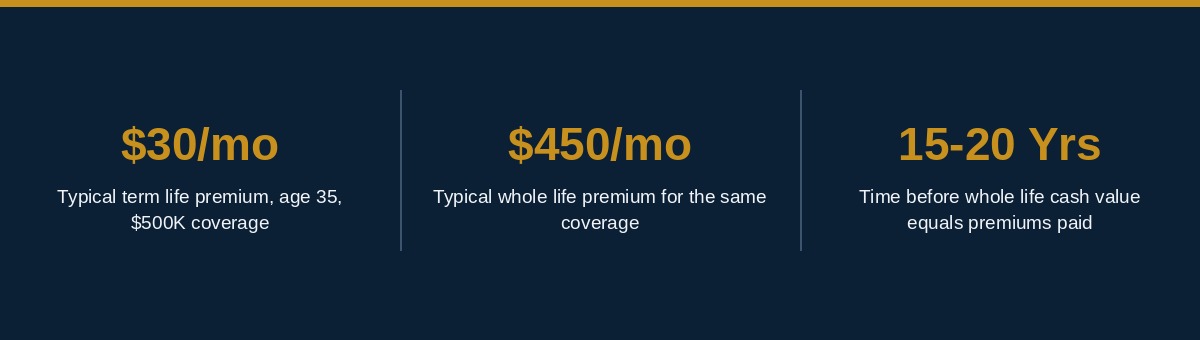
Bottom line up front for anyone skimming: a healthy 35-year-old can typically get $500,000 of term coverage for $25 to $40 a month, versus $350 to $550 a month for the same coverage amount under a whole life policy.
This guide walks through the term vs whole life insurance comparison using real premium numbers, real cash value timelines, and the specific situations where each type actually makes sense, so you’re not choosing based on a sales pitch alone.
Term vs Whole Life Insurance: How Each One Actually Works
Term life insurance covers you for a fixed period — typically 10, 20, or 30 years — and pays a death benefit only if you pass away during that term. If the term ends and you’re still alive, the policy simply expires with no payout and no refund.
Whole life insurance covers you for your entire life as long as premiums are paid, and it builds a cash value component over time that you can borrow against or, in some cases, withdraw from while you’re still living.
The term vs whole life insurance choice is really a tradeoff between cost and permanence: term is temporary and cheap, whole life is permanent and expensive, and neither is objectively “better” without knowing what you actually need coverage for.
Term vs Whole Life Insurance: The Real Premium Numbers
For a healthy, non-smoking 35-year-old seeking $500,000 in coverage, term life typically runs $25 to $40 a month. The same person buying whole life coverage for the same amount typically pays $350 to $550 a month — roughly ten to fifteen times more for the identical death benefit.
Over a 30-year term, that term policyholder pays approximately $10,800 total, with zero cash value at the end since the policy simply expires. The whole life buyer, over the same 30 years, pays around $162,000 in total premiums.
That much larger whole life outlay isn’t purely a cost, though — it builds an estimated $110,000 to $135,000 in cash value by year 30, meaning roughly 68% to 83% of those premiums become accessible funds rather than a pure expense.
Term vs Whole Life Insurance: How Cash Value Actually Grows
Cash value in a whole life policy grows slowly at first. After the first year, with roughly $5,400 in premiums paid, cash value typically sits between $0 and $500 — a small fraction of what you put in.
It generally takes 15 to 20 years before your cash value even equals the total premiums you’ve paid into the policy, which is a critical detail many buyers don’t realize until they’re a decade into a policy and want to exit it.
This slow-growth reality is central to the term vs whole life insurance debate: cash value is a genuine long-term asset, but it is not a short- or medium-term savings vehicle, and treating it like one leads to disappointment.
Term vs Whole Life Insurance: The “Buy Term, Invest the Difference” Argument
A common strategy against whole life is to buy the cheaper term policy and invest the monthly premium difference — roughly $310 to $510 a month in the example above — into a retirement account or index fund instead.
Run over 30 years at typical market returns, that invested difference can grow to an estimated $510,000 to $530,000, which comfortably exceeds the $110,000 to $135,000 cash value a whole life policy would have built over the same period.
The catch is discipline: this strategy only outperforms whole life if the premium savings are actually invested consistently rather than spent, which is exactly the gap between the strategy’s theoretical return and how it plays out for many real households.
Who Should Actually Choose Term Life Insurance
Term life insurance is the right fit for most families with a defined, temporary need: replacing income while children are young, covering a mortgage until it’s paid off, or protecting a spouse during working years before retirement savings are sufficient.
Because it’s dramatically cheaper, term life also lets you buy a larger death benefit for the same monthly budget — often the more important factor for young families who need meaningful coverage but have limited cash flow.
If your need for coverage has a natural end date — kids becoming financially independent, a mortgage getting paid off, retirement savings reaching a sufficient level — term life’s expiration isn’t a downside, it’s a match to your actual timeline.
Who Should Actually Choose Whole Life Insurance
Whole life insurance fits a narrower set of situations: high-net-worth individuals managing estate tax exposure, parents of a special-needs dependent who will require lifelong financial support, business owners who need permanent key-person coverage, or someone who wants to lock in insurability after a serious health diagnosis.
It can also suit people who have maxed out other tax-advantaged savings vehicles and want another place to build value with a death benefit attached, though this is a smaller and more specific use case than general advertising for whole life often suggests.
If none of these situations apply to you, whole life’s much higher cost is difficult to justify purely as protection, since term life protects the same income or debt at a fraction of the price.
Making the Decision for Your Situation
Start with a simple question: does your need for coverage have a natural end date? If yes, term life insurance is very likely the better fit, and the money you save monthly can go toward retirement savings, debt payoff, or an emergency fund instead.
If your need for coverage is genuinely permanent — a lifelong dependent, an estate planning goal, or a business succession requirement — whole life insurance, or a hybrid approach with both term and a smaller permanent policy, is worth a real conversation with a licensed advisor.
Whichever direction you lean, get quotes for both types before deciding, and compare the actual numbers for your age, health, and coverage amount rather than relying on national averages, since your personal quote can differ meaningfully from the examples above.
To sum up the term vs whole life insurance decision: term is the lower-cost choice that fits most temporary income-replacement needs, and whole life is a higher-cost, permanent tool best reserved for specific estate or lifelong-dependent situations.
Related Reading
How Much Life Insurance Do You Need? The 2026 DIME Method Guide
Renters Insurance 101: What It Covers and Why You Need It
National Association of Insurance Commissioners (NAIC)
This article is for general informational purposes only and is not financial, insurance, or legal advice. Premium figures are illustrative averages for a healthy non-smoker and will vary by age, health, insurer, and state — get a personalized quote before making a decision.

About the Author: BizShieldGuide Team
The BizShieldGuide team researches and writes plain-language guides to business and personal insurance — general liability, professional liability, workers' compensation, business owners policies, cyber liability, and industry-specific coverage for small business owners, alongside straightforward explainers on auto, home, and renters insurance for everyday readers. Our articles are grounded in publicly available data from insurers and carriers (Insureon, The Hartford, Progressive, State Farm, and others), industry cost surveys, and standard policy language, and we link to primary sources wherever a number or coverage detail could change. We are not licensed insurance agents or brokers, and nothing here replaces a quote or advice from one for your specific situation.