
If your financed or leased car gets totaled or stolen, your regular comprehensive and collision coverage only pays out the vehicle’s actual cash value — not what you still owe the lender. GAP insurance is what covers that difference, and for a lot of drivers it’s the one coverage that stands between a single bad accident and being stuck paying off a car that no longer exists. Here’s what GAP insurance actually covers, what it costs, and how to know whether you still need it.
What Does GAP Insurance Actually Cover?
GAP stands for Guaranteed Asset Protection. When your car is declared a total loss, your insurer pays out its actual cash value minus your deductible — but that number rarely matches your remaining loan or lease balance, especially early on. GAP insurance pays the leftover balance so you’re not left financing a car you no longer have.
To use it, you generally need to already carry comprehensive and collision coverage, since GAP is designed to fill the gap left by those payouts rather than replace them.
How Much Does GAP Insurance Cost?
Added to an existing auto policy through an insurer, GAP coverage typically runs somewhere around $20 to $50 a year for many drivers, though it can run higher depending on the vehicle and state. Buying GAP insurance through a car dealer at the time of purchase is usually far more expensive — often a flat few hundred dollars added directly to the loan, where you also end up paying interest on it over the life of the loan.
Dealer GAP Insurance vs. Insurer GAP Insurance
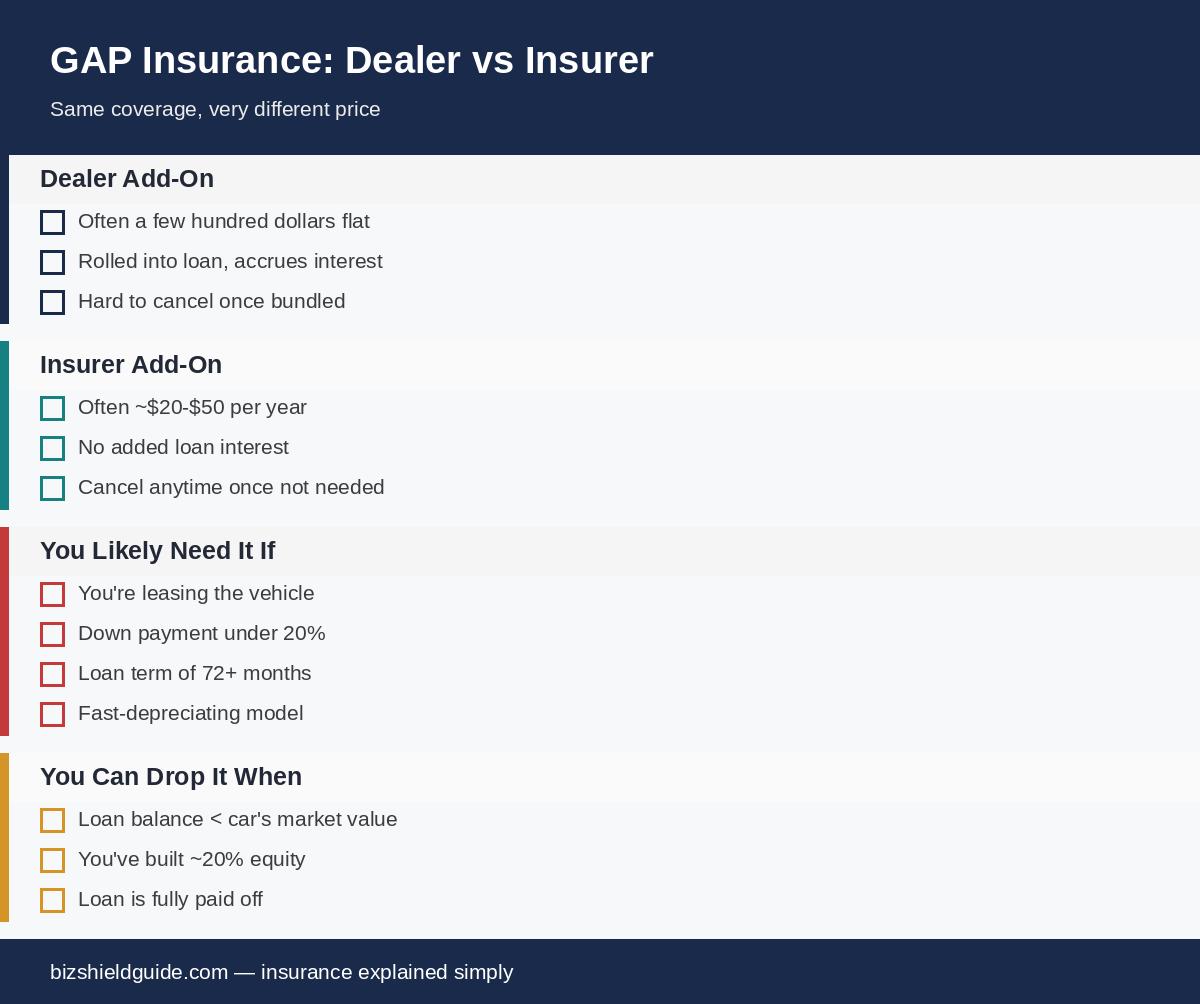
Both versions provide the same basic protection, but the price gap between them is significant enough that it’s worth comparing before you sign anything at the dealership. An insurer add-on is typically cheaper, doesn’t accrue loan interest, and can be canceled at any time once you no longer need it — a dealer add-on is often locked into the financing itself.
When Do You Actually Need GAP Insurance?
GAP insurance matters most when there’s a real chance your loan balance is higher than your car’s market value. That’s most common in a few specific situations:
- Leased vehicles: Many leasing companies require GAP coverage as a condition of the lease.
- Small down payment: Less than roughly 20% down leaves more room for negative equity early on.
- Long loan terms: A 72- or 84-month loan takes longer to catch up with a depreciating car.
- Fast-depreciating vehicles: Some models lose value quicker than the loan balance shrinks.
When You Can Safely Drop It
GAP insurance stops being useful once your loan balance drops below your car’s actual market value — at that point, a total-loss payout would already cover what you owe. Most drivers reach that crossover once they’ve built around 20% equity in the vehicle, which for a typical loan tends to happen within the first two to three years of ownership. Once your loan is paid off entirely, GAP insurance no longer serves any purpose at all.
Bottom Line
GAP insurance is inexpensive protection against a very specific and very real risk: owing more on a car than it’s worth when it’s totaled or stolen. If you’re leasing, put down less than 20%, or financed over a long term, it’s worth adding through your insurer rather than the dealer. For more on keeping your overall auto costs down while you’re carrying it, see our guide on lowering your car insurance premium.
For the Insurance Information Institute’s own breakdown of how GAP coverage works, see their guide to GAP insurance.
Related Reading
Lower Your Car Insurance Premium and Save Big: The Proven 2026 Guide
Cheapest Car Insurance Companies: The 2026 State-by-State Guide

About the Author: BizShieldGuide Team
The BizShieldGuide team researches and writes plain-language guides to business and personal insurance — general liability, professional liability, workers' compensation, business owners policies, cyber liability, and industry-specific coverage for small business owners, alongside straightforward explainers on auto, home, and renters insurance for everyday readers. Our articles are grounded in publicly available data from insurers and carriers (Insureon, The Hartford, Progressive, State Farm, and others), industry cost surveys, and standard policy language, and we link to primary sources wherever a number or coverage detail could change. We are not licensed insurance agents or brokers, and nothing here replaces a quote or advice from one for your specific situation.