
When it comes to life insurance for new parents, the short answer is: for most new parents, the right move is a 20 to 30-year term life insurance policy sized to replace your income and cover childcare, debt, and future costs — bought as early as possible, ideally before or shortly after the baby arrives, with a properly named beneficiary (never the child directly) and a look at whether the stay-at-home parent needs coverage too.
Becoming a parent is one of the few moments insurers and financial planners actually agree is worth stopping to reassess your coverage — a new dependent changes the math on how much life insurance you need and, just as importantly, how fast you should act. Waiting until “things settle down” is the most common mistake, since underwriting itself can take several weeks.
This guide covers how much life insurance for new parents actually makes sense, term versus whole life for this specific stage of life, when to buy, what to do about a stay-at-home parent’s coverage, how to name a beneficiary correctly when you have a minor child, and realistic cost numbers by age and coverage amount.
How Much Life Insurance Do New Parents Actually Need?
Sizing life insurance for new parents correctly starts with the DIME method — Debt, Income replacement, Mortgage, and Education — which for a household earning $85,000 with a mortgage and college goals can land north of $2 million in coverage before subtracting existing savings and any employer-provided policy. We cover the full formula and a worked example in our DIME method guide; the short version for new parents is that your number just went up, and an employer group policy (often capped at one or two times salary) rarely covers the gap on its own.
Term vs. Whole Life Insurance for New Parents
Term life insurance is the right fit for the large majority of new parents: it buys far more death benefit per premium dollar during the specific 20 to 30 years your children actually depend on your income, and the term length can be matched to your mortgage payoff or your youngest child’s expected independence age. We compare the two structures in detail in our term vs. whole life insurance guide.
Permanent insurance (whole or universal life) costs meaningfully more per dollar of coverage and is rarely the right primary tool for a new parent’s core income-replacement need. It can make sense in narrower cases — estate planning, a policy meant to last your entire lifetime, or coverage for a child with lifelong care needs — but shouldn’t be the default recommendation just because an agent frames it as “insurance that builds savings.”
When Should You Buy Life Insurance After Having a Baby?
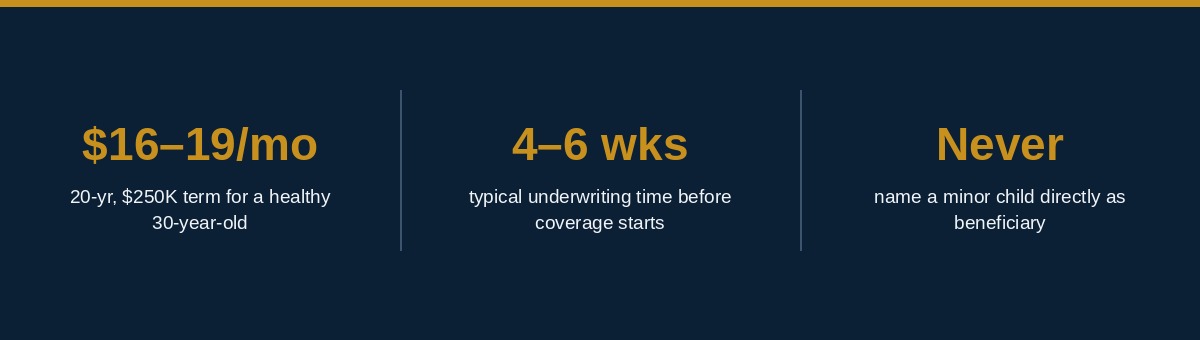
The best timing is actually before the baby arrives, ideally during the first trimester of pregnancy while the parent applying is generally in good health for underwriting purposes — coverage can then be in place well before the due date. Underwriting for a fully underwritten term policy commonly takes four to six weeks, so applying the week the baby comes home means going without coverage during exactly the period your family’s financial exposure just increased.
If you didn’t buy before birth, the second-best time is now — postpartum health changes and the normal busyness of early parenthood make it easy to keep pushing this down the list, and every month of delay is a month of uninsured risk for a family that now depends on you more than before.
Don’t Forget the Stay-at-Home Parent
A parent who doesn’t earn a paycheck still needs coverage, sized differently than income replacement — think in terms of replacing what it would actually cost to hire the childcare, housekeeping, and household management that parent currently provides for free. National average childcare costs run roughly $13,000 to $15,700 per year, which for coverage lasting until the youngest child is grown often points to a policy in the $250,000 to $500,000 range, not zero.
This is one of the most commonly skipped steps in new-parent life insurance planning, precisely because the stay-at-home parent isn’t the household’s income earner — but replacing their unpaid labor with paid help after a loss is a real cost, not a hypothetical one.
Naming a Beneficiary When You Have a Minor Child
Never name a minor child directly as your life insurance beneficiary. If you do, and the policy pays out while the child is still a minor, the money typically can’t be released to them directly — it usually requires a court-appointed guardian of the estate, adding delay, legal cost, and oversight your family didn’t ask for at an already difficult time.
The standard fix is naming a trust (even a simple one set up for this purpose) or using a Uniform Transfers to Minors Act (UTMA) custodial designation as the beneficiary instead, with a person you trust named as trustee or custodian to manage the funds until the child reaches adulthood. The NAIC’s consumer guide to life insurance beneficiaries walks through these designations in more detail, and it’s worth a short conversation with an estate attorney if your situation is at all complex.
Should You Add a Child Rider to Your Policy?
A child rider is a small, inexpensive add-on — typically covering all of your children under one flat premium, often just a few dollars a month — that pays a modest benefit if the unthinkable happens to a child, and usually covers funeral and related costs rather than functioning as income replacement. Many riders can also be converted later into the child’s own permanent policy as an adult, without new medical underwriting, which is a genuinely useful feature if a family history of a serious health condition might otherwise make insurance harder to get later.
It’s not a required piece of a new parent’s coverage plan, but it’s cheap enough that most families who ask about it end up adding it once they see the actual premium.
What Life Insurance for New Parents Actually Costs
The actual cost of life insurance for new parents varies by age and health. For a healthy, nonsmoking 30-year-old, a 20-year term policy runs roughly $16 to $19 a month for $250,000 of coverage, and about $31 to $38 a month for $500,000. At age 40, a $500,000, 20-year policy runs closer to $47 to $59 a month. These are averages, not quotes — your actual premium depends on health, tobacco use, and the specific insurer, so treat these as a planning baseline rather than a guarantee.
Common Mistakes New Parents Make With Life Insurance
The most common mistake is waiting — treating life insurance as a someday task rather than something tied to a specific event (pregnancy, birth) that just changed your actual financial exposure. The second is sizing coverage only around the earning parent and leaving the stay-at-home parent at zero. The third is naming a minor child directly as beneficiary, which creates exactly the legal complication a life insurance payout is supposed to avoid.
Bottom Line on Life Insurance for New Parents
A 20 to 30-year term policy, sized using the DIME method, applied for as early in pregnancy as possible, with a trust or UTMA beneficiary designation instead of the child directly, covers the large majority of new-parent situations well. Layer in coverage for a stay-at-home parent and a low-cost child rider, and most families have a genuinely solid plan in place for less than the cost of a streaming subscription each month.
Quick Recap: Life Insurance for New Parents
Choosing the right life insurance for new parents comes down to a few repeatable steps: size the policy with the DIME method, buy term rather than whole life for this stage, apply as early in pregnancy as possible, cover the stay-at-home parent too, and name a trust or UTMA custodian instead of the child directly. Get those five right and the rest of the details are easy to adjust later.
Related Reading
How Much Life Insurance Do You Need? The 2026 DIME Method Guide
Term vs Whole Life Insurance: The Proven Way to Save and Choose Right in 2026

About the Author: BizShieldGuide Team
The BizShieldGuide team researches and writes plain-language guides to business and personal insurance — general liability, professional liability, workers' compensation, business owners policies, cyber liability, and industry-specific coverage for small business owners, alongside straightforward explainers on auto, home, and renters insurance for everyday readers. Our articles are grounded in publicly available data from insurers and carriers (Insureon, The Hartford, Progressive, State Farm, and others), industry cost surveys, and standard policy language, and we link to primary sources wherever a number or coverage detail could change. We are not licensed insurance agents or brokers, and nothing here replaces a quote or advice from one for your specific situation.